
COLA di RIENZO. — Born in Rome in 1313, he died there following a revolt on 8 October 1354. He was a notary and a man of considerable classical culture, although this had been acquired and retained in a chaotic and uneven manner. His first important political activity was the mission he undertook in Avignon in 1343, when, sent by the Roman government (the popular regime of the thirteen Buoni Uomini), he attempted to persuade Clemente VI to return to Rome and to have him proclaim the Jubilee for 1350: the Jubilee was obtained, while the visit to Rome was accepted but postponed. During his stay in Avignon, C. obtained the office of notary of the urban Camera and, more importantly for his future political activity, was encouraged by the proximity and friendship of Petrarca in his nostalgia for ancient Rome and its libertas. Upon returning to Rome, C. intensified his myth of an Italy restored to unity and made once again the center of a renewed Empire, where the tradition of ancient Rome was blended with his own theocratic Augustinianism. Having allied himself with the people and the mercantile classes, his subtle opposition to the power of the Barons culminated on 20 May 1347 in the suppression of baronial power and the granting of political authority to C.; the Pope sanctioned the act by appointing him and the papal vicar rectores Urbis et districtus (27 June 1347).
C. reorganized the city’s administration, justice, and security, and expanded Rome’s effective jurisdiction over the province. At first rector of the city,
he subsequently had himself called tribune, and was able to act authoritatively because the people loved him and part of the nobility had ended by supporting him.
To realize his Roman dream, C. summoned the delegates of the Italian states to Rome, in an attempt to establish an Italian alliance uniting all political forces: the fulcrum of this union was naturally to be the imprescriptible right of the Roman people as depositary of imperial authority; indeed, C., bypassing any possible authorization by the representatives of the Italian states, proclaimed that the Roman people were effectively taking the authority of all Italy back into their own hands as its head. And since every Italian is a Roman citizen, he consequently has the right to vote in the imperial election: an Italian was therefore to be elected to the imperial office at Pentecost 1348.
But C.’s dream collapsed because of the opposition of certain Italian states (above all Florence), jealous of their sovereignty, and because of the Curia’s repudiation of him. Although at first it had viewed C.’s work favorably as a means of suppressing the baronial claims, it now again supported the barons, fearing that the success of C.’s attempt would destroy the Church’s rights over the Papal territory. On 12 October 1347, the Curia charged the cardinal legate Berrando di Deaux with assuming the government of Rome (the same cardinal had also been instructed to bring C. to trial). On 20 November, having failed to control a tumult because of the apathy of the people who had once acclaimed him, C. left Rome; he went to the Hermitage of monte Morrone, and then (1350) to Prague, to Carlo di Boemia, urging him to assume the imperial crown. But the latter imprisoned C. (who had been excommunicated in 1347–48) and handed him over to Clemente VI (1352), who kept him imprisoned in Avignon.
Under the new pope Innocenzo VI, C.’s fortunes revived, since he was sent to Rome as the forerunner of Albornoz’s attempt at restoration. On 1 August 1354, C., as papal representative, entered Rome to great acclaim; the opposition of the Barons, followed by his declining popularity as a result of a tyrannical policy and heavy taxation, left him isolated; and he was killed by the people in a revolt.
C.’s personality was complex: he was a dreamer and a man of impulse. Overestimated by a rhetorical tradition, his stature must be reduced; he lacked a clear political awareness capable of penetrating the actual reality of the historical situation, which was not yet mature for his attempts at Italian unity. That unity, moreover, existed above all on a sentimental-literary plane, since C. understandably had no concept of nation in the modern sense of the word. The idea of imperial Rome and of the Roman people as depositary of imperial sovereignty was joined and confused in him with the idea of spiritual Rome, in the vision of a renovatio that reflected the millenarian preaching of the fraticelli, though without their ardent spirit of penance and charity, precisely because in C. the work of the Holy Spirit, too, was chiefly seen and felt as operating within political society and not within the Corpus Christi mysticum. In him, moreover, every ideal eschatological solution existed more on a formalistic than on a mystical plane. C. was a victim of the aporias of an age in transition from Christian-Roman universalism to pre-humanistic individualism.
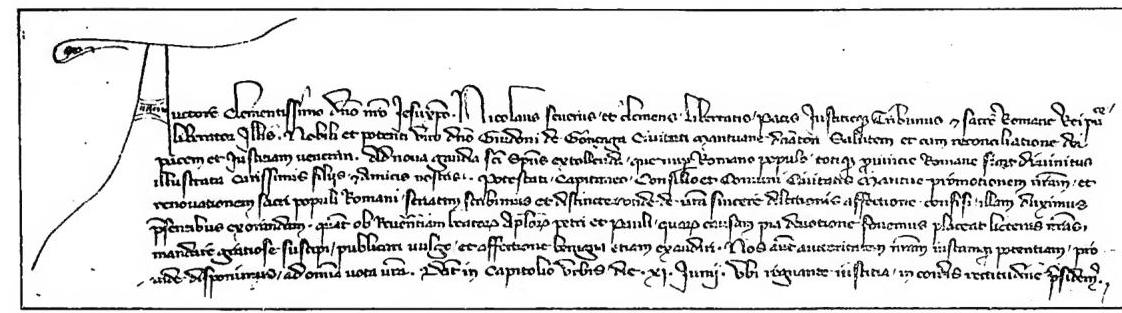
COLA DI RIENZO - Letter from C. to Guido di Gonzaga (11 June 1347) - Mantua, State Archives, (photograph: Institute of Book Pathology)
he felt obliged to act in accordance with them: « nichil actum fore putavi, si, que legendo didiceram, non aggrederer exercendo »; only in this way could he become terrible to the powerful and dear to the people (Briefwechsel etc., part 3, pp. 203–204).