
COLONNA, FAMIGLIA. — The first C. whom history records is that PERTUS DE COLONNA who, under Paschal II (1099–1118), had occupied Cave, territory of the Holy See, and had been driven out of it, with the loss of Colonna and Zagarolo (Lib. Pont., II, pp. 298, 307 n. 15).
He was probably the son of Gregorio dei conti di Tuscolo, brother of Benedict IX. In the ecclesiastical hierarchy, the first to appear is that GIOVANNI, created cardinal of S. Prassede in 1212, who in 1223, on returning from a journey to Palestine, brought back the reputed column of the Flagellation and placed it in his titular church. He stood beside Gregory IX in the struggle against the emperor Frederick II, until in 1240 he passed over to the imperial camp and to the Ghibelline party, to which the C. house thereafter remained a constant adherent. He died in 1245.
The nephew of this cardinal was another GIOVANNI C. who, sent to Paris for his studies, became a Dominican despite the opposition of his uncle, who attempted to discredit him with Gregory IX. He was appointed archbishop of Messina by Alexander IV in 1255 and was transferred from there to Nicosia in 1262. In 1262–64, under Urban IV, he was vicar of Rome. The year of his death is unknown. He compiled a Mare historiarum from the origins of the world to Louis IX, which was printed in French translation in 1488; its most important passages are found in MGH, Scriptores, XXIV, pp. 266–84.
He also wrote De viris illustribus, concerning both pagans and Christians (Hurter, II, p. 438).
In Rome, the C. family had its houses adjoining the church of the SS. Apostoli, but it extended its power over almost the whole region of Trevi, also occupying the mausoleum of Augustus: the Agosta. Toward the end of the thirteenth century, the house was divided into three branches: that of Palestrina, which was the principal one and took its name from the city of the same name, the most important stronghold in the region; that of Gallicano; and that of Genazzano.
The daughter of Oddone C. of Palestrina was that MARGHERITA who, having embraced the religious life, became a Poor Clare nun, died at Castel S. Pietro on Monte Prenestino on 30 December 1280, and was venerated as a blessed. Her cult was confirmed on 17 September 1847, and her body was transferred to S. Silvestro in Capite (cf. L. Oliger, B. Margherita C. — Le due vite scritte dal fratello, etc., Rome 1935).
The blessed woman’s elder brother was GIACOMO, who completed his studies at Bologna and on 12 March 1278 was created cardinal of S. Maria in via Lata by Nicholas III.
The C. house succeeded in winning the favor of Nicholas IV, who on 16 May 1288 created PIETRO C., son of Giovanni and brother of Cardinal Giacomo, cardinal of S. Eustachio; he had studied canon law at Padua. STEFANO, Cardinal Pietro’s brother, was entrusted by the Pope with special missions for peace in Romagna, so that the family became very powerful in Rome during those years (cf. P. Balan, Storia d'Italia, IV, Modena 1895, pp. 154 ff.).
MATTEO, ODDONE, and LANDOLFO complained about the government of their brother, Cardinal GIACOMO, head of the family after Giovanni’s death. Pope Boniface VIII intervened in the matter, but the two cardinals, having rebelled against his authority, were deprived by him of the cardinalate and excommunicated on 23 May 1297. In the war that followed, Palestrina was destroyed and the C. were forced to flee. It was then that STEFANO and GIACOMO SCIARRA, brothers of Cardinal PIETRO, took refuge in France with King Philip the Fair; and Sciarra, as is well known, was among those who, together with the king’s emissaries, attacked the Pope at Anagni on 6 September 1303. The death of Boniface VIII, which occurred a month later, changed the fortunes of the C.: the two cardinals were released from the censures by Benedict XI,
but they did not regain their cardinalitial dignity until Clement V: Cardinal Giacomo died at Avignon on 14 August 1318; Cardinal Pietro, archpriest of S. Maria Maggiore and of the Lateran (1318), died in 1326, also at Avignon (cf. L. Moehler, Die Kard. Jakob Peter C., Paderborn 1914). With the two cardinals, the fortunes of the Colonna family at the Avignon court had begun.
Sciarra C. was senator of Rome in 1312 during the disturbances provoked by the arrival of the emperor Henry VII; he was subsequently among the supporters of Louis the Bavarian. On 17 January 1328 he crowned him emperor in the name of the Romans and on 10 April sanctioned the deposition of John XXII. Forced to flee Rome together with the Bavarian in August, he died in October 1329. Stefano C., by contrast, fought with the Guelphs and later, in 1347, was among the most tenacious opponents of Cola di Rienzo, succeeding in driving him from Rome and restoring order to the city toward the end of that year.
He died very old not long afterward. During those years, the struggles of the C. against the Roman barons—Orsini, Savelli, and Caetani—were continuous; they were waged with alternating fortunes and brought ruin upon the entire country.
The senior member of the house had remained Stefano; from him were born STEFANO the younger and GIOVANNI C., created cardinal deacon of S. Angelo by John XXII on 13 December 1327, one of the very few Italians of those years. He too was archpriest of the Lateran and died on 3 July 1348. His friendship with Francesco Petrarca is well known; Petrarca was his guest for several years in Avignon. Cardinal Giovanni’s brother was that GIACOMO C., canon of Noyon, who, appointed bishop of Lombes in Gascony on 23 May 1328 at the age of twenty-seven (d. 1341), likewise entered into a special bond of friendship with Petrarca.
As soon as the schism broke out, Urban VI took pains to reconcile the C. family, since the Orsini family was hostile to him; in his great creation of 18 September 1378, he created AGAPITO, of the title of S. Prisca, and STEFANO, provost of S. Omer, cardinals. The latter died before receiving his title, and Agapito died in October 1380. Agapito had acquired a certain reputation in his day; previously archdeacon of Bologna, he had successively been bishop of Ascoli, Brescia, and Lisbon. A friend of Cardinal Roberto di Ginevra, he had lost his bishopric because he had not followed him into the schism; only after repeated solicitations had he accepted the cardinalate.
NICCOLÒ and GIO-
VANNI C. of Palestrina took an active part in the struggles that, with alternating fortunes, took place in Rome and its environs during the period of the schism, maneuvering among the various factions that dominated in those sad days.
On 12 June 1405, Innocent VII created ODDD C. a cardinal; he belonged to the branch of Gallicano and was elected pope at Constance on 11 November 1417 under the name Martin V. Papal States, the Pope relied especially on Giordano, his elder brother, and on Antonio, Prospero, and Odoardo, the sons of his third brother Lorenzo, who had died tragically. PROSPERO was created cardinal deacon of S. Giorgio in Velabro on 24 May 1426, but was published only on 8 November 1430. In those years, worthy adherents of the C. house, such as Giuliano Cesarini and Domenico Capranica, also received the purple.
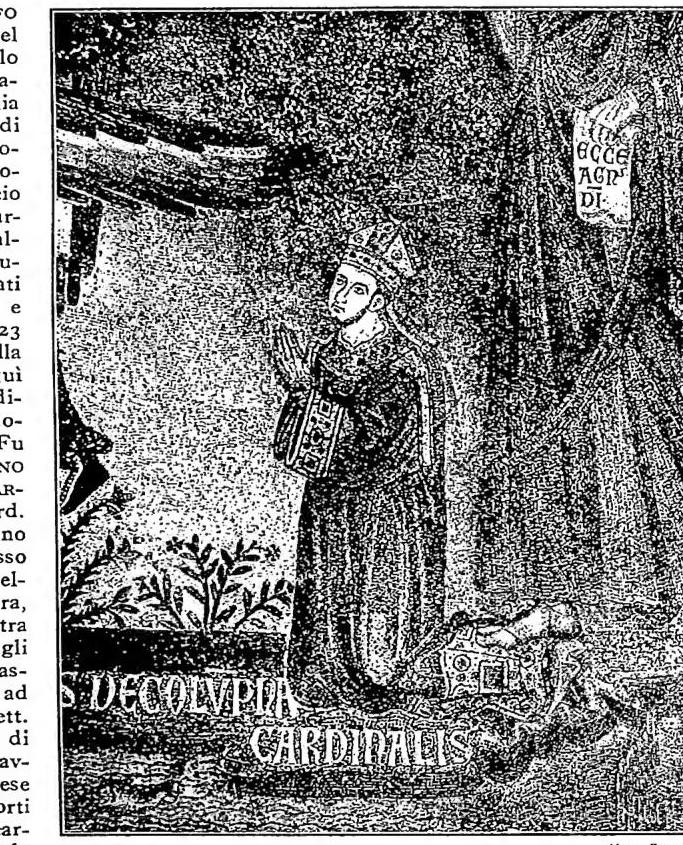
(photo Sanzini) COLONNA — Cardinal Giacomo C. in the mosaic by J. Territi in the apse of S. Maria Maggiore (ca. 1290) — Rome.
particularly that of the Orsini. The consequences became apparent after the death of Martin V (1431), when the Orsini succeeded in prevailing, strengthened by the favor of the new pope, Eugene IV. A war arose, which was soon complicated by the affairs of the kingdom of Naples and by those of the condottieri eager to make their fortunes. Cardinal Prospero hoped to become pope in 1447, but preference was given to Cardinal Parentucelli, who became Nicholas V. The cardinal later died in Rome on 24 March 1463.
A new phase in the struggle with the Orsini and with the Church began under Sixtus IV. On 15 May 1480 this pontiff created GIOVANNI Colonna cardinal of S. Maria in Aquiro, and he soon received the bishopric of Rieti in commendam. The Colonna supported the cause of Ferdinand, king of Naples, together with the Savelli, while the Orsini supported that of Count Girolamo Riario, the Pope’s nephew. Having fallen under suspicion of the Pope, Cardinal Colonna, together with Cardinal Savelli, was held as a hostage on 2 June 1482 and was not released until 14 November 1483.
As the conflicts intensified, through Riario’s agency the protonotary LORENZO Colonna, head of the house, was put to death on 30 June 1484, and the fortunes of the Colonnesi suffered a severe blow; nevertheless, they maintained themselves during the following pontificates amid political rivalries, serving as captains. When Cardinal Giovanni died on 28 September 1508 and was buried in the church of the SS. Apostoli, the bishopric of Rieti went to his nephew Pompeo, abbot of Grottaferrata and Subiaco, more a man of faction and arms than an ecclesiastic, and a fierce opponent of Julius II in 1511; he was created cardinal of the SS. Apostoli by Leo X on 1 July 1517 and vice-chancellor in 1524 under Clement VII.
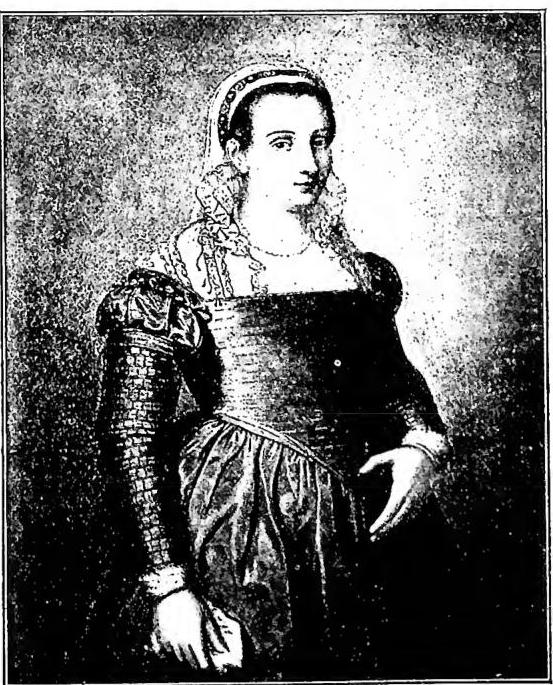
(from E. Ferrero and G. Müller, Cartoppo di Vittoria C., Torino 1819)