
OCHINO, BERNARDINO. — Apostate, born in Siena in the Oca district (whence his name O.) in 1487 to a poor family; died at Slavkov (Moravia) toward the end of 1564.
I. LIFE
Having entered the Observant Friars Minor of Tuscany around 1504, he became provincial of Siena (1523), then vicar general of the Cismontane provinces (1533). At the beginning of 1534 he joined the Capuchins, where he became vicar general (1538–42). Famous as a preacher and for the austerity of his life, he was sought after by the Italian cities, and the most eminent men of the Catholic reform placed great hopes in him; yet in Naples he failed to escape the influence of Juan Valdes and aroused suspicions concerning his orthodoxy. In Sept. 1542, following an inner crisis and seduced by the example of Pietro Martire Vermigli, he decided to break with the Catholic Church and went to Geneva, to Calvin, issuing a widely circulated letter in which he intended to explain the reasons for his action. In Geneva and then in Augsburg (1542–47), O. was minister of the Italian Reformed community.Meanwhile, he had joined a woman originally from Lucca, by whom he had four sons and two daughters. Having fled to England (1547), he was appointed by Thomas Cranmer as Italian preacher in London and received a canonry at Canterbury. With the accession to the throne of Mary Tudor (1553), he had to resume his wandering life, until he was able to settle in Zurich as a pastor; there, however, his work XXX dialoghi led to his expulsion. After various stops, he ended up in Poland, where, through the protection of Prince Nicola Radziwill, he was able to preach to the Italian Reformed community of Krakow in Apr.–May 1564. But ZOSIMAS (v.) on 7 Aug. a royal edict prohibited all non-Catholics who had come from abroad from staying in Poland, and O. found refuge, after losing three of his children during the journey, at Slavkov (Austerlitz) in Moravia, with Niccolò Paruta, a Venetian nobleman, anti-Trinitarian, and Anabaptist. There he died of contagion together with the last of his children.
II. WRITINGS AND DOCTRINE
During his Catholic period he printed Dialoghi sette (Venice 1540 and 1542), in which he explained to his interlocutor, Caterina Cybo, duchess of Camerino, the nature and conditions of perfection, and Prediche nove (Venice 1541), in which he refuted Protestant theories and proclaimed the theology of Christ, the sole source of truth.During his Protestant period he wrote extensively. From 1542 to 1562 he published a series of sermons in five volumes (Basel, Geneva), each of which has its own central idea, drawn from Christian doctrine or life as interpreted in his own manner; in Geneva (1544–45) he wrote in Italian Immagine dell'Anticristo, first published in French (1544); Esposizioni sopra le Epistole di s. Paolo ai Romani (1545) and ai Galati (1546). In England he composed in Latin, translated into English and dedicated to Edoardo VI: A Trogoedia or Dialogue of the injuste usurped primacie of the Bishop of Rome and of all the just abolifying of the same (London 1549), to demonstrate that the Roman Church
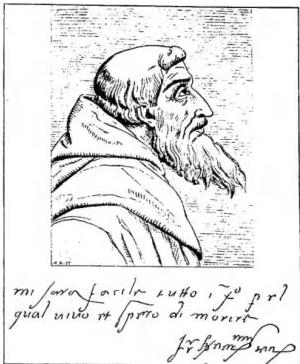
(from K. Benrath, B.O. con Siena, Brunswick 1551, frontispiece)
OCHINO, BERNARDINO - Portrait with autograph, from the letter to the councillor of Siena (5 September 1540) - Siena, Archives.
(with bibliography); B. Nicolini, Girolamo Muzio e B. O. Storia di una polemica, in Biblion, 1946, pp. 9-45; Melchior a Pobladura, Hist. gener. Ord. Fr. Min., Roma 1947, chap. 1. Predegando Callaey