
LUCIFERO. - Latin name (lucifer) of the planet Venus or "morning star", which in the Vulgate
Already the Egyptians had recognized the identity of the solitary star that appears at sunset (Uáiti) and the god (Tiumutiri) who greets the sun at its rising. "Infima est quinque errantium terrae proxima stella Veneris, quae φωσφόρος Graece, lucifer Latine dicitur quum antegreditur solem, quum subsequitur autem hesperos" (Cicero, De nat. deorum, II, 20; cf. Pliny, Hist. nat., II, 8-6 [36]).
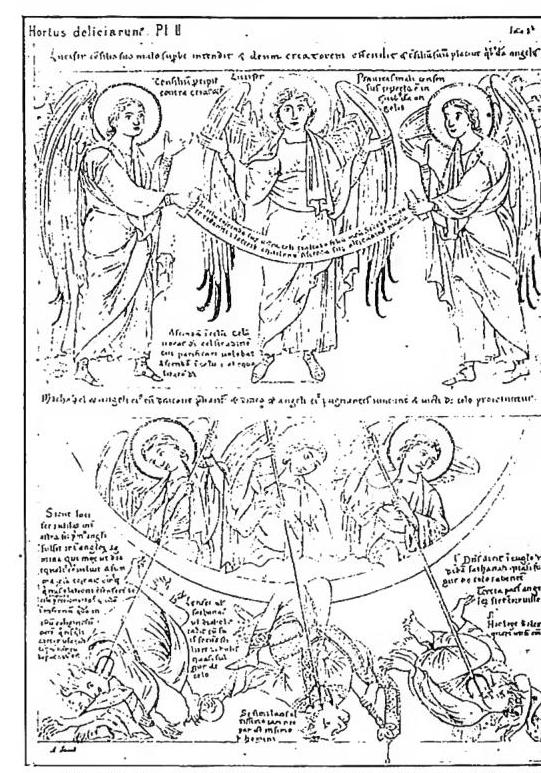
In his oracle against Babylon, Isaiah (14, 12) addresses the powerful and proud king, enemy of God, who has died (hurled down into šé'ēl): "How you have fallen from heaven, O shining son of the dawn? (hélèl ben šábar; the Vulgate follows the Septuagint: ὁ ἐωσφόρος ὁ πρωὶ ἀνατέλλων)"; among the Greco-Romans as well, the mythical Lucifer was the son of Aurora. Aquila, Symmachus, and probably the Masorete vocalizers see in hélèl not a form of hélal "to shine" but a hiph'il of jálal "to wail"; St. Jerome agrees (Comm. in Is., V, 14: PL 24, 161): "in hebraico ... legitur ... ulula fili diluculi; significatur autem aliis verbis lucifer; et dicitur si quod flere debeat et lugere, qui quondam sic fuerit gloriosus ut fulgori luciferi comparatus sit", and makes L. the highest fallen angel, who must lament the loss of his original splendor. Following the Jews, the Fathers (Origen, Tertullian, Cyprian, Ambrose, Cyril of Alexandria, etc.) devil (v.) in this L., inasmuch as it denotes the glorious state from which he fell (D. Petavius, De angelis, III, 3, 4).
The fall of L. expressed in Is. 14, 12 seems to be alluded to in Lc. 10, 18 and Apoc. 9, 1-11 (L. plunging into the abyss is Abaddon [v.]). Some (G. Estius, A. Calmet, etc.) see in Phil. 2, 6-11 a contrast with the titanic ascent attempted by L. (Is. 14, 14); thus St. Bernard (PL 183, 36; cf. 184, 793 sq.; 184, 684: he opposes Mary's "Magnificat" to the canticle of L.).
The morning star symbolizes the moral splendor of the high priest Simon son of Onias (Eccl. 50, 6: ἀστήρ δωδηνός, and Vulg. "stella matutina"; but the Heb. has "luminous star"). In the New Testament, it denotes Jesus as the "morning star rising in hearts" with the faith that prepares for the parousia (II Pt. 1, 19); Jesus is "the bright morning star" (Apoc. 22, 16: ὁ ἀστήρ ὁ λαμπρός ὁ πρωινός), and he will give the victor "the morning star" (τὸν ἀστέρα τὸν πρωινόν; Apoc. 2, 28), that is, his glory. The Latin liturgy, in the Exultet, invokes Christ as "Lucifer matutinus... Lucifer qui nescit occasum".
In Latin patristic language, the pejorative meaning of the term became fixed following the application of Is. 14, 12 to Satan, where the trajectory from the highest pinnacle to the deepest abyss is described (Dante, Inf., 31, 143; 34, 89; Purg. 12, 25 vs. Lc. 10, 18). Already Lucifer (Lucifera for a woman) was a fairly frequent first and last name in the Roman milieu (J. Perin, Onomasticon, II, Padua 1940, p. 141). According to a tradition, the morning star had been God's first creation (cf. Ps. 109, 3 Vulg. and Apoc. 22, 16 b; St. Augustine, Serm., 119, 14 and 174, 1).