
UMILTÀ. — A moral virtue that restrains the soul, so that it does not tend with immoderate movement toward what is above it (Sum. Theol., 2ᵃ-2ᵃᵉ, q. 161, a. 1); or, more broadly: that virtue which restrains the disordered desire for one’s own greatness and inclines a person to love his own reality as known in the light of sincere truth.
I. NATURE OF U
The true nature of u. is to be sought in its function of moderating pride, which is a deviation from two legitimate tendencies implanted by God in human nature: self-esteem and the desire for the esteem of others. The former is the basis of personal dignity; the latter is one of the foundations of sociability. Although these two inclinations are, in a certain sense, providential, they are liable to easy deviations. U. has the task of opposing these deviations and maintaining order in self-esteem and in the desire for the esteem of others. It is therefore truth and justice, with justice understood here in the broad sense, insofar as it designates the virtuous disposition that assures each thing the place it deserves. The pagans knew of u. only modesty and, insofar as they knew it, practiced it very imperfectly. S. Tommaso, on the other hand, shows that u. is not opposed even to a virtue that might seem its polar opposite, magnanimity (v.).These are different aspects of one and the same reality, reached from different positions and tending to set different energies in motion. It is proper to u. to recognize the disproportion between reality and the vain desires for great things that exceed the individual's possibilities. On the practical plane, awareness of one's own deficiency forms the guiding rule of the will, and therein essentially consists u. (ibid., q. 161, a. 2 e 6). For s. Tommaso, moreover, u. is attached as a potential part to the virtue of temperance, whose object is the moderation and restraint of the impulse of the passions. Now, since u. is nothing other than a bridle on the human spirit in its continual anxiety for proud striving, it falls within this more general virtue.
II. HUMILITY, REVELATION, INCARNATION
The virtue of Christian humility is illuminated by a new light after Revelation has more fully disclosed humility’s connection with God, with the free will of man, and with Jesus Christ, the Redeemer and Savior of man through the most heroic exercise of humility. Considering that every sin has as its common element rebellion against the law of God,it can be understood how humility embraces the whole moral aspect of man in his life of return to God, and how the nothingness of the creature before God offended by sin takes on a profound sense of confusion.
This aspect of humility, which is the most mysterious and the most difficult for the human heart, is understood in contemplation of the mystery of Christ, which the Apostle St. Paolo reveals as a mystery of humility. The famous Christological text of the Letter to the Philippians (2:6–11) says that “Christ, subsisting in the nature of God, did not deem it necessary to cling jealously to equality with God, but emptied himself, taking the nature of a slave, becoming like men, recognized as a man in all his outward appearance; he humbled himself, becoming obedient unto death, even death on a cross. Therefore God exalted him...” For this precise aspect, humility possesses its proper light in the mystery of the Incarnation and Redemption.
III. HUMILITY IN HOLY SCRIPTURE AND IN THE VARIOUS SCHOOLS OF SPIRITUALITY
The continual appeal to humility in the New Testament demonstrates its excellence and necessity. Jesus’ teaching focuses particularly on humility, which forbids exalting oneself above others and makes relations with one’s neighbor easy and loving (Mt. 22, 2-12; Lc. 14, 7-11). Humility attracts the Lord’s benevolent gaze (Lc. 18, 9-14) and enables one to avoid ostentation in fulfilling the duties of prayer, penance, and almsgiving (Mt. 6, 3-18). St. Paul strongly and insistently recommends humility to his faithful (Phil. 2, 3-11; Eph. 4, 2; Rom. 12, 16; Gal. 6, 3, 5). St. Peter says to the faithful: « Clothe yourselves with humility, because God resists the proud and gives his Grace to the humble; humble yourselves under the mightyhand of God » (Pt. 5, 5-6). See also the teaching of St. James in his letter (4, 5-8).
Guided by Revelation, the Fathers of the Church, spiritual masters, and theologians, after the theological virtues, make their moral teaching converge on humility. St. Augustine returns to God through the mystery of humility revealed by Holy Scripture (Confessions, VII, chaps. 9, 20, 21, etc.). Eastern and Western monastic asceticism sees humility as the authentic measure of spiritual progress.
Fundamental in Cassian is Book IV, chap. 39 of the Institutions (PL 49, 198-199), adopted and completed by St. Benedict in chap. 7 of his Rule.
Nevertheless, in order to understand correctly the monastic method of humility, it must be kept in mind that St. Benedict, together with the whole
This conception pervades all medieval ascetic teaching on the virtue of humility: thus St. Bernard in De gradibus humilitatis: PL 182, 941-72, and St. Anselm (In lib. De similitudinibus, c. 99, n. 108: PL 159). Finally, the acceptance of the Benedictine enumeration is found in the Sum. Theol., 2a-2ac, q. 161, a. 6. A synthesis of the entire medieval spiritual mentality is found in the book Imitation of Christ, which so aptly anticipates modern spirituality; it opens with an appeal to humility (lib. I, c. 2, 15, 16, 17); and throughout all the books it returns to it as its favorite theme (lib. II, c. 2, 9, 12; III, c. 3, 4, 7, 8, 13, 14, etc.; IV, c. 15, 18).
For Franciscan spirituality, it is enough to recall St. Francis’s song of perfect joy (Fioretti, chap. 8).
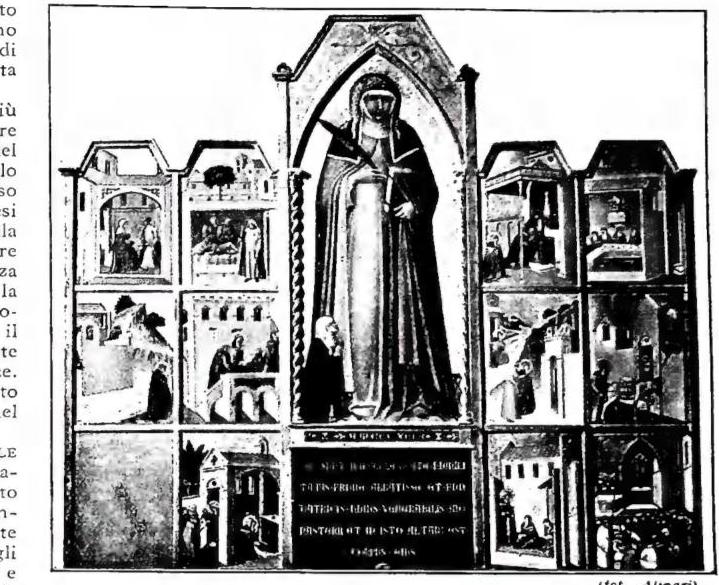
(photo Anderson)
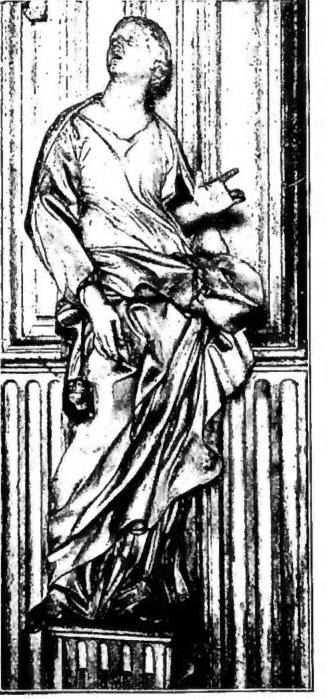
UMILTÀ - Humility. Detail of the stucco decoration of the Oratory of S. Lorenzo, by G. Serpotta (1687–1696) - Palermo.
(fol. Enc. Catt.)