
PHILIPPIANS, EPISTLE TO THE. — One of the four letters of imprisonment, addressed by St Paul to the community at Philippi.
SUMMARY:
I. Character
II. Analysis and content
III. Occasion
IV. Pauline authenticity and unity.I. CHARACTER
The F. has an unmistakable character of its own in comparison with the other Pauline letters, including those of the group in which it is commonly classified; it differs from them in content and tone, if not in the place and circumstances of composition. Apart from the very brief Epistle to Philemon (v.), which, because of its destination and subject, is entirely personal in character, the F. is the most familiar of the Pauline letters: more truly a letter than any other. It is marked by the most cordial intimacy, free from every anxiety: Paul knows well that he is understood, and that between him and his correspondents there is no danger of those misunderstandings that could be created, for example, by the captious factionalism of the faithful at Corinth. He therefore opens his heart with the simplicity and confidence of a father and, by reflection but unmistakably, conveys the readers’ devotion. Some polemical passages are not directed at the recipients but at the avowed enemies of Paul’s preaching, the Judaizers (3, 2-11), who seem to be outsiders to the community, or else at those members of the community who have fallen short of their vocation to the point that they may be called «enemies of the Cross of Christ» (3, 18 sqq.; cf. J. H. Michael, pp. 132 sqq., 171 sqq.; W. Michaelis, pp. 52 sqq., 61 sqq.). The letter accurately reflects the relations that consistently existed between Paul and the Church of Philippi, the most faithful of those founded by him, the only one in which erroneous doctrines and serious divisions of spirit gained no foothold. This does not mean that the Apostle fails to warn against every danger of doctrinal deviation and of cooling in religious fervor, or against signs of minor internal dissensions (cf. 4, 2).The F. is not a fundamentally doctrinal writing, such as could be compared with the powerful treatises of the Epistles to the Romans and the Galatians, and with I Corinthians. Nevertheless, it contains doctrinal insights of considerable importance, first among them the celebrated Christological passage in 2, 6-11. Christian life and morality, mystical union with Christ, and progress toward perfection occupy a notable place in it, but outside any preconceived scheme. This letter of joy, which recalls the Gospel of s. Luca more than any other writing, is even more significant as a Christian vision of life because it comes from a prisoner and is addressed to believers who have suffered and continue to suffer for the cause of Christ. On s. Luca’s residence at Philippi, V. FILIPEPI.
II. ANALYSIS AND CONTENT
The nature of the writing explains why it can be divided according to the customary scheme into a doctrinal and a practical part. Alongside the information concerning the Apostle’s present circumstances, there appear from the outset exhortations to a more fervent Christian life, reinforced by arguments of a dogmatic nature. The thoughts follow one another freely, at times linked by a very slender thread, but with great naturalness, apart from a few rather abrupt and unexpected transitions (3, 1 ff.).The opening (1, 1-11) is less solemn than those of the Epistle to the Romans and of the First and Second Epistles to the Corinthians; it is closer to those of the First and Second Epistles to the Thessalonians, also because of the absence of the title “apostle.” Here Paul calls himself, together with Timothy, a “servant of Jesus Christ.”
After the customary address to “all the saints,” with particular mention of the ἀπίσκοπος and the βέλκους, and the wish of grace and peace (1 ff.), the Apostle gives thanks and expresses his joy for the divine gifts so abundantly bestowed upon this community, of which he is proud. He bears all these dear children in his heart, even as a prisoner, and while he struggles for the propagation and defense of the Gospel (3-8), his prayer implores an increase of charity among the faithful, so that they may know and practice what is best, in order to be pure and blameless in preparation for the day of Christ (9 ff.).
The Apostle’s imprisonment too has turned to the advantage of the Gospel: besides promoting Christianity among the soldiers on guard, it has aroused in many brethren a greater fervor in preaching. Some are moved by a not very praiseworthy antagonism; but that does not matter: provided that Christ is preached, by whomever and for whatever motive, Paul’s heart will always be filled with sincere joy (1, 12-18). Everything will turn to his benefit and to the honor of Christ, glorified both by the Apostle’s life and by his death; for him “to live is Christ and to die is gain”: he is ready to sacrifice the desire to be released from the bonds of the body and to be with Christ, in order to remain, as in fact he will, for the greater benefit of these faithful, whom he expects to see again (1, 19-26).
Let the readers conduct themselves in a manner worthy of the Gospel of Christ, in perfect unity of spirit, without trembling before their adversaries; for this is their boast: not only to believe in Christ, but to suffer for him, as Paul gives them the example (1, 27-30). For all that is most dear in Christ and in the communion of spirits, let them complete his joy through perfect concord, taking care not to act for vain glory, but rather regarding others as superior to themselves. The great lesson Christ has given us commits us to this: although he could rejoice in everything that was due to him because of his perfect likeness to the Father, he chose to humble himself by assuming the condition of a slave, becoming in all things a man like us, humble and obedient unto death, even death on a cross. For this reason God exalted him, giving him a name superior to every other name, so that all heavenly, earthly, and infernal creatures might recognize and confess that “Lord” is Jesus, to the glory of God the Father (2, 1-11). Let the faithful, therefore, work out their own salvation with fear and trembling, in that spirit of docility of which they have given proof. God is the one who gives them both the will and the action. Let them shine like stars amid a perverse and misguided generation, proving that he has not labored among them in vain. And if his blood is poured out as a libation upon the sacrificial offering of their faith, he will rejoice, and they too ought to rejoice with him (2, 12-18).
Paul intends to send Timothy to Philippi, who has already given magnificent proofs of devotion to the cause of the faithful, while “all” seek their own interests rather than those of Christ. He hopes to find himself soon among his children as well. Meanwhile, he has decided to send them Epaphroditus, recovered from a long illness; they should receive him with joy and esteem men of such a character highly: for the cause of Christ, indeed, “in the service of the Apostle, Epaphroditus has risked his life” (2, 19-30).
Again exhorting the faithful to joy, Paul warns them against the advocates of a circumcision that no longer has any value (it is merely an incision or mutilation: κατεταχά; cf. J. H. Michael, p. 135). What matters is spiritual circumcision. The credentials in which these men glory would not be lacking in Paul; but he considers them filth, in order to gain Christ and, through him, true righteousness, by sharing in his Passion, death, and Resurrection. It is Paul’s exertion of all his powers to attain the goal, just as Christ once seized him: a forgetting of the path already traveled, in order to run once more toward the reward to which God calls him above, in Christ Jesus (3, 1-14). In this way of thinking and acting the faithful must imitate him, keeping far from the practice of those “many” who have become “enemies of the Cross of Christ” and have the belly as their god. On the contrary, the homeland of believers is heaven, from which they await Jesus as Savior, who must transform them into his own glory. Let the F., the Apostle’s “joy and crown,” stand firm thus in the Lord (3, 15-4, 1).
Let Evodia and Syntyche be more united, with the help of the “genuine Sigro,” they who have labored for the Gospel with Clement and the others, “whose names are in the book of life.” Let all rejoice in the Lord, showing gentle goodness (τὸ ἐπτατελές) toward everyone. “The Lord is near.” Let them be free from earthly concerns; let their prayer rise to God; let his peace fill their hearts, while they strive to pursue everything good and honorable that they have been able to see in their Apostle (4, 2-9). He gives thanks for what they have sent him—not because he is unaccustomed to every kind of deprivation, but because these gifts prove their affection. They are the only ones from whom he has accepted personal offerings. Now, however, he abounds in this kind of sacrifice which, through him, they have offered to God; and God will reward them magnificently. To him, our Father, be glory for ever and ever (4, 10-20).
The epilogue (4, 21 ff.) contains general greetings, also from the saints “who are of Caesar’s household,” and the wish of the Grace of Christ.
III. OCCASION
F. was written when Epafrodito, having recovered from a serious illness, was preparing to return to Philippi. Paul had to thank those good faithful people who had shown themselves so devoted, both by sending material assistance and by arranging for Epafrodito to remain at the prisoner’s side to assist him on behalf of the community. It is not unlikely that Paul had already written to the F. (3, 1-18); but the view that an exchange of letters took place between Epafrodito’s arrival and the sending of F. (cf. J. H. Michael, p. XXI s.) encounters difficulty in the fact that Paul here thanks the faithful for the offerings they sent; nor is it very probable that he returned to the subject several times, given his evident intention of delicately demonstrating his independence with regard to these gifts. The fact that the people of Philippi had been informed of Epafrodito’s illness can also be explained without a letter from Paul.Certain internal features of the letter seem to separate it, as regards place and date of composition, from the other three letters of the captivity. Some aspects of its content and style would seem to bring it closer, rather than to these letters, to the great Pauline letters. The presence of the Judaizing danger (3, 2-11; cf. however Col. 2, 8-23) suggests a period not far removed from the Galatian crisis (v. GALATI, EPISTOLA 31). But these are criteria easily subjected to subjective interpretations. While in recent decades the critics who placed F. in connection with the Caesarean imprisonment have considerably diminished (cf. T. W. Mancon, p. 182), the defenders of its Ephesian origin have increased, particularly in non-Catholic circles (cf. W. Michaelis, pp. 2, 8; P. Feine-J. Behm, Einleitung in das Neue Test., 8ª ed., Leipzig 1936, p. 177). They, however, have not yet been able to produce arguments capable of counterbalancing those that support Rome.
IV. PAULINE AUTHENTICITY AND UNITY
The Pauline authenticity of the F., denied only by the radicals of the Tübingen school (not by all the followers of this school) and of the Dutch school (cf. M. Goguel, Introduction au Nouv. Test., IV, 1, Paris 1925, pp. 28, 410; J. Huby, p. 264), is today being admitted with ever greater frequency. Indeed, even if one sets aside the external testimonies, the Pauline characteristics of the letters are so pronounced as to exclude any likelihood of a forgery.In addition to the allusions in I Clem. 3, 4; 21, 1 (Phil. 1, 27); 47, 2 (Phil. 4, 15); in St. Ignatius, Ad Smyrn., 4, 2 (Phil. 13); 11, 3 (Phil. 3, 15); ad Philad., 1, 5; 8, 2 (Phil. 2, 3), there is the explicit testimony of Polycarp, Ad Phil., 3, 2, who recalls to the F. the letters written to them by Paul; allusions occur in 1, 1 (Phil. 2, 17; 4, 10); 2, 1 (Phil. 2, 10; 3, 21); 9, 2 (Phil. 2, 16); 12, 3 (Phil. 3, 18). The F. is also cited in a writing of the churches of Tione and Vienne (Eusebius, Hist. excl., 5, 2: PG 20, 433). Phil. 4, 18 is cited as Pauline by St. Irenaeus (Adv. Haer., 4, 18, 4: PG 7, 1026; cf. 2, 8, 3 [Phil. 4, 17]; 5, 13, 4 [Phil. 3, 10]: PG 7, 995, 1159). The authenticity of the F. is regularly affirmed by Clement of Alexandria (Strom., 4, 13: PG 8, 1300; Paed., 1, 6: PG 8, 312), by Tertullian (De resurrectione carnis, 23: PL 2, 826 [873]; Adv. Marcionem, 5, 20: PL 2, 522 ff. [554 ff.]), and by the Muratorian Fragment (Enchiridion Biblicum, Rome 1927, no. 4).
An argument against the unity of the F. was thought to have been found in the text of Polycarp cited above, which indeed speaks of “letters” sent by Paul to the F. But, besides the fact that the plural ἐποστολία is often used for a single letter (litterae), Polycarp might have been referring either to the collection of letters sent to the faithful of Macedonia or, more probably, he was better informed about the correspondence between Paul and the F., which need not have been limited to the canonical writing.
That there is an abrupt and unexpected transition at Phil. 3, 1 ff. is undeniable: 3, 1 would seem to be the beginning of a letter’s conclusion; but then the text decisively resumes in order to renew recommendations already made (3, 16); and there follow the very harsh expressions of 3, 2, 18; indeed, the whole of chap. 3 recalls the vigorous polemics of the great letters, almost as a reflection of those same struggles. One may suppose an interruption in the drafting of the F., during which the Apostle
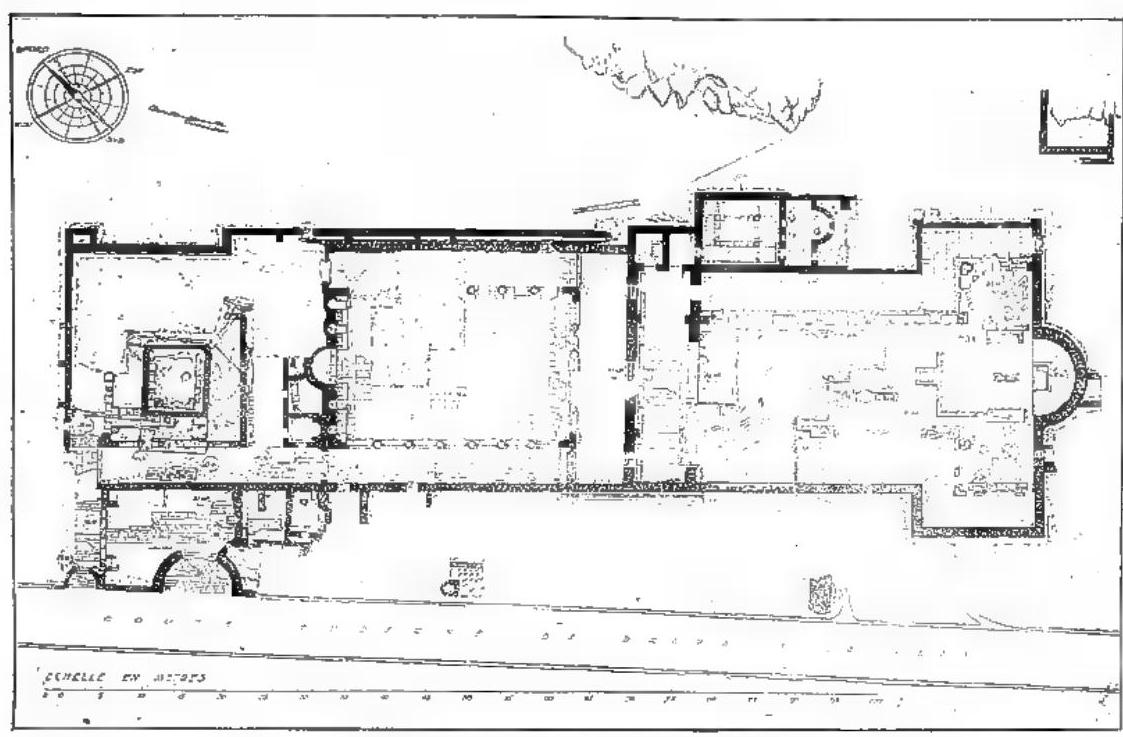
(from P. Leuccia, Philippe et la Macedonie orientale à l'époque chrétienne et lacontine. Paris 1855, Ions II 80)
FILIPPI - Planta della basilica a nord del Foro (ca. 500).
Gli attacchi più radicali contro l'unità della F. sono di A. Loisy, La naissance du christianisme, Parigi 1933, p. 28, a H. Delafosse (Turmel), L'Epître aux Philippiens, ivi 1928; per il primo la F. sarebbe una combinazione di due biglietti di Paolo, uniti all'inizio del sec. II e integrati con elementi di gnosi cristiana (2, 6-11) e di polemica antigiudaica; per il secondo i passi dottrinali sarebbero di un marcionita che, ca. il 140, tentava di divulgare sotto il nome di Paolo le dottrine del proprio maestro.
Contro questi tentativi di vivisezione s'è pronunciata la maggioranza dei critici, tra i quali si rilevano A. Jülicher-E. Fascher, Einleitung in das Neue Test., 7ª ed., Tubinga 1931, p. 122; M. Goguel, loc. cit., pp. 400-409. Quest'ultimo conchiude (p. 409) che le obbiezioni affacciate contro l'unità della F. possono risolversi tenendo conto della libertà che caratterizza la composizione di una lettera.
BIBLI: Commenti moderni (i cattolici sono contrassegnati da ): J. B. Lightfoot, St. Paul's Epistle to the Philippians, 12ª ed., Londra 1896, ristampa 1903; M. R. Vincent, A critical and exegetical commentary to the Epistles to the Philippians and to Philemon, 3ª ed., Edimburgo 1911, ristampa 1922; J. Knabenbauer, Commentarius in 1. Pauli Apostoli Epistolos. IV. Epistolos ad Ephesios, ad Philippenses et ad Colossenses, Parigi 1912, pp. 175-278; P. Ewald, Der Brief des Paulus an die Philipper, 4ª ed., Lipsia-Erlangen 1923; J. H. Michael, The Epistle of Paul to the Philippians, Londra 1928, ristampa 1948; F. Tillmann, Die Gefangenschaftsbriefe des heiligen Paulus, 4ª ed., Bonn 1931, pp. 121-62; J. Huby, St Paul. Les Epîtres de la Captivité (Verbum Salutis, 8), 2ª ed., Parigi 1935, pp. 251-366; W. Michaelis, Der Brief des Paulus an die Philipper, Lipsia 1935; * A. Médebielle, Epître aux Philippiens (La Ste Bible, ed. L. Pirot. 12), Parigi 1938, pp. 75-100. Studi: O. Schmitz, Aus der Welt eines Gefangenen, 4ª ed., Berlino 1931; H. E. Anderson, Outline studies in Philippians, Londra 1931; W. W. Cash, Helps to the study of Philippians, ivi 1933; O. Linton, Zur Situation
des Philipperbriefes, in Conicciatura Neotesiamentica, II, Uppsala-Lipsia 1936, pp. 9-21; E. Peterson, Apostolo e martire nella lettera al F., trad. II. della 2ª ed. red. di A. Pintonello, Roma 1947; T. W. Manson, St. Paul in Ephesus, The date of the Epistle to the Philippians, in Bulletin of the John Rylands Library, 23 (1949), pp. 182-200. Per il testo cristologico di 2, 5-11; H. Schumacher, Christus in seiner Präventiva und Kanons nach Phil. 2, 3-8, I, Roma 1914, II, ivi 1921; W. Foerster, ἀφθαλμία, in Theologisches Wörterbuch zum Neuen Test., I, p. 472 sgn.; H. Kruse, Harpagans, in Verbum Domini, 27 (1949), pp. 335-360; cf. inoltre la bibl. di Biblica, 30 (1949), p. 138*.
Teodorico da Castel San Pietro