
TURMEL, JOSEPH. — Modernist theologian, born in Rennes on 13 December 1859, died there on 5 February 1943.
He was ordained a priest on 3 June 1882 and appointed professor of dogmatic theology at the Seminary of Rennes; in 1884 the crisis began that was to lead him away from the Catholic faith. Deprived of his chair in 1892, he became chaplain to the Petites Soeurs of Rennes, and continued his scholarly activity by regularly writing the historical chronicle for the Revue du clergé français and contributing patristic studies and notes to numerous French and foreign journals. Indeed, he was entrusted with the first volume of the Bibliothèque de théologie historique of the Catholic Institute of Paris; thus there appeared, alongside Prat’s Théologie de St Paul and D’Alès’s Théologie de Tertullien, T.’s Histoire de la théologie positive (2 vols., Paris 1904–1906). Critics and theologians soon raised objections, which prepared the way for its condemnation by the Index (7 March 1910 and 2 January 1911). Other works had also been criticized, but they could not yet compromise his orthodoxy. T., following a tactic systematically adopted by the Modernists, preferred to express his views in articles signed with pseudonyms (as many as 14); thus, in 1906, he wrote on the development of the dogma of the Trinity in the Revue d’histoire et de littérature religieuses (under the name A. Dupin), emptying the argument of tradition of its substance. The following year, in the same journal, an article signed G. Herzog appeared, denying tradition concerning the virginity of Mary. T. himself, in reviewing it, acknowledged that it was demolishing, but refrained from refuting it on the pretext that this required a specialist.
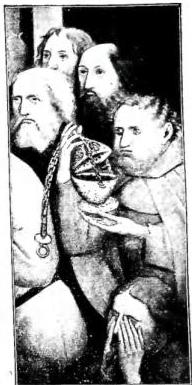
(courtesy of the Office for the Recovery of Works of Art)
TURIBOLO — Apostle with a thurible. Detail from the Death of the Virgin by Hans Multscher (1459) — Vipiteno, Civic Museum.
that there was a close affinity of style and thought between Herzog and the Histoire of T., concluding that the former had plagiarized from the latter’s manuscripts. The entire French Catholic press was alarmed by the suspicion that had come to weigh upon T.’s orthodoxy. Proceeding by the same method, Salter reached the same conclusions regarding the article by A. Dupin, but T. withdrew into disdainful silence, discouraging his defenders and aggravating the suspicions of his adversaries. Pressed by the archbishop of Rennes, T. declared that he knew neither Herzog nor Dupin and signed a general formula of adherence « to the integral doctrine of the Church ». The controversy was closed, for the time being, because of T.’s obstinate silence and the lack of direct and irrefutable evidence. Shortly thereafter came the condemnation of T.’s works (5 July 1909; 7 March 1910), after which he disappeared from the theological world, sheltering behind old and new pseudonyms in articles that engaged the finest representatives of French Catholic theology and criticism. For twenty years « the Herzog-Dupin case » remained an enigma. In 1929 Salter, having obtained decisive evidence, published a new article with the complete list of T.’s pseudonyms and works. On 6 November 1930 the Holy See declared him excommunicated vitandus and degraded from the clerical state.
In his final years he published an’Histoire du diable (Paris 1931) in the Christianisme collection directed by P. L. Couchoud, a brief study on the Apocalypse (ibid. 1938), and an attack against the Shroud of Turin (ibid. 1938); from 1930 to 1931 he also published, in 6 volumes, a venomous Histoire des dogmes. Of his destructive work nothing remains that was not promptly refuted; regarding his person, there remains a severe judgment for the double game he systematically pursued for more than twenty years.
His principal works, besides those mentioned, are: S. Jérôme (Paris 1905); Histoire du dogme de la papauté des origines jusqu'à la fin du IVe siècle (ibid. 1908); (H. Delafosse), Les écrits de St Paul (4 vols., ibid. 1925–27); (L. Coulange), Catéchisme pour adultes (2 vols., ibid. 1929–30 [cf. Index of Prohibited Books under T., Delafosse, Herzog, Dupin, Coulange]).