
SINDONE. – Funerary cloth that wrapped the Body of Jesus Christ. Several cloths preserved in various places have aspired to this honor (Compiègne, Besançon, Cadouin, Bitonto, etc.); careful analysis has shown that the only S. with a serious likelihood of being authentic is the one currently preserved in the cathedral of Turin and originating from Lirey and Chambéry.
I. HISTORY
The earliest historical documents concerning the S. are obviously the Gospels; later, there are references to the funerary cloths of Christ’s burial in the 7th century; clearer still is the mention made of it by Robert of Clari in 1204. He attests to the presence of the S. in the imperial chapel of St. Mary of Blachernae, in Constantinople, and says that the S. was displayed, as was its right, every Friday, so that the figure of Christ could be clearly seen. From 1204 to 1350 the documents are silent. It should be noted that, for many other distinguished relics as well, there is no continuous sequence of documents; the case of the S. is therefore not isolated. There are, however, historical reports that make it possible, by inference, to reconstruct with serious probability the history of the S. during this period as well.When the Latins conquered Constantinople (1205), the bishop of Troyes, Garnier de Trainel, was present there; he was specifically entrusted with safeguarding the relics of the Imperial Chapel. He died in Constantinople. One of his two household members, Guglielmo di Champlitte, was present at his death; he later married into the family of the counts of Charny, the family in which the S. indeed appears around 1350. Goffredo I di Charny built a collegiate church at Lirey and there, with the authorization of the papal legate, Cardinal Pietro di S. Susanna, displayed the sacred linen for public veneration. It is natural to think that the papal legate must have received from Goffredo di Charny information sufficient for him to regard the S. as an authentic relic; nevertheless, no written documents concerning this information have survived. On the other hand, the draft of a letter subsequently sent by the bishop of Troyes, Pietro d’Arcy, to Pope Clement VII in Avignon has survived. The tone of the letter is highly polemical; the bishop attests that his predecessor, Enrico di Poitiers, had investigated the matter and had even found the painter who had painted the S.; he further asserts that the cloth was displayed non ad finem devocionis, sed questus, while false miracles were also being fabricated. Clement VII settled the matter prudently, permitting the display of the S., but enjoining the Canons of Lirey not to assert officially the authenticity of the relic, while at the same time granting an indulgence to the faithful (1390). In substance, “the Shroud of Lirey emerged unscathed from the disputes of 1389–90; the action of the bishop of Troyes to accuse the Canons of Lirey of fraud, greed, and profiteering was quickly silenced” (Cognasso). Recently, Monsignor Pietro Savio, of the Vatican Secret Archives, presented at the International Conference of Sindonological Studies (Rome 1950) documents in which the figures of Goffredo di Charny and the Canons of Lirey appear in a highly favorable moral light.
From Lirey, after various journeys caused by wartime circumstances, the S. passed to Chambéry and became the property of the dukes of Savoy (1453); there it suffered a fire in 1532 and had to be repaired by the Poor Clares of Chambéry (the white patches sewn on at that time are still clearly visible on the S.); in 1535 the S. traveled to Turin, Vercelli, and Nice (during the war between Charles V and Francis I); it then returned to Chambéry for a short time; in 1578 Emanuele Filiberto transported it to Turin so that s. Carlo Borromeo might venerate it there; the S. is still in Turin, in the monumental Chapel designed by Guarini. During the Second World War the S. was transported for a short time to the sanctuary of Montevergine, where it could be examined by Gedda.
II. THE S. AND SCIENCE. — A vigorous controversy concerning the S. of Turin arose particularly between 1898 and 1902. At the suggestion of Nogueir de Malijai, a learned Salesian priest, King Umberto I had Pia take a photograph of the S.; an unexpected fact immediately struck the photographer during the development of the plate: on it one did not see the usual negative, but rather a wonderful positive, exceedingly beautiful and delicately shaded, such as no artist could ever have produced. Indeed, it must be said that several painters, among them Reffo, attempted to work back from the photograph to the construction of a negative, but with most unfortunate results.
Nogueir and Vignon, in Paris, conducted research and studies, with the aid of chemical experiments, in an attempt to explain the process by which the remarkable imprint might have been produced. Vignon then proposed a theory known as “vaporographic”: the urea in perspiration would have been transformed into ammonia, which would have oxidized and darkened a solution of aloe supposedly present on the cloth. Almost simultaneously, Canon Chevalier published the draft of Pietro d'Arcy’s letter, mentioned above, maintaining that the S. was the work of mystification and fraud (as, moreover, Leclercq, Suire, in DACL, XV, cols. 1718–24, has also maintained quite recently). It may be said, generally speaking and with a certain number of exceptions, that the authenticity of the S. has been particularly defended by scholars of the experimental sciences (chemists, physicians, technicians), whereas historians and some exegetes have more commonly opposed II.
In a delicate problem such as this, it is appropriate first of all to affirm that Faith is not properly at issue here; the Church has officially defined nothing; everyone is free to form his own conviction on the basis of his own research and that of others. It seems, however, that in a problem of archaeology the “external documents” (all the more so if they are evidently polemical, as in our case) must be supplemented by the “internal examination” of the object. And, since this is a very particular object, it is reasonable to turn to competent technical specialists. A cloth such as that of the S. cannot be studied solely with dictionaries and criteria of linguistic philology.
A scholar who certainly knew historical criticism well, together with all the demands of philology, but who at the same time understood the requirements of scientific-experimental studies, S. S. Pius XI, in a conversation with Cardinal Fossati, Archbishop of Turin, spoke words of great gravity and considered judgment: “We have personally followed the studies on the Holy S. and have become convinced of its authenticity. Objections have been raised, but they do not hold.”
The study of the S., especially after 1931—that is, after a new photograph of technical perfection had been taken by Enrie in the presence of prelates and scientists—entered a new phase, particularly through the work of chemists (Scotti),
(phot. Enrie) SINDONE — The fabric of the S. enlarged fivefold — Turin, Cathedral, Chapel of the Holy S.
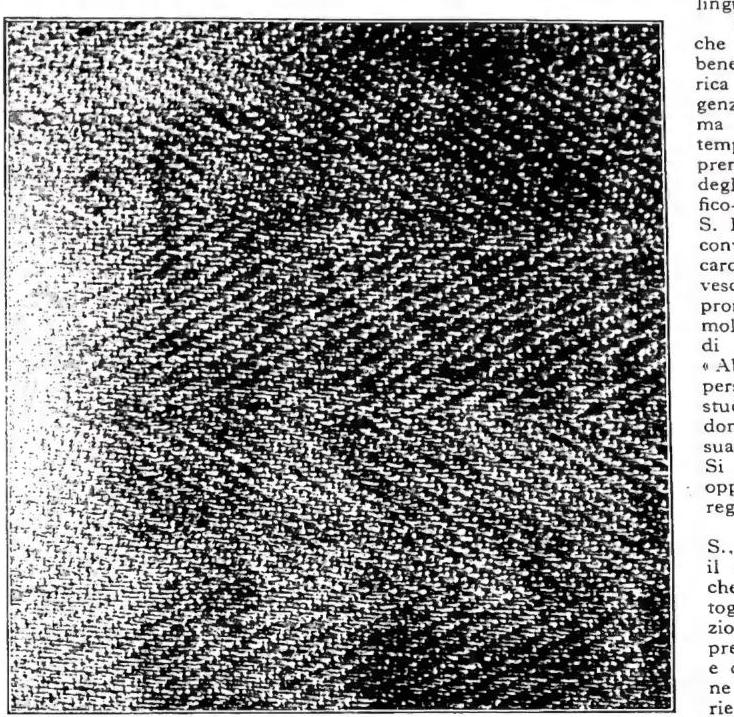
As for the process by which the imprints on the S. were formed, it is less easy to pronounce a definitive judgment. Vignon’s theory was criticized by Dezani and by the present writer (1931–33); Romanese and Judica, through elegant experiments, obtained partial reproductions from a corpse by various procedures, through a kind of contact and using various chemical substances. The difficulty encountered by these scholars in producing these partial reproductions of the imprints nevertheless leads them to declare that providential circumstances must undoubtedly have contributed to the formation of the imprints on the S. The essential circumstance was certainly the Resurrection of Christ; had Christ not risen, the S. would obviously have deteriorated, as always happens with the cloths that envelop buried corpses.
In the scientific-experimental field, only two authors have recently produced evidence against authenticity: Fr. Braun, indirectly, by citing experiments conducted by a Parisian painter, and Dr. Eskenazi of Istanbul; both authors maintain that the S. must have been formed by tracing from a model created by a medieval artist. Thus, from painting (invoked by Pietro d'Arcy), one passes to sculpture. But it is well known that no sculptor could have created such a figure in 1350; the anatomy of the period was infinitely distant from figures such as those of the S.
The only scientific hypothesis that can be formulated to explain the S. is this: that an unknown person in the Middle Ages killed a man in a very specific manner, namely, in a way differing from the common iconographic tradition, with the aim of fabricating a unique relic. It should be noted that the imprints on the S. rule out the case of an ordinary corpse; it is in fact possible to discern on the cloth different imprints of living blood and postmortem blood (Caselli).
The internal examination of the S. therefore proves objectively favorable to its authenticity.
III. THE S. AND HOLY SCRIPTURE. — In discussions concerning the authenticity of the S., recourse was naturally had to the Gospels and, in general, to the biblical passages that might shed some light on the manner in which Christ was buried; but among exegetes one observes a somewhat unedifying disagreement. The central points of the discussion may essentially be reduced to four: a) the distinction between the preparation and the burial of the corpse, with regard to the proper meaning of the verb ἐνταφιάζειν used by the Evangelists (Io. 19, 40; Mt. 26, 12); b) the number and nature of the perfumes employed; c) the number and distinction of the cloths in which the body of Jesus was wrapped; d) how many and which of them were in immediate contact with the sacred remains. On each of these points, here is what the most careful examination of the terms and circumstances, in the writer’s judgment, permits one to affirm with certainty.
a) There can be no doubt that Joseph and Nicodemus followed Jewish customs insofar as the circumstances of time and place allowed. However, the Evangelist’s words (Io. 19, 40), translated in the Vulgate as «scut mos est Iudaeis sepelire», in view of the constant meaning of the Greek verb ἐνταφιάζειν («to prepare for burial, to embalm») and the structure of the sentence, must refer solely to the application of aromatics in treating the corpse. Before applying the aromatics, it was customary generally to wash the corpse, but the Gospels never mention such washing in the case of Jesus; it is unlikely that it was performed, both because of the lack of water on Calvary and because of the excessive time that the special condition of Jesus’ body would have required, lacerated by wounds and encrusted with clots of blood, while haste was necessary and the burial had to be completed before sunset because of the imminent Sabbath rest. The same must be said of cutting or shaving the hair, which was not omitted under normal conditions. Despite these omissions in the preliminaries, the burial properly so called, or interment, could quite well have been—and in the intention of those carrying it out in fact was—complete and definitive.
b) For the anointing of the sacred remains of the Crucified, John gives the specific names of the substances employed, myrrh and aloe (aloe), actually used by Nicodemus; Luke speaks generically of oily ointments (myra) and aromatics (ἀρώματα), purchased by the pious women but rendered useless by the ensuing resurrection. The two terminologies complement each other: myrrh was made into a liquid gum like oil (μύρον); aloe, whether a resin, like ordinary medicinal aloe, or a wood, like aquilaria agalloca (which seems to be the meaning of biblical aloe), supplied a solid perfume (ἄρωμε) in powder form; their mixture (μίγμα according to the common reading in Io. 19, 39) formed an ointment suitable for spreading on the skin and not without effect on the fabrics enveloping the corpse.
c) For these fabrics the Synoptics use a single name, σινδών, s. or sheet; St. John has two terms, ὀθόνας (Vulg. linteamina, linen cloths) and σουδάριον, a Latin word that passed into Greek and the Eastern languages. The same Evangelist uses a third term (Io. 11, 44), but in connection with the burial of Lazarus: χειρίαι, bands or strips. Many modern authors have understood ὀθόνας precisely in the sense of bands; others, instead, identified it with the s. of the Synoptics or regarded the three terms as equivalent. Finally, some maintained the equivalence of sudarium and s. Amid this confused tumult of divergent opinions, a document from around A.D. 320, published only in 1952 in the Catalogue of the Greek and Latin Papyri of the J. Rylands Library in Manchester (vol. IV), appropriately offers a clarifying word. Greek papyrus 627 is a long list (ἀναγραφή) of the personal belongings of an agent of the Roman government in Egypt. Under the generic heading ὀθόναλον (line 9), it records two kinds of φαντάριον (Latin faciale, synonym of sudarium), four σινδόνια (lines 13–17), and an indeterminate quantity of bands or strips (φασκίας, line 41). Here we have all four terms of the Gospels, two with the same Greek word and two with the Latin equivalent; the first, ὀθόνας, indicates a category, linen cloths, while the other three designate three distinct kinds within that category: sheet (s.), sudarium, and bands. This too is the meaning that must be given to these words in the Gospels; indeed, it was already the interpretation given them by the Fathers, for example, St. Augustine (De consensu. Evang., III, 23, end). In conclusion, the Gospel accounts specify two pieces of cloth employed in the burial of Jesus: the s., which enveloped the body, and the sudarium, which covered its head. The bands or strips, though not mentioned, must be presumed, both because of their general use and because they are mentioned in the case of Lazarus, and because of the need to make the s. or sheet adhere to the body of the deceased.
d) It remains to determine the exact position of the cloths on the body of Jesus. This may be conceived in two ways: either the s. surrounded the body only from the feet to the neck, while the head was wrapped solely in the sudarium; or the s. enveloped the entire body, including the head. The example of countless Egyptian mummies brought to light in modern times shows that the general, if not absolutely exclusive, practice was the latter. To keep the outer s. or sheet close to the head, the Egyptians, who did not use a sudarium, passed a band or strip around the neck, just as they used others to bind the trunk and lower limbs. As for Jewish practice, it may be questioned whether the sudarium was applied directly to the head beneath the s., or placed outside, over the s., thereby serving the function of the Egyptian band. The scene of Lazarus’s resurrection, when he appeared to those present with his hands and feet bound with bands and his face wrapped in the sudarium (Io. 11, 44), suggests that the sudarium was customarily placed outside, visible to those looking on.
e) For the question of the Turin s., the testimony of a Gospel that arose on the periphery of the canonical Gospels should not be overlooked. St. Jerome in fact had in his possession a Gospel written in Aramaic and held it in such esteem (he was not averse to believing it to be the original of St. Matthew) that he himself translated it into Greek and Latin. Both versions were lost, but fragments have come down to us, partly in the margins of Greek manuscripts of the canonical Gospel of Matthew and partly in quotations by St. Jerome himself. In chapter 2 of his book De viris illustribus (PL. 23, col. 641, n. 831), the holy Doctor quotes a passage in which it is said that the risen Jesus appeared to James the Less « after having given the s. to the servant of the priest ». The circumstances of time and person leave no doubt that here the s. must be understood as the one in which Jesus himself was buried. Whatever historical authority one may grant or deny to that apocryphal Gospel and its account, it is certain in any event that in the second century, when that writing was already circulating, there were Christians who took an interest in the fate of the Savior’s burial s. and believed they knew with whom it was preserved. Christian antiquity, therefore, is not entirely silent, as has so often been said and repeated, regarding the relic of the holy s. - Vedi tav. XLII. Alberto Vaccari