
ASTRONOMY. – Among ancient peoples, astrology (v.) was the mother of astronomy. Since, according to the common opinion, the fate of human beings depended on the constellations, the positions and groupings of the planets, in order to predict a configuration favorable to an undertaking of some importance it was necessary to observe celestial phenomena assiduously, so as to infer their periodic recurrences. From observations of the sun, the Chinese determined the length of the solar year as 365.25 days, and probably as early as 2000 B.C. they knew the so-called Metonic cycle of 19 years, after which the phases of the moon recur on the same dates of the year. Among the Babylonians, observations began in the 23rd century B.C. and, continued for many centuries, led to the laws governing the movements of the sun, of the
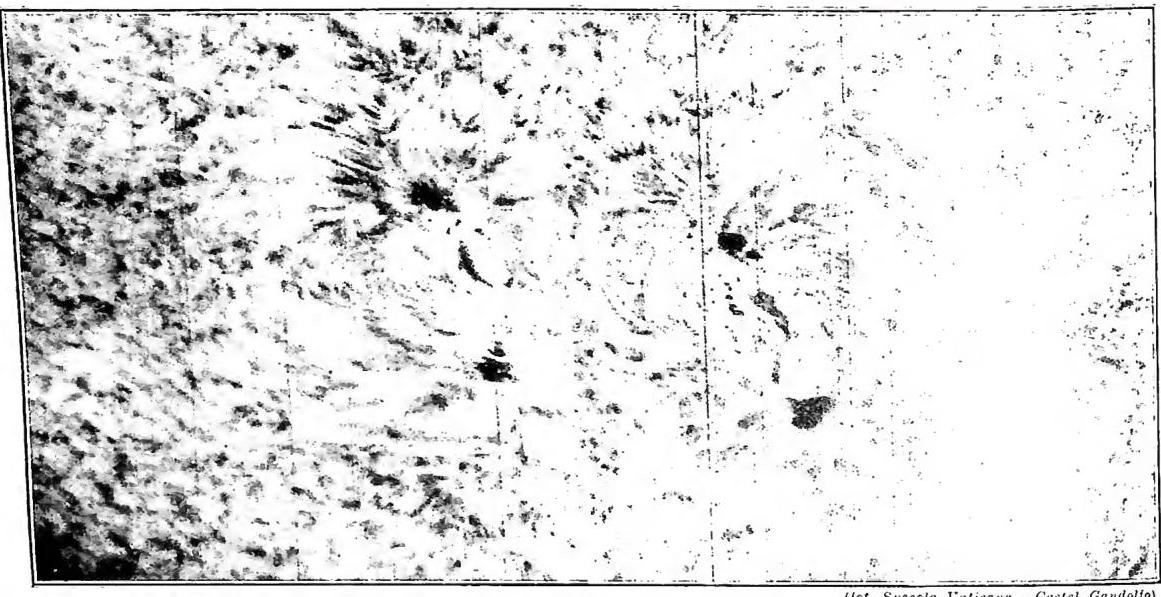
(phot. Sproula Vaticana - Castel Gandolfo)
In antiquity, the absolute immobility of the Earth and its central position in the world were accepted by almost universal consensus. In the 5th century B.C., Philolaus, a native of Taranto, whence he emigrated to Thebes in Boeotia, supposed that a fire was situated around the centre of the world, around which the five planets revolve, followed by the Sun and the Moon, and finally the Earth and, last of all, near the central fire, the Antichthon. The Earth’s revolution around the central fire takes place over the course of one day; and this condition, together with the other—that the face of the Earth is always turned outward—produces day and night, as well as the apparent daily revolution of all the stars, including the Sun and the Moon. Since the Antichthon always remains on the unknown side of the Earth, it is never visible. While Eudoxus (408-365 B.C.) and Aristotle (384-322 B.C.), rebelling against this conception, created the system of the Sun concentric with the immobile Earth, Heraclides Ponticus (4th century B.C.) taught the rotation of the Earth around its own axis and the revolution of Mercury and Venus around the Sun as their centre, anticipating the Tychonian system. Meanwhile, an unknown contemporary of Heraclides noted that the inequalities of the planets produced by the Sun cannot be explained merely by making the planets revolve around the Sun and the Sun around the Earth, but also by exchanging the roles of the Sun and the Earth, that is, by placing the latter among the planets. Thus the idea of Copernicus was fully attained, and was later adopted by Aristarchus of Samos (310-230 B.C.) and by his pupil Seleucus of Seleucia.
Unfortunately, the Greek astronomers after Aristarchus paid no attention to these remarkable advances and stubbornly continued to base their calculations on the hypothesis of an immobile earth. The most celebrated was the great Hipparchus, who applied trigonometry to astronomy and, from his observations (made between 161 and 126 B.C.), compiled a catalogue of 1080 stars. Comparing their positions with those observed 150 years earlier, he discovered the phenomenon of the precession of the equinoxes. Three hundred years later, the work of the observers was brought to completion in the synthesis of the great observer of ancient astronomy, Claudius Ptolemy (v.). In the Almagest, he set forth his geocentric system: the spherical Earth stands immobile at the centre of the universe; around it the celestial sphere rotates in a diurnal motion from east to west; combined with this motion are the various motions of the seven planets: the Moon, Sun, Mercury, Venus, Mars, Jupiter, and Saturn, from west to east on planes approximately parallel to the ecliptic. In order to reduce all celestial phenomena to uniform circular motions, he adopted an extremely complicated system of deferents and epicycles.
Ptolemy’s system remained dominant throughout the Middle Ages. It then collapsed through the work of the great reformer of astronomy, the canon of Frauenburg, Niccolò Copernicus (v.), who in his immortal work De revolutionibus orbium coelestium (1543) placed the Sun at the centre of the planetary system. About 70 years later, Kepler discovered his three laws governing the elliptical motion of the planets, and in 1687 Newton demonstrated that those laws were a necessary consequence of his law of universal gravitation: two bodies attract one another with a force directly proportional to their masses and inversely proportional to the square of their mutual distance.
Descriptive astronomy began with the invention of the telescope at the beginning of the 17th century. Its application to astronomy, first undertaken by Galilei, led to a multitude of remarkable discoveries: the satellites of Jupiter, the phases of Venus, the mountains of the Moon, the spots on the Sun, the stellar composition of the Milky Way, and the appendages of Saturn, whose annular nature was discovered by Huyghens in 1656. He also discovered Saturn’s largest satellite, Titan, followed by the discovery of four other satellites by Cassini (1671-72, 1684). The return in 1759 of the comet of 1682, predicted by Halley, provided the first proof of the existence of periodic comets. Of these, thirty-eight are so far known whose return has been observed, and 27 of them have periods of less than 10 years. When, in 1781, W. Herschel began surveying the sky, he had the good fortune to find the planet Uranus, two satellites of it in 1787, and Saturn’s 6th and 7th satellites in 1789. On 1 January 1801, the Theatine father Giuseppe Piazzi discovered Ceres, the first of that swarm of asteroids between Mars and Jupiter, whose number now exceeds 1600. A new era of discovery began when Leverrier, from the perturbations of Uranus’s orbit, found the planet Neptune by calculation alone (1846); its only satellite was discovered a month later by Lassell. These were followed by Saturn’s 8th satellite (Bond, 1840), two further satellites of Uranus (Lassell, 1851), the two satellites of Mars (Hall, 1877), Jupiter’s 5th satellite (Barnard, 1892), Saturn’s 9th and 10th satellites (W. Pickering, 1898, 1904), Jupiter’s 6th and 7th satellites (Perrine, 1904-1905), its 8th (Melotte, 1908), and its 9th, 10th, and 11th satellites (Nicholson, 1914-38). Finally came the trans-Neptunian planet Pluto, found by Tombaugh (1930) near the position assigned to it by Prof. Lowell in a paper of 1915. A 5th satellite of Uranus was found in 1940 by Kniper.
In 1866 Schiaparelli demonstrated that the swarms of shooting stars in August, called the “tears of St. Lawrence” or Perseids, follow the orbit of the comet of 1862. Likewise, it was found that the Leonids, shooting stars appearing in mid-November, follow the orbit of Tempel’s comet of 1866. Similar connections were found between other swarms and known comets. It was therefore concluded that these swarms are the product of the partial disintegration of comets, whose nuclei consist essentially of a mass of meteorites.
To summarize: the planetary system contains 9 major planets, 30 satellites, more than 1600 asteroids, and 38 periodic comets, in addition to the Sun, whose mass is approximately 800 times greater than that of all the planets taken together. The mean distance of the Earth from the Sun is 149,673,000 km.; that of Pluto is approximately 40 times greater.
The application of spectral analysis to the study of celestial bodies was begun by Fraunhofer and Kirchhoff, the latter of whom in 1861 drew a map of the solar spectrum. Of fundamental importance Secchi (v.), who, after a systematic examination of 4000 stars, reduced their spectra to 4 types—a classification that was soon universally accepted. Spectral analysis shows that the matter of the Sun and stars is identical with terrestrial matter. The temperature of stellar photospheres ranges from 3000 to 23,000 degrees. That of the Sun is approximately 5700°; within it the temperature increases, and at the centre, according to Eddington, it is approximately 40 million degrees, while the central density is 28 times that of water. In that fiery furnace, subatomic processes generate the enormous energy radiated by the Sun, equivalent, per second, to a number of kilowatt-hours written with 21 digits. And yet our Sun, with its diameter of 1,390,000 km., is rather a dwarf star in comparison with the giant stars.
and supergiant stars, whose absolute luminosity surpasses that of the Sun by as much as 20,000 times or more. Giants of enormous dimensions are, for example, Betelgeuse and Antares, with radii respectively 300 and 450 times that of the Sun, that is, equal to one and a half times the semimajor axes of the orbits of Earth and Mars, but with a density of only 1/3000 that of atmospheric air. On the other hand, there are dwarf stars smaller in size than the planet Uranus, indeed smaller than Earth, but with a density more than 50,000 times that of water.
Not all stars shine with unchanging brilliance. More than 9,000 variable stars have already been discovered, some of which vary irregularly, others with more or less regular periods. A distinction is made between short-period variables (from a few hours to two months) and those with long periods (from four months to two years or more). Short-period variation is generally caused either by the mutual eclipses of the components of a binary star or by the pulsations of a star as it alternately expands and contracts. The cause of long-period variations is still unknown. The Sun too, with its eleven-year period of sunspots, is a slightly variable star.
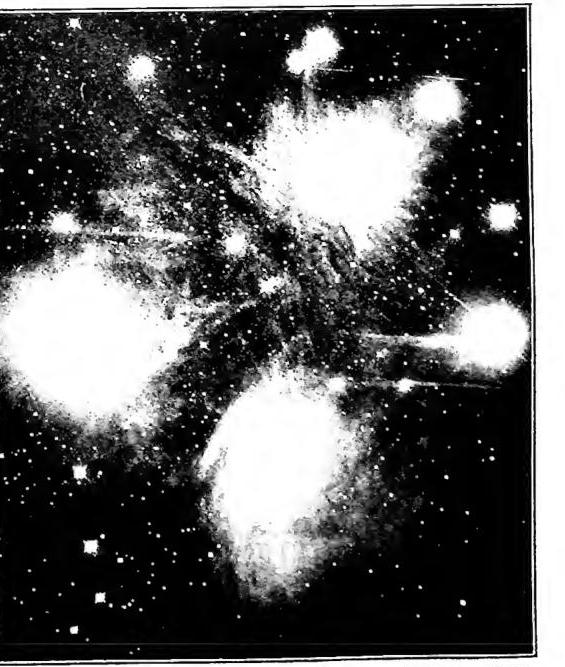
(photograph: Vatican Observatory—Castel Gandolfo)
ASTRONOMIA — The Pleiades enveloped in nebulosity.
The expelled matter then dispersing into space, the brilliance gradually diminishes.
In recent years, while searching the nebulae outside the Milky Way for new stars, a particular kind was discovered, which were called supernovae on account of the intensity of their light, whose maximum is on average equal to 50 million times that of the Sun, varying between 2.5 and 1,100 million times. Thus far about fifty supernovae have been discovered. Probably the famous new star of Tycho Brahe of 1572 also belonged to this class.
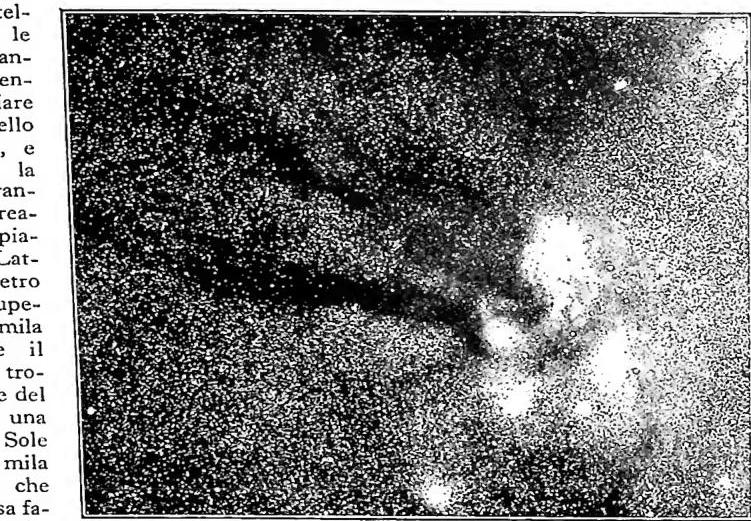
Of the greatest importance was the application of photography to a. It has enabled us to count, measure, and catalogue millions of stars; to determine their positions, magnitude, and movements; to sound the depths of cosmic space; and to admire the marvellous grandeur of creation. Today we know that the Milky Way has a diameter perhaps considerably greater than one hundred thousand light-years; that its centre lies in the direction of Sagittarius, at a distance of approximately 30,000 light-years from the Sun; and that this immense family of stars must be reckoned at several hundred billion stars, a large proportion of which, joined in pairs, threes, or larger groups, describe their orbits as double or multiple systems according to the law of universal gravitation. Our stellar system is a complex of star clusters, loose groupings such as those of the Pleiades, the Hyades, and the Praesepe; of luminous and dark nebulae, masses of gas of unimaginable tenuity or of solid corpuscles, from the tiniest dust particles to fragments the size of a fist and larger; of dark clouds, such as those of the great bifurcation of the Milky Way, which absorb part of the light of the stars behind them; and of about one hundred compact globular clusters, each consisting of some hundred thousand stars. In all probability our galactic system has the flattened shape of a spiral nebula, in which all the stars revolve, over a period of approximately 200 million years, around the central mass, estimated to equal 70 billion solar masses.
Outside the Milky Way there are millions of similar stellar systems: the nearest of these, at a distance of 800,000 light-years, is the spiral nebula of Andromeda, visible to the naked eye as a faintly luminous patch. It has a diameter of at least 50,000 light-years and contains 2 to 3 billion stars. Of such nebulae, with diameters between 10,000 and 100,000 light-years, conglomerations of several billion stars, approximately 30 million are perceptible with large photographic telescopes, with which, after several hours of exposure,
the most distant, up to 170 million light-years away, appear on the plate as barely visible traces. And when the new telescope with a five-metre aperture is ready, the distance to which cosmic space can be penetrated will be doubled again.
A. and HOLY SCRIPTURE. — The sacred authors, having no scientific aims, speak of the world as it appears to the senses and as it was conceived in their time. In the Bible we find no reference to what modern a. teaches us. According to St. Augustine, it was not the Lord’s intention to impart scientific instruction to us, since such knowledge does not contribute to eternal salvation. Cardinal Baronius used to say that God wished to instruct us how to go to heaven, not how the heavens go. References to the heavenly bodies are therefore rare in the Old Testament. The first visibility of the Moon determined the beginning of each month, and this was the sole reference to the heavens made for the purposes of Jewish ritual. But there is a remarkable fact: while in those times, among all the surrounding nations, the heavenly bodies were objects of divination and idolatry, the attitude of the sacred authors in this regard was always absolutely impeccable. And no ancient author can be compared with the great Hebrew authors in spiritual elevation, poetic sublimity, and admiration for the works of the Creator. “In the beginning God created Heaven and Earth”: this is the great truth revealed by God to men, whatever the meaning of the “six days” in which creation was accomplished. “You alone are, O Lord! You made the heavens, the heaven of heavens and all their host, the earth and everything it contains, the seas and all that is in them; You give life to all these things, and the host of heaven adores You” (II Esd. 9:6).
Venus and Saturn are the only planets mentioned in the Old Testament. “How have you fallen from heaven, O Lucifer, who shone in the morning!”: thus Isaiah (14:12) addresses the chief of the demons. And the prophet Amos reproaches Israel: “You have carried the statues of your idols, the star of your god”; in Hebrew: “Kijjūn (Saturn) your idol, the star of your god.”
The passages in which particular constellations are mentioned are:
Iob 9:9: “(God) created the Bear, Orion, the Pleiades, and the recesses of the southern sky.” According to Schiaparelli, the recesses of the southern sky (interiora Austri) refer to a group of brilliant constellations formed by Argo Navis, the Southern Cross, and Centaurus—constellations that were visible in Palestine when the book of Iob was written but are no longer visible because of precession.
Ibid. 38, 31: “Can you perhaps bind together the shining stars of the Pleiades or interrupt the course of Arcturus?” The Hebrew text has Orion instead of Arcturus.
Ibid. 38, 32: “Are you perhaps the one who makes the morning star appear in its time and brings forth the Evening Star over the children of the earth?” The original text instead reads: “Can you bring forth Mazzârôth in its station? Or can you guide 'Ajîš with its children?” Probably Mazzârôth means the planet Venus, and 'Ajîš the stellar group of the Hyades.
Am. 5, 18: “Seek him who created Arcturus and Orion.” The Hebrew text has the Pleiades instead of Arcturus.
II Reg. 23, 5: “(Josiah) exterminated the soothsayers... and those who burned incense to Baal, to the Sun, to the Moon, to the twelve signs (Mazzârôth), and to the entire host of heaven.” Mazzârôth, according to many interpreters, is identical with the Mazzârôth of Iob 38, 32.
These are the only allusions to particular constellations in the Old Testament. They are entirely absent from the New Testament. As for the Star of the Magi, it is enough to pause for a moment over the details of the Gospel account (Mt. 2, 2, 9, 10) to understand that this account intends to present an absolutely miraculous phenomenon, which cannot in any way be brought within the stable laws of a natural, albeit rare, heavenly body (G. Ricciotti, Vita di Gesù Cristo, n. 174; cf. n. 253). - Vedi Tavv. XXIII-XXIV.