
BARONIO, CESARE, venerable. — Eminent cardinal and historian, born at Sora on 30 October 1538, he began his studies at Veroli, continued them at Naples on 29 October 1556, enrolling in the Faculty of Law, and pursued them at Rome in 1557, enrolling at the Sapienza.
At that time the spiritual movement of s. Filippo Neri was already flourishing, centered in the church of S. Girolamo della Carità, in the Rione Regola. B. decisively joined this movement, and this event had capital importance in his life, since it determined his vocation and scholarly career and secured his success under the prestige and wise counsel of s. Filippo.
A year later, in 1558, at the insistence of s. Filippo himself, who had perceived his great abilities, B. began to narrate, although at first reluctantly, the history of the Church in the small room of the church of S. Girolamo itself, which still preserves its original name of oratory, the meeting place of a group of intellectuals and spiritual men. This narration was the seed of the Annales Ecclesiastici, begun and developed through the living unfolding of the spoken word.
While leading an entirely ascetic life of prayer and works of charity, he entered the sacred Orders in 1560. In order to appease his father, angered by his ecclesiastical vocation, he obtained doctorates in utroque on 20 May 1561 and was ordained a priest on 27 May 1564. Continuing steadily for years to narrate ecclesiastical history, with an increasingly broad design and ever richer documentation, he soon attracted attention and came into contact with the most learned men of his time in Rome, among them Cardinal Sirleto, around 1577.
At this time the material for B.’s principal work, the Annales Ecclesiastici, had been largely collected; indeed, vol. I appeared in 1588 under the title: Annales Ecclesiastici auctore Caesare Baronio Sorano Congregationis Oratorii Presbytero. The other 11 vols. followed in sequence up to 1607. They recount, year by year, the history of the Church up to 1198.
The work had been occasioned by the Ecclesiastica historia integrum ecclesiae Christi ideam complectens, congesta per aliquot studiosus viros in urbe Magdeburgica, which appeared in 13 vols. at Basel in 1559–74 and in which history was divided by centuries. It was the work
of the learned Protestant Matthias Vlacic (Flacio Illirico), who, with the collaboration of others and with the aid of documents, intended to provide the Reformation with a scholarly foundation. The publication had aroused a broad response, and on the Catholic side the need had been felt not to fall behind in the scholarly field; for this reason the pontiffs Pius IV, Pius V, and Gregory XIII, and men such as Panvinio, Sigonio, and Canisio, had worked toward this end, though without addressing the problem in all its complexity.
S. Filippo Neri, aware of these anxious and insufficient efforts and of the urgency of the task, found the suitable instrument in B. and induced him to undertake the great labor. B. himself, in vol. VIII of the Annales, gave Neri this testimony.
The Annales enjoyed great success, which remained unchallenged for a very long time. There were 21 editions up to 1756, and another edition in France from 1864 to 1887. There were also partial editions, abridgments, and translations into Italian, French, German, and Polish.
There could be no lack of someone to continue the work B. had left unfinished. The continuation by the Dominican A. Bzowski extends to 1572; that by the French bishop E. De Sponde to 1646; and finally, that much more important continuation by O. Rinaldi of the Vatican Archives extends to 1565 and made use of the material collected by B. G. Laderchi continued Rinaldi’s work up to 1571, followed from 1572 to 1585 by A. Theiner; all three were Oratorians. The Conventual friars Antonio and Francesco Pagi published, in four volumes, a highly esteemed Critica historica chronologica in universos annales eccles. C. B., Antwerp 1705. This work was added to the new edition of the Annales produced at Lucca by Archbishop Mansi in 1738–56. With
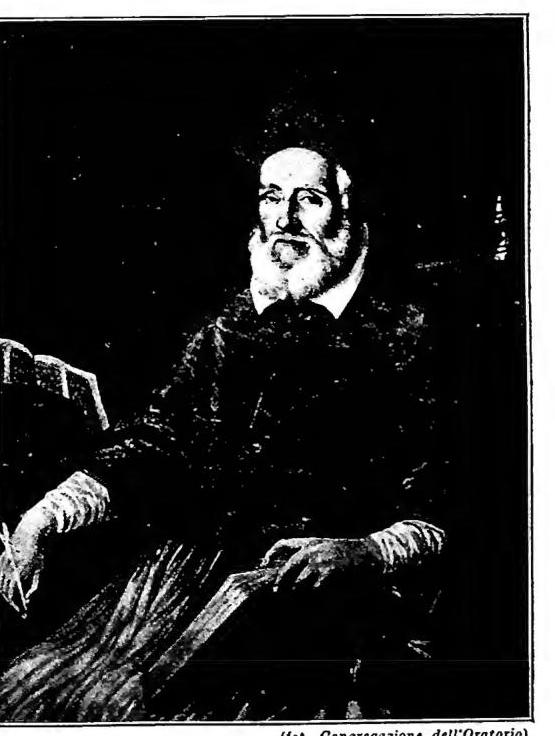
(photograph: Congregazione dell'Oratorio)
BARONIO, CESARE — Portrait from the Roman school (17th century) at the Filippini Fathers — Rome.
The Protestant writers, such as Casaubon and Basnage, undertook the criticism of B. in an entirely different spirit, in order to discredit his authority.
Four centuries after the first edition, B.’s work no longer renders scholars the services it rendered his contemporaries. The criticism of today, so highly developed, was scarcely in its infancy in B.’s time, especially in the field of ecclesiastical studies; he practiced it as the times and the means permitted him—ample indeed, but often insufficient for the undertaking.
At times the historian allowed himself to be overruled by the apologist, as in the question of the «Sicilian Monarchy» and in a few other matters of secondary importance. But it must immediately be added that the fabric, design, and development of B.’s labor—in short, its substance—remain intact even today in their fundamental value, and above all there remains the central motive of the work: namely, the idea that Catholic doctrine has undergone no changes in its essence.
The documentation is abundant, at times even excessive for the subject, and to procure it B. spared no effort in the Vatican Library and requested manuscripts even from far away. Thus his critical arrangement, insofar as it was permitted by the chosen method of narrating year by year—which, moreover, was traditional—marks a great historiographical advance.
B. also brought to his work a scrupulous honesty, which no one ever called into question, not even determined adversaries such as Sarpi. He considered it «sacrilege» not to transcribe a text in its proper terms and, while preserving its substance, to alter its form for literary reasons, as he once reproached a man who had done so while correcting the proofs of the Annals.
On 9 Sept. 1598 he wrote to his confrère Talpa: «I fear that, because I am a cardinal, there may not be, as before, such strict censors to correct my writings as I desire them to be... Let them spare me nothing... Now more than ever is the time for my writings to pass through the alembic and the fine sieve». In a controversy concerning St. Gregory the Great, he had a pamphlet published under the name of his confrère Gallonio, so as not to weigh upon the question with his authority as a cardinal. He was therefore quick to recant whenever he had fallen into error. At times he errs through an excessive love of exactness. Thus in the intricate question of chronology, in which he forcibly sought to make profane chronology and ecclesiastical chronology proceed hand in hand and thereby establish secure milestones.
His great gift for erudition is remarkable and indisputable. Muratori not only calls him «the great cardinal, — a marvelous intellect — immortal», but enters into the merits of the work and writes: «I never take his sacred Annals in hand without admiring that great intellect which was able to construct from the ground up so majestic an edifice, with such erudition and such fine criticism, although at that time so many aids that we now possess were lacking» (letter to Bianchini, 21 May 1735). Alfredo di Reumont states that B. «was the first to clear the ground of ecclesiastical history».
In addition to the abundant material he left and other writings of no great importance, B. composed the lives of St. Ambrose and St. Gregory Nazianzen, the former published in 1587, the latter left unpublished and then included by the Bollandists in their work, and subsequently printed by Alberici. In these lives the same critical sense found in the Annals is evident, and Calenzio rightly says that they are the first hagiographies in the modern sense of the word.
B.’s correspondence is extremely interesting; it also contains very many letters from great personages addressed to him. It was published in 3 vols. by R. Alberici: Epistolae et opuscula inedita, I and II, Rome 1759; III, ibid. 1770.
B.’s scholarly position also determined his rapid and brilliant hierarchical career, in which he brought great advantages to the Church. In 1593, after the resignation of St. Philip, he was elected provost of the Congregation of the Oratory, and in 1594 confessor to Clement VIII.
This latter promotion would not in itself have possessed historical importance had it not provided the occasion for a political action of universal significance. The question of the reconciliation of Henry of Navarre with the Church was then burning, so that he might be elected king of France. The Spanish party, extremely powerful in Rome, obstructed such a reconciliation for political reasons.
There was also great division within the Roman Curia itself and among the cardinals. B. intervened decisively and contributed effectively to the reconciliation that took place in 1595 and saved Europe and France from greater divisions. His elevation to higher offices was rapid: B. was appointed apostolic protonotary on 21 Nov. 1595; cardinal on 5 June 1596; and librarian of the S.R.C. in 1597. At his appointment as cardinal, B. chose as his titular church that of SS. Nereus and Achilleus, which everyone had refused for a long time because it was almost in ruins and would therefore have required extensive repairs and personal expenditure.
B. accepted it freely for precisely this purpose, had it restored from the foundations and decorated, at enormous sums for those times, even incurring debts. He thus saved one of the most ancient monuments from irreparable ruin. It was also he who, having become commendatory abbot of S. Gregory on the Caelian, promoted the first restoration works. His role in the struggle against opponents of ecclesiastical jurisdiction was notable, particularly on the occasion of the Venetian interdict under Paul V; he then published the Paraenesis ad Rempublicam Venetam (Rome 1606) to withdraw it from the course it had taken. He showed equal zeal against attempts to promote less worthy persons to ecclesiastical dignities and the cardinalate. Instead, it was he who proposed Bellarmino to the Pope and urged his appointment as cardinal.
But B.’s work, personality, and holiness shone forth especially in the two Conclaves of 1605. In the first, which opened on 14 March, B. managed to obtain as many as 32 votes, but could not secure the few additional votes lacking because of the firm opposition of the Spanish party and the exclusion imposed by Spain following the publication of the «Sicilian Monarchy». After the newly elected pope, Leo XI, died a few days later, in the following Conclave, opened on 8 May, Cardinal Tosco was about to be elected pontiff. He was a highly learned man, especially in law, but not equal to the great dignity, above all because of his great freedom of speech. B., remaining the sole opponent, went out to meet the procession of cardinals that was proceeding to proclaim the candidate and spoke so effectively that the agreement previously reached with difficulty was broken.
At the proposal of Cardinal Montalto, who had reluctantly consented to Tosco, B.’s name was put forward once again. A large number of cardinals then tried to drag him toward the Pauline Chapel for the adoration customary at elections, but B. resisted, «clinging with his feet and hands to the columns and doors, shouting: I do not wish to be pope: elect another pope worthy of the Holy See» (letter from Cardinal de Joyeuse to Henry IV of France).
Although ill and old, B. continued to work intensely not only on the Annals but on everything that might be useful to the Church. He immediately grasped the scholarly importance of sacred archaeology, which was coming into being precisely in those days with the discovery of the cemetery at Vigna Sanchez on the Via Salaria; he visited the holy places and took part in scholarly meetings. Indeed, the Pontiff delegated him to identify the remains of St. Cecilia in Oct. 1596.
He was also involved, at the commission of Paul V, in the reform of the Roman Ritual; in Florence he had the image of the legendary Pope Joan removed from public display, energetically intervened in writing on the question of the Venetian interdict, and occupied himself with the reform of the Premonstratensians.
He died on 30 June 1607 and was buried in the Chiesa Nuova, beside the high altar. Henry IV, who had also appealed to B. on other matters, ordered a funeral upon the cardinal’s death and attended it personally, in recognition above all of the major role he had played in Henry’s reconciliation with the Church.
If through his work he rendered the Church a great service, still greater was that which he rendered it through the holiness of his austere and penitential life, wholly devoted to charity toward the poor and the unfortunate, and free from ambition and nepotism. Benedict XIV declared him “venerable” (18 January 1745).
B.’s outstanding scholarly stature gave rise within the Congregation of the Oratory to a broad historical movement and created a fine tradition of historical scholarship. Besides the later continuators of the Annals already mentioned, we recall here Gallonio, Severano, Bozzio, and Marciano, who left important writings of a historical nature.