ASTROLOGIA

ASTROLOGY. – It is the art of knowing the future by observing the aspect, position, and influences of the planets and constellations.

1. HISTORY

Such an art was, to varying degrees, the heritage of all peoples, both civilized and primitive, and was, from the earliest times, closely linked to religion. The testimony of Diodorus Siculus received, in the second half of the last century, singular confirmation when a series of excavations on the soil of ancient Nineveh brought to light the library of King Ashurbanipal (c. 668–626 BC), composed of about 4,000 tablets written in cuneiform characters, containing original texts, astrological predictions, and exegetical inscriptions. The doctrinal part of this library refers back to a general work, titled, from the opening words of its first sentence, “When Anu, Enlil...,” and whose author, certainly dating back beyond the 6th century BC, remains unknown to us. We are, however, informed by the preserved astrological predictions of the astronomical knowledge of the Babylonians-Assyrians and of the objects toward which their inquiry was directed. In addition to the seven planets, 270 stars and constellations were known (there is a single term in the texts to denote both), the symbols of the Zodiac (v.), (from the Epic of Gilgamesh up to the Seleucid and Arsacid eras numbering 11, since the Scales were considered the claws of the Scorpion) and comets. Such a vast and precise body of astronomical knowledge gave great impetus to the art of predicting the future from the course of the stars, from the observation of celestial and atmospheric phenomena. The observations were systematized by the Babylonian priests, who formed a hereditary class whose progenitor was Eumendmanki, the seventh of the antediluvian kings according to the list of Berossus, who, in turn, would have been initiated into the art of divination by Shamash and Adad. These priests, who had the precise duty of watching the sky from the observatories of Nineveh and Borsippa, considered the planets to be personifications of their deities and followed the occurrence of solar and lunar eclipses. The predictions thus had an official character (they concerned mostly the king and the fate of the country) and were in close relation to religion. The method of astrological inquiry included the observation of the intensity and color of the light of the star or planet at dawn and dusk, their conjunction with other planets, etc. While these data concerned the moon, the sun, and Mars, for the remaining planets attention was given more to their conjunction with other planets; comets, meteors, winds, and storms were also considered dependent on the planets and stars. The extraordinary simplicity of the language in which the astrological predictions are expressed has led some to think that in these cases Babylonian is the translation of analogous predictions in Sumerian (thus of a non-Semitic people), which would push the origin of astrology back to the threshold of the 3rd millennium BC.

Starting from the 6th and 5th centuries B.C., astrology began to spread from Babylon: first to Persia (frequent allusions in Sassanid literature show that astrologers made calculations regarding the propitious or unfavorable conjunction of the stars), then to India (whence it spread throughout Asia, especially after relations between India and Greece, which had by then matured in this science, gave a more scientific character to knowledge), and finally to Greece.

Prior to the Hellenistic age, Greek culture does not seem to have taken kindly to astrology. In the Cretan-Mycenaean age, symbols of the sun, moon, and stars do not appear frequently, at least according to the results of archaeological research. In epic poetry, only Venus seems to be known, as evidenced by Homer’s frequent references. With the beginning of Ionian speculation, the teachings—direct or indirect—of the East began to bear fruit: Thales and his successors knew
Article illustration
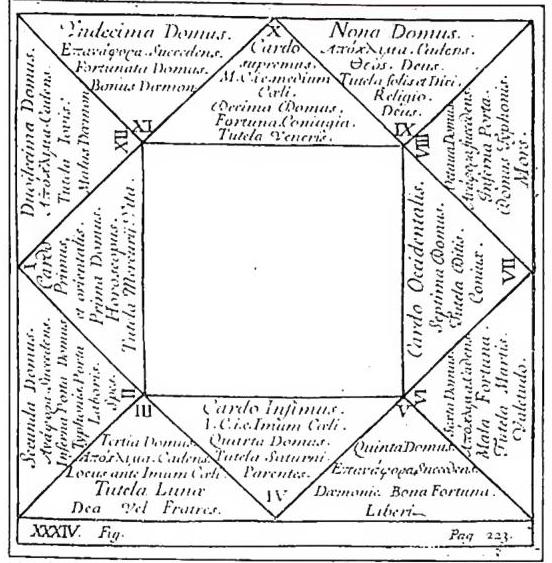
(from M. Manilius, *Jelennawiann*, ed. Fariqi 1872, p. 175) Astrology - Quadrature of the twelve celestial houses or mansions to determine the influence of the planets and constellations.

the origins, closely connected with astronomy, so much so that in the Mediterranean world a distinction began to be made only gradually. The translation of small Babylonian texts aided the work of Berosus. “The seed fell on fertile ground: astrology, long confined in a hieratic tradition, began to submit to discussion, troubled and transformed by the inventive genius of the Greeks, and at this time, the early 3rd century, it passed from an Oriental religion to a science.” A science that found its support in the philosophical doctrine of cosmic unity, according to which the universe, composed of four or five elements (water, earth, air, fire, and aether), is subject to a continuous exchange of actions and reactions among them. In this system, astrology was united with other pseudo-sciences—alchemy, astrological medicine, magic, etc.—that is, with those occult sciences (cf. occultism) which would hold sway until the end of the Renaissance. Man, too, compared to a microcosm (μικρός κόσμος), was the stage for this process of exchanges, and in some texts every part of the human body was under the influence of an element, a planet, or a celestial body. In this way, an even more fantastic mythology than that of tradition was created. Natural laws, subjected to such influences, were no longer intelligible through reason but required a particular occult science, not devoid of religious coloring. Henceforth, there was no longer a distinction between science and religion, where the unity of the whole was not an order of formulas or a system of laws, but a unity of concrete things.

Violent polemics also attended the art in antiquity: Carneades deployed all his dialectical skill to refute its possibility; Panaetius, by contrast, broke with his master on this point and granted his favour to the new science; and even more so did Posidonius of Apamea. The disputes may be said to have closed when, around the mid-second century AD, there appeared the Tetrabiblos or Quadripartitum, the famous work of Ptolemy, a product of the progress of astrology and mathematics in the school of Alexandria.

At Rome astrology appears at the time of the Punic Wars. It was brought by Eastern slaves, mostly Greeks. The Roman Senate, jealous guardian of civic tradition, opposed astrology, as it did all foreign cults which, beginning at this period, began to infiltrate Italy. The chief opponents of astrology were the haruspices, and numerous are the edicts forbidding the practice of the Chaldean art. Yet astrology made its way: by the end of the Hellenistic age the legions of Caesar carried to every place the symbol of the Bull, the zodiacal sign of Venus, the ancestress of the ‘gens Iulia’; while Augustus published his horoscope and had coins struck bearing the star of his nativity, the Goatfish. The triumph of astrology may be said to be complete when the Oriental cults, above all Mithraism, prevailed over the ancient Roman religion. Marcus Manilius, in the age of Augustus and Tiberius, wrote the poem Astronomicon; astrologers are found beside the emperors as counsellors, most famous among them being Balbillus, Nero’s astrologer, who attempted to reconcile astrology with haruspicy. Cicero, Tacitus and Pliny the Elder took their stand against astrology, which found favour instead with Seneca.

Christianity opposed the Chaldean art strenuously, combating it on moral grounds as a diabolical art. It is obvious, moreover, that astrology degenerates into a form of superstition when from the position and movement of the stars one seeks to deduce with certainty the course or outcome of events which are the product of the free will of men; it ceases to be such, however, when it confines itself to formulating conjectures, taking into account the undeniable influence which the stars exert upon the earth, upon living organisms and hence, by reflection, upon the human soul (v. HOROSCOPE; ZODIAC).

Article illustration
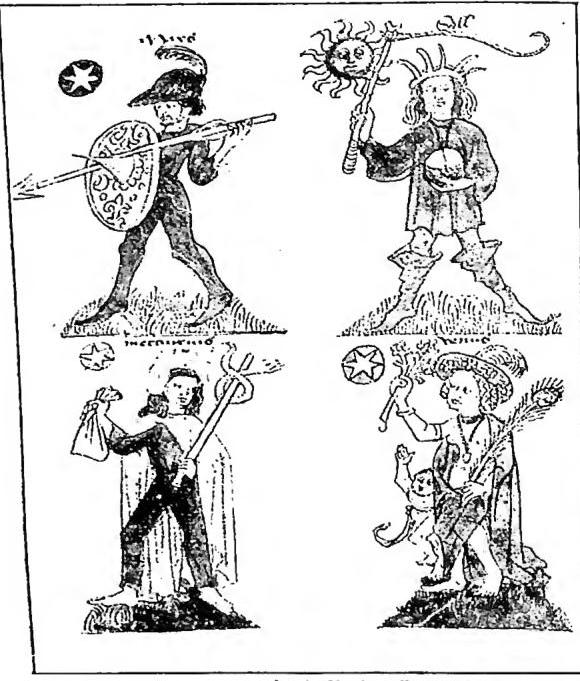
(from D. Haeber, *Pferdesternbilder u. Sternbilder*, Strasbourg 1910)

Astrologia - Figurations of the planets: Mars, Sun, Mercury, Venus. Fifteenth-century manuscript - Tübingen, University Library.

A good soil in which to flourish the art found in Islam: Muḥammad himself first taught absolute dependence on God and the complete slavery of man, thereby giving rise to an unlimited determinism; moreover, the star-worship of ancient Arab paganism continued to exert its influence. The abundance of astrological writings in Arabic is prodigious. Theophilus of Edessa, astrologer at the court of Caliph al-Mahdī, asserts that the art is the queen of the sciences, while Avicenna rails against its futility. The positive and enlightened tendency of Arab philosophy, which is linked to Averroes, was instead favourably disposed toward II. In Italy we find the University of Padua with Peter of Abano and Cecco d’Ascoli steeped in astrological doctrines, and at the court of Frederick II Michael Scot professes a mitigated astrologism according to which the stars are signs of events. Meanwhile, in the 13th century, Guido Bonatti is renowned for serving Guido da Montefeltro, ascending the tower of S. Mercuriale in Forlì before every military action to consult the stars.

Humanism and the Renaissance held the art in high esteem. “No wonder when one considers that the art found its place in the ideal, then professed, of a human nature that lives in full harmony and active exchange of influences with the rest of nature; everywhere in the world energies analogous to those of man are recognised. The human spirit operates with marvellous efficacy and purpose upon its own body; so it acts upon others, and these, in turn animated, among themselves and the world-soul upon all. The heavens, therefore, act upon the earth.” And this philosophical motif unfolds at a moment of passivity and heteronomy that finds its expression precisely in the art, which makes human life determined by the stars, enslaved to conjunctions and oppositions beyond its power. From this point the art splits into natural (astronomy) and judicial. All universities have a professor of the art. Yet there were no lack of opponents: Pico della Mirandola, for example, with his *Disputationes in astrologiam*, which, drawing partly on the authority of the Fathers of the Church and partly on experience, rails against the art that “corrupts philosophy, adulterates medicine, undermines religion, produces and spreads superstition, fosters idolatry, makes men wretched, anxious, fatalistic, and from free men makes them slaves and unhappy in all their actions.” Other adversaries of the art are found in Girolamo Savonarola (*Adversus astrologos*) and Geminiano Montanari (*L’A. convinta di falso*). Nevertheless Pope Julius II commissioned astrologers to choose the day for his coronation, Paul III to determine the best hours for each consistory, and Leo X even appointed a professor of the art at the Sapienza.

But these were the last glimmers. With the development of the experimental method, astrology began to lose ground, and by the early 18th century it was completely neglected. A revival was attempted by occultists at the end of the 18th century, but at that very time the discovery of two new planets, Uranus and Neptune, overturned all astrological postulates, marking its end.

The main forms of astrology cultivated by the Greeks in the 1st century, and then, with some changes, flourishing until the late Renaissance, were, according to Nallino, the “system of interrogations,” to satisfy the needs of daily life; the “system of elections,” to determine the propitious moment for beginning an action; and the “system of nativities,” aimed at knowing the future events of persons, peoples, cities, etc., by studying the influence of the constellation and the planet that at a particular moment was on the eastern horizon, according to the indications of the astrologer. Such an operation was called “ascendant” or, in Greek, “horoscope” (q.v.). In casting the horoscope, one had to carefully observe in which sign of the zodiac (q.v.) the planets appeared, their influence varying from sign to sign, and which constellations and planets then dominated the sky.

BIBL.: A. Bouché-Leclercq, *L'Astrologie grecque*. Paris 1899; *Catalogus codicum astrologorum graecorum*, ed. F. Cumont, F. Bell, W. Kroll, etc. Brussels 1899 ff.; F. Boll, *Sphaera*, Leipzig 1903; F. X. Kugler, *Sternkunde und Sterndienst in Babel*, Münster 1907 ff.; F. Cumont, *Astrology and Religion among the Greeks and the Romans*, New York 1912; F. Saxl, *Beiträge zu einer Geschichte der Planetendarstellungen im Orient*, in *Der Islam*, 3 (1912) pp. 151–74; L. Thorndike, *A History of Magic and Experimental Science*, New York 1923; F. Boll, C. Bezold, W. Gundel, *Sternglaube und Sterndeutung*, 4th ed., Leipzig 1931; F. Boll and W. Gundel, *Sternbilder, Sternglaube und Sternsymbolik bei Griechen und Römern*, in Roscher, *Lexikon der Mythologie*, VI, Nacht. A–Z, cols. 867–1071; A. J. Festugière, *La Révélation d’Hermès Trismégiste*, Paris 1944, passim. Mario Camozzini

2. ASTROLOGY AND THE CHURCH

To form a correct judgment on astrology and understand the reasons for the Church’s intervention and the condemnations it issued, one must distinguish two kinds of astrology: natural and judicial. Both aim at the prediction of future events; but whereas natural astrology is based on the logical and scientific search for and conquest of the physical laws of the universe, judicial astrology claims to determine the influences of the heavenly bodies on earthly beings and especially on man, formulating, by means of certain rules, conclusions about the various fates of individuals and peoples by simply considering and calculating the configuration and position
Article illustration
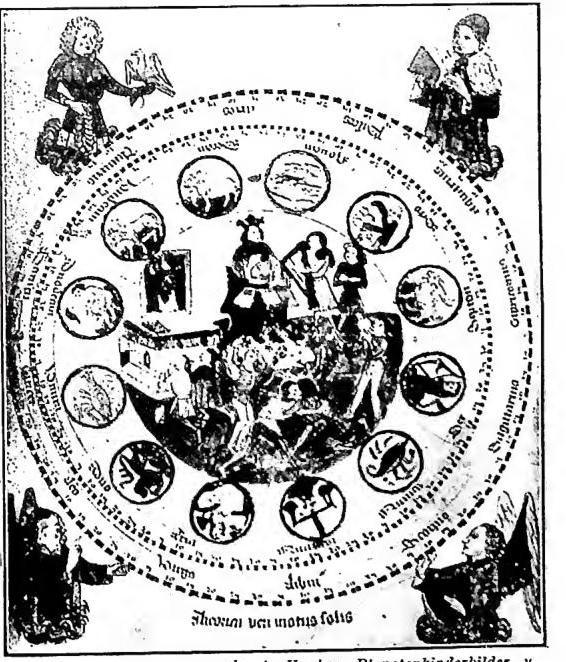
(from A. Hauber, *Planetenkinderbilder und Sternbilder*, Strasbourg 1918)
ASTROLOGY — The Sun and the zodiacal constellations and their influences on men — Manuscript from the 15th century — Erfurt, Municipal Museum.

V. ASTROLOGIA
Astrology — Sun and zodiacal constellations and their influences on men — Manuscript from the 15th century — Erfurt, Civic Museum.

The astrologers of antiquity and the Middle Ages believed that the stars and planets exercised an influence on the life of man, and that this influence could be determined by the position of the planets at certain specific moments of his life (e.g., birth, marriage, commerce, war, etc.). Thus astrology entered the field of morality and religion, inasmuch as it taught that this influence was a determining and decisive factor in history, in life, in human actions, and consequently also in the very economy of man’s eternal salvation. “The astrologers,” attests St. Augustine, “claim that in the heavens there is the inevitable cause of sin: it is Venus or Saturn or Mars that has made us perform this or that action, thus seeking to absolve man, who is but flesh and blood and worm of pride, from guilt, and to lay the blame upon Him who created and rules the heavens and the stars” (Confess., IV, cap. 3).

Now the Church, while never having had nor ever having anything to say against natural astrology, because true science will never find anything in its researches that is contrary to religion, could not but intervene, and even energetically, against judicial astrology, because this ended by denying on the one hand man’s free will and on the other God’s providence and salvific will, casting souls into the grip of a desperate fatalism.

The pagans themselves, who in view of the scientific knowledge of their time could hardly distinguish between true science and superstitious imposture in this field, and who therefore called astrologers indifferently by the various equivalent names of astronomers, astrologers, mathematicians, planetari, genethliacs, Chaldeans, Babylonians, expressed words of scorn and contempt for the practices of judicial astrology. “Mathematici genus hominum potentibus infidum, sperantibus fallax” (Tacitus, Hist., I, 22). And Cicero: “Contemnamus Babylonios et eos qui ex Caucaso, coeli signa servantes, numeris et motibus stellarum cursus persequuntur; condemnemus hos aut stultitiae, aut vanitatis, aut imprudentiae” (De divin., I, 19). In the same sense, but for higher motives, Holy Scripture: “Turn not to the wizards, nor consult the soothsayers, lest you be defiled by their contact: I am the Lord, your God” (Lev. 19, 31). “Fear not the signs of the heavens, which the gentiles fear, for the rites of the peoples are vain” (Jer. 10, 2; cf. also Is. 47, 13).

When Christianity appeared and the tenacious practices of judicial astrology persisted, ecclesiastical tradition shows us the Fathers and councils ever hostile to this kind of superstition. It suffices to cite St Augustine: “In my affairs, in my sins, I do not accuse fortune, I do not say: ‘this was done to me by destiny,’ I do not say: ‘Venus made me a thief, Mars made me a thief, Saturn made me avaricious’” (Enarrationes in psalmos, 40, 6). “This man, the astrologer converted, seduced by the enemy while still a believer, had long been an astrologer, seduced and seducer, deceived and deceiver. He lured, he deceived, he uttered many lies against God, who would have given men the power to do good and not to do evil. Adultery is not committed by my personal will, but by Venus; murder is not committed by personal will, but by Mars; the just man is not made by God, but by Jupiter; and many other sacrilegious absurdities. How many Christians did he rob of their money! How many bought lies from him!” (ibid., 61, 23). One may add the anathemas launched by the Council of Toledo in 447 (Denz-U, no. 35) and by the Council of Braga in 561 (ibid., no. 239); the condemnation by Sixtus V with the bull Caeli et terrae Creator of 5 January, later taken up and expanded by the bull of Urban VIII Inscrutabilis iudiciorum of 31 March 1621.

The condemnations did not alter the state of affairs; the disputes at the University of Paris, which in 1210 and 1215 forbade the Metaphysics of Aristotle when interpreted in favor of judicial astrology (H. Denifle, op. cit. in bibliography, pp. 70–79), and the later condemnation of 1277 of several propositions favorable to the same doctrine (ibid., p. 543 ff.), far from extinguishing the controversy, kept it ablaze; and the ranks of the professors continued to be divided into two opposing camps. It must however be noted that some of them, though favorable to judicial astrology, remained on this side of the line that separated them from superstition.

S. Tommaso followed a more moderate and almost prophetic middle path, which would later also be taken by Dante. His doctrine, expounded in the Sum. Theol. (1ª, q. 65, a. 4; q. 70, aa. 1, 3; q. 115, aa. 3, 4, 6; 1ª-2ª, q. 9, a. 5), in the Summa contra gentes (III, qq. 84-85), in the De sortibus and in the De iudiciis astronum, can be summarized in the following points: 1) the influence of the celestial bodies is exerted upon the intellect and the will only indirectly and mediately, through the varying participation that the lower faculties (sensibility) offer to that influence, being bound to the corporeal organism; 2) yet the intellect suffers the repercussion of every kind of disturbance that arises in the imagination, instinct, or sensitive memory, while the will always retains the power to resist and oppose the passions; 3) the wise man can even dominate the stars; 4) inclinations, having their seat in the organism, can under the influence of the stars in turn affect the character of individuals and cause one, for example, to be more prone to anger or concupiscence; 5) the influence of the stars varies with the changing dispositions of the subject who receives it; 6) it may be that when astrologers foretell the future, this does not happen by mere chance, but because they have obeyed a kind of subconscious instinct, “instintu quodam occultissimo, quem nescientes humanae mentes patiuntur” (Sum. Theol., 1ª-2ª, q. 9, a. 5, ad 3); 7) in all cases, it must always be held that the will remains free to follow or not the influence of the stars in its actions. Man therefore retains his full responsibility.

This is philosophical and theological doctrine to be upheld so as not to fall into the heresy that denies freedom and Providence. As for the theoretical part, namely the reality of the influence of the celestial spheres, it must be said that, as it stands, it is no longer admitted by science. Yet it remains true that a relationship exists between the material part of our being and the environment in which we live, and that the stars exert upon us, through their mass, temperature, or radiations, a certain action more or less definite or definable. With this we are far removed from the pretentious body of doctrine of the astrologers, who wish to establish precise relations between celestial phenomena and all the actions of our life.

As regards medicine, on the other hand, the Church was much more liberal in its concessions, allowing the practice of astrology in medicine as well as in navigation. We can observe this from the Summula Caietana (one of those compendia used for the practice of confession, Venice 1572, but reprinted many times): “... de astrorum autem iudiciis circa corporales effectus (puta sanitatis vel infirmitatis, fertilitatis vel sterilitatis, pluviae vel siccitatis) nulla est quaestio, quia haec absque peccato fiunt; quoniam effectus quaeruntur et reducuntur in suas causas naturales” (p. 25).

Some have wished to see in the journey of the Magi, prompted by a star, a confirmation of astrology. But this cannot be; both because in astrology a particular star is never given a special significance regarding human destiny, but certain stars and constellations are considered in their reciprocal positions, and especially because the star of the Magi moved with them, disappeared and reappeared, and stopped over the dwelling of Jesus.

Bibl.: F.L. Ferraris, Prompta bibliotheca canonica, juridica etc. I. Paris 1852, cols. 885-96; H. Denifle, Chartularium Universitatis Parisiensis, I, ibid. 1887; A. Graf, Miti, leggende e superstizioni nel medioevo, Turin 1892, pp. 271-300; H. O. Voigt, Die Geschichte Jesu und die A., Leipzig 1911; T. Pégues, Commentaire français littéral de la Somme Théol. de s. Thomas d’A., V. Paris 1925, pp. 569-82; P. Choisnard, S. Thomas d’A. et l’influence des astres, ibid. 1926; G. Plank, A. als Tatsachenforschung, in Hochland, 25 (1927-28, 11), pp. 406-18; R. Pasteris, A. e libertà nella Divina Commedia, in Scuola Cattolica, 6a serie, 14 (1929, 11), pp. 348-58; 15 (1930, 1), pp. 37 seq., 119 seq., 397 seq., 438 seq.; 16 (1930, 11), pp. 93-118; R. von der Eest, V. O. Ocrutisme, in DFC, III, cols. 1130-32; M.-M. Gorce, s. V. in DHG, IV, cols. 1234-51, with extensive bibliography.

Celestino Testore

3. A. IN SACRED ART. — As has already been seen, the Church was entirely opposed to every kind of superstition, and in particular to the fatalism inherent in astrological doctrine, yet it did not prevent the elements of the astral world from completing the mirror of human life and from appearing in the decorations of sacred buildings. Already the miniatures of the Chronography of 354 had presented astrological allegories of classical inspiration, which were reproduced again and again in the following centuries, with slight variations. Medieval art then went on to represent A. personified, as a richly dressed woman holding astronomical instruments (astrolabe, compass), her gaze fixed on high, either alone or in the group of the Liberal Arts; or else to compose complex symbolic figurations, such as the year surrounded by the months, to which the signs of the zodiac correspond, and by the days, to which the planets correspond. Famous examples of these compositions are the mosaic pavement of the cathedral of Aosta, the frescoes of the baptistery of Parma and of the cathedral of Lucca, those of the church of the Eremitani in Padua, of the chapel of the Sacrament in the Malatesta temple in Rimini, of the Sala del Cambio in the Palazzo Pubblico of Perugia, etc.

Moreover, after the entry into sacred art of the images of the planets—i.e., the personifications themselves of pagan deities who determine the fate of mortals—had been facilitated by the position taken by St. Thomas Aquinas with regard to astrology, the medieval encyclopedic spirit even succeeded in coordinating, in the reliefs on the bell tower of Giotto in Florence, the seven planets not only with the seven liberal and mechanical arts, but also with the seven virtues and the seven Sacraments; not very differently did the author of the fresco representing the Triumph of St. Thomas in the Spanish Chapel in Florence. The apex of the development of this iconographic theme is reached by the mosaics in the cupola of the Chigi chapel in S. Maria del Popolo in Rome, depicting, on designs by Raphael, God the Creator of the firmament, surrounded by the symbols of the planets, each guided by the angel of its motive order.

BIBL.: E. Mâle, L'art religieux en France de la fin du moyen âge, Paris 1908, p. 318 seq.; K. Künstle, Die Ikonographie der christlichen Kunst, Freiburg in Br. 1928, vol. I, p. 138 seq.

4. ASTROLOGY IN PASTORAL MEDICINE

After the relations between medicine and astrology had been established as early as the time of Galen, who wished to formulate laws governing the mysterious relations between the revolutions of a star and the determination of diseases, this science entered frankly into the astrological field in the Middle Ages, after Arab influence had stamped its mark on Western thought. The various parts of the body were held to correspond to and be governed by the zodiacal signs; the planets were held to determine temperamental characters and benign or malignant qualities, which were also attributed to

Article illustration
(propr. Deyachari)
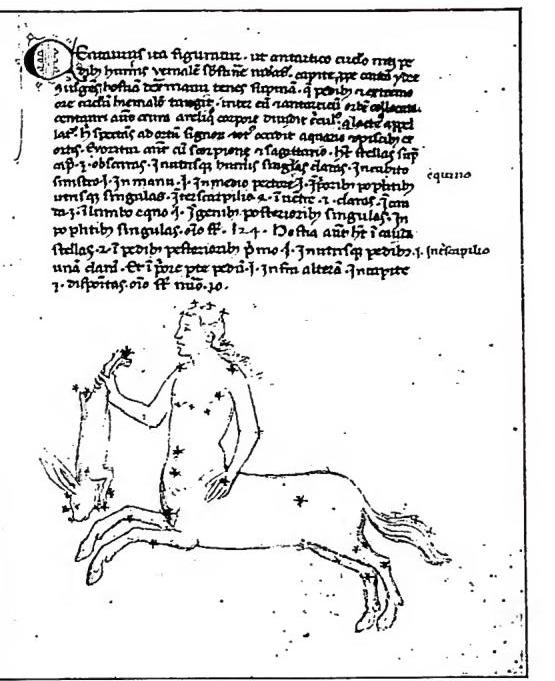
Astronomy - Depiction of the Centaur, Cod. Vat. Lat. 3110, fol. 73² (14th-15th c.) - Vatican Library.

Asprosoma - Depiction of the Centaur, Cod. Vat. Lat. 3110, fol. 75° (14th-15th c.) - Vatican Library.

(propr. Deggenhart)

Asprosoma - Depiction of the Centaur, Cod. Vat. Lat. 3110, fol. 75° (14th-15th c.) - Vatican Library.

Various reciprocal positions assumed by these; the moon served to convey astral influences from the heavens to the earth. With these elements, complicated by many secondary factors, it was deemed permissible to formulate diagnoses and prognoses, to prescribe treatments, based solely on the hour at which the illness had begun, in order to know the state of the heavens at that moment and derive the horoscope, as was done for births and other events. Medical astrology, without doubt, hindered the progress of medicine, though one must acknowledge in it a dim intuition of the effects that cosmic waves and influences, and perhaps even astral ones, have on human health; it flourished until the 17th century and enjoyed an ephemeral revival with mesmerism. - See Pl. XXII.

Bibl.: K. Sudhoff, Iatromanathetaiker vornehmlich in 15. und 16. Jahrhundert, Breslau 1902; A. Bigourand, L'astronomie: évolution des idées et des méthodes, Paris 1917; A. Pazzini, De mediciarum astrologia Hippocratis, in Boll. Ist. Stor. II. Arte Sanitaria, 1 (1923), pp. 1-42; F. Cumont, L'Égypte des astrologues, Brussels 1937; J. Contenau, La médecine en Assyrie et en Babylonie, Paris 1938; A. Pazzini, Medicina primitiva, Rome 1941.

Asprosoma - Among ancient peoples astrology (q.v.) was the mother of medical astrology. For, according to common opinion, the fate of men depended on the constellations, the positions and groupings of the planets; in order to forecast a favorable configuration for any important undertaking, it was necessary to observe assiduously celestial phenomena so as to deduce their periodic returns. From observations of the sun the Chinese determined the length of the solar year as 365.25 days, and probably as early as 2000 B.C. they knew the so-called Metonic cycle of 19 years, after which the lunar phases recur on the same dates of the year. Among the Babylonians observations began in the 23rd century B.C. and, continued for many centuries, led to the laws governing the movements of the sun, the

In antiquity the absolute immobility of the Earth and its central position in the world were accepted by almost universal consensus. In the 5th century BC Philolaus, a native of Tarentum, who emigrated thence to Thebes in Boeotia, supposed that around the centre of the world there was placed a fire, around which the five planets revolve, then the Sun and the Moon, finally the Earth and lastly, near the central fire, the Antichthon. The revolution of the Earth around the central fire takes place in the space of a day; and this same condition, together with the other that the surface of the Earth is always turned outwards, produces day and night and the apparent daily revolution of all the stars, including the Sun and the Moon. The Antichthon, remaining always on the side of the Earth that is unknown, is never visible. Meanwhile Eudoxus (405–365 BC) and Aristotle (384–322 BC), rejecting this conception, constructed the system of the Sun homocentric to the immobile Earth, while Heraclides of Pontus (4th century BC) taught the rotation of the Earth on its own axis and the revolution of Mercury and Venus around the Sun as their centre, thus anticipating the Tychonic system. Meanwhile an unknown contemporary of Heraclides noted that the inequalities of the planets produced by the Sun cannot be explained merely by making the planets revolve around the Sun and the Sun around the Earth, but also by exchanging the roles of the Sun and the Earth, that is, by placing the latter among the number of the planets. Thus was the idea of Copernicus fully anticipated, which later was adopted by Aristarchus of Samos (310–230 BC) and by his pupil Seleucus the Chaldean.

Unfortunately the Greek astronomers who came after Aristarchus took no account of these remarkable advances, and persistently maintained the hypothesis of the immobile Earth as the basis of their calculations. The most famous is the great Hipparchus, who applied trigonometry to astronomy and from his observations (made between 161 and 126 BC) compiled a catalogue of 108 stars. By comparing their positions with those observed 150 years earlier, he discovered the phenomenon of the precession of the equinoxes. Three hundred years later the work of the observers was brought to completion in the synthesis of the great observer of antiquity, Claudius Ptolemy (v.). In the Almagest he set forth his geocentric system: the Earth, of spherical shape, is immobile at the centre of the universe; around it the celestial sphere revolves in its daily motion from east to west; with this motion are compounded the various motions of the seven planets: Moon, Sun, Mercury, Venus, Mars, Jupiter, Saturn, from west to east on planes sensibly parallel to the ecliptic. To reduce all celestial phenomena to uniform circular motions, he adopted an exceedingly complicated system of deferents and epicycles.

Ptolemy’s system remained dominant throughout the Middle Ages. It then collapsed through the work of the great reformer of astronomy, the canon of Frauenburg, Nicolaus Copernicus (v.), who in his immortal work *De revolutionibus orbium coelestium* (1543) placed the Sun at the centre of the planetary system. About seventy years later Kepler discovered his three laws governing the elliptical motion of the planets, and in 1687 Newton demonstrated that those laws were a necessary consequence of his law of universal gravitation: two bodies attract each other with a force directly proportional to their masses and inversely proportional to the square of the distance between them.

The descriptive phase of astronomy began with the invention of the telescope at the start of the 17th century. Its application to astronomy, first undertaken by Galileo, led to a host of remarkable discoveries: the satellites of Jupiter, the phases of Venus, the mountains of the Moon, the spots on the Sun, the stellar composition of the Milky Way, and the appendages of Saturn, whose ring nature was discovered by Huyghens in 1656; he also discovered Saturn’s largest satellite, Titan, followed by the discovery of four more satellites by Cassini (1671–72, 1684). The return in 1759 of the comet of 1682, predicted by Halley, provided the first proof of the existence of periodic comets. To date thirty-eight such comets are known whose returns have been observed, of which twenty-seven have periods of less than ten years. When in 1781 W. Herschel began to survey the sky, he was fortunate enough to discover the planet Uranus, in 1787 two satellites of the same, and in 1789 the sixth and seventh satellites of Saturn. On 1 January 1801 the Theatine priest Giuseppe Piazzi discovered Ceres, the first of that swarm of asteroids between Mars and Jupiter, whose number now exceeds 1,600.

A new era of discovery opened when Leverrier, from the perturbations of Uranus’s orbit, calculated the position of the planet Neptune (1846) by mathematics alone; its only satellite was found a month later by Lassell. This was followed by the eighth satellite of Saturn (Bond, 1840), two more satellites of Uranus (Lassell, 1851), the two satellites of Mars (Hall, 1877), the fifth satellite of Jupiter (Barnard, 1892), the ninth and tenth of Saturn (W. Pickering, 1898, 1904), the sixth and seventh of Jupiter (Perrine, 1904–1905), the eighth (Melotte, 1908), the ninth, tenth and eleventh of the same (Nicholson, 1914–38), and finally the trans-Neptunian planet Pluto, found by Tombaugh (1930) near the position assigned to it by Prof. Lowell in a memoir of 1915. A fifth satellite of Uranus was found in 1940 by Kuiper.

Article illustration

In 1866 Schiaparelli demonstrated that the August meteor showers, called the “tears of St Lawrence” or Perseids, follow the orbit of the comet of 1862. Likewise it was found that the Leonids, the mid-November meteors, follow the orbit of Tempel’s comet of 1866. Similar connections were discovered between other showers and known comets. Hence it was concluded that these showers are the product of a partial disintegration of comets whose nuclei consist essentially of a cluster of meteorites.

In summary: the planetary system comprises 9 major planets, 30 satellites, more than 1,600 asteroids, 38 periodic comets, besides the Sun, which has a mass about 800 times greater than that of all the planets combined. The average distance of the Earth from the Sun is 149,673,000 km; that of Pluto is about 40 times greater.

The application of spectral analysis to the study of celestial bodies was begun by Fraunhofer and Kirchhoff, the latter drawing a map of the solar spectrum in 1861. Of fundamental importance was the work of Father Secchi (q.v.), who after a systematic examination of 4,000 stars reduced their spectra to 4 types—a classification that was soon universally accepted. From spectral analysis it follows that the matter of the Sun and the stars is identical with that of the Earth. The temperature of stellar photospheres ranges from 3,000 to 23,000 degrees. That of the Sun is about 5,700°; inside, the temperature increases, and at the centre, according to Eddington, it is about 40 million degrees, while the central density is 28 times that of water. In that fiery furnace sub-atomic processes generate the enormous energy radiated by the Sun, equivalent per minute to a number of kilowatt-hours expressed by a 21-digit figure. Yet our Sun, with its diameter of 1,390,000 km, is rather a dwarf star compared with giant and super-giant stars whose absolute luminosity exceeds that of the Sun by up to 20,000 times or more. Enormously large giants are, for example, Betelgeuse and Antares, with radii respectively 300 and 450 times that of the Sun—i.e. equal to 1½ times the semi-major axes of the orbits of the Earth and Mars—but with a density of only 1/3,000 that of atmospheric air. On the other hand there are dwarf stars smaller than the planet Uranus, indeed smaller than the Earth, but with a density more than 50,000 times that of water.

Not all stars shine with unvarying brightness. More than 9,000 variable stars have already been discovered, some varying irregularly, others with more or less regular periods. A distinction is made between short-period variables (from a few hours up to two months) and long-period variables (from four months up to two years or more). Short-period variation is mostly caused either by the mutual eclipses of the components of a binary star or by the pulsations of a star alternately expanding and contracting. The cause of long-period variation is still unknown. Even the Sun, with its eleven-year sunspot cycle, is a slightly variable star.

Among variable stars, a special place is reserved for novae: stars that suddenly rise from a minimum to a maximum brilliance, then decline—first rapidly, then progressively or with periodic oscillations—back to normal magnitude. It can now be stated with certainty that the phenomenon of a nova essentially consists in the explosion of a star, although the intimate cause of the explosion remains unknown to this day. As a result of this explosion, the outer layers are violently ejected, and the phenomenon appears to us as a tremendous increase in the star’s diameter, accompanied by a vast increase in total brightness. As the ejected matter disperses into space, the brightness gradually diminishes.

In recent years, in searching nebulae outside the Milky Way for novae, a particular kind was discovered and called supernovae on account of the intensity of their light, which at maximum averages fifty million times that of the Sun, ranging between 2.5 and 1,100 million times. About fifty supernovae have been discovered so far. The famous new star of Tycho Brahe in 1572 probably belonged to this class.

Article illustration

Of the greatest importance has been the application of photography to astronomy. It has enabled us to number, measure, and catalogue millions of stars, to determine their positions, magnitudes, and motions, to probe the depths of cosmic space, and to marvel at the wondrous grandeur of creation. Today we know that the Milky Way has a diameter perhaps well over one hundred thousand light-years, that its center lies in the direction of Sagittarius at a distance from the Sun of about thirty thousand light-years, and that this immense family of stars must be reckoned in the

Article illustration
Astronomia - Nebulosa di @ Ophiuchi.

A vast multitude of stars, a large part of which, grouped in twos, threes, or more, describe their orbits as double or multiple systems according to the law of universal gravitation. Our stellar system is a complex of star clusters, loose groupings such as the Pleiades, the Hyades, the Praesepe, of bright and dark nebulae, masses of gas of unimaginable tenuity or of solid corpuscles, from tiny dust particles to fragments the size of a fist or larger, dark clouds like those of the great rift in the Milky Way, which absorb part of the light from the stars behind them, and about a hundred compact globular clusters, each consisting of about a hundred thousand stars. Very probably our galactic system has the flattened shape of a spiral nebula, in which all the stars revolve, in a period of approximately 200 million years, around the central mass, estimated to be equal to 70 billion solar masses.

Beyond the Milky Way there exist millions of similar stellar systems: the nearest of these, at a distance of 800,000 light-years, is the spiral nebula of Andromeda, visible to the naked eye as a faintly luminous spot. It has a diameter of at least 50,000 light-years and contains from 2 to 3 billion stars. Of such nebulae, with diameters between 10,000 and 100,000 light-years, aggregations of several billion stars, about 30 million are detectable with large photographic telescopes, with which, after several hours of exposure, the most distant ones, up to 170 million light-years away, appear on the plate as barely visible traces. And when the new telescope with a 5-meter aperture is completed, the penetrable distance of cosmic space will be doubled once more.

THE AUTHOR AND HOLY SCRIPTURE. — The sacred authors, having no scientific aims, speak of the world as it appears to the senses and as it was conceived in their time. In the Bible we find no reference to what modern science teaches us. According to St. Augustine, it was not the Lord’s intention to impart to us scientific truths, since they do not contribute to eternal salvation. Cardinal Baronius used to say that God wished to instruct us as to how one goes to heaven, not as to how the heavens go. References to celestial bodies are therefore rare in the Old Testament. The first visibility of the moon determined the beginning of each month, and this was the only reference to the heavens made for the purposes of the Hebrew ritual. Yet there is a remarkable fact: while in those times, among all the surrounding nations, the celestial bodies were objects of divination and idolatry, the attitude of the sacred authors toward them was always absolutely irreproachable. And no ancient author can compare with the great Hebrew authors in spiritual elevation, sublimity of poetry, and admiration for the works of the Creator. “In the beginning God created the heaven and the earth”: this is the great truth revealed by God to men, whatever may be the meaning of the “six days” in which creation was accomplished. “Thou alone art, O Lord! Thou hast made the heavens, the heaven of heavens and all their host, the earth and all that is therein, the seas and all that is in them; Thou givest life to all these things, and the host of heaven worshippeth Thee” (II Esd. 9, 6).

Venus and Saturn are the only planets mentioned in the Old Testament. “How art thou fallen from heaven, O Lucifer, that didst rise in the morning!”: thus Isaiah (14, 12) apostrophizes the prince of demons. And the prophet Amos reproaches Israel: “Ye have borne the images of your idols, the star of your god”; in Hebrew: “Kijjûn (Saturn) your idol, the star of your god.”

The passages where certain constellations are mentioned are:

Job 9, 9: “(God) hath made the Bear, Orion, the Pleiades, and the chambers of the south.” According to Schiaparelli, the chambers of the south (interiora Austri) refer to a group of bright constellations formed by the Ship Argo, the Southern Cross, and the Centaur, constellations that were visible in Palestine when the Book of Job was written, but are no longer visible there because of the precession.

Ibid. 26, 13: “The spirit of His hand hath garnished the heavens, and His cunning hand brought forth the crooked serpent.” This probably refers to the constellation Draco.

Ibid. 38, 31: “Canst thou bind the sweet influences of the Pleiades or loose the bands of Orion?” The Hebrew text has Orion instead of Arcturus.

Idi. 38, 32: «Sei forse tu che fai apparire a suo tempo la stella del mattino e fai nascere il Vespero sopra i figli della terra?». Nel testo originale si legge invece: «Potrai produrre Mazzaròth nella loro stazione? O potrai guidare 'Ajiš coi suoi figli?». Probabilmente Mazzaròth significa il pianeta Venere, ed 'Ajiš il gruppo stellare delle Iadi.

Am. 5, 18: «Cercate colui che creò Arturo ed Orione». Il testo ebraico ha: le Pleiadi invece di Arturo.

II Reg. 23, 5: «(Giosia) sterminò gli aruspici... e quelli che bruciavano incenso a Baal, al Sole, alla Luna, ai dodici segni (Mazzaròth) e a tutta la milizia del cielo». Mazzaròth, secondo molti interpreti, è identico al Mazzaròth di Iob 38, 32.

Queste sono le uniche allusioni a determinate costellazioni nel Vecchio Testamento. Nel Nuovo Testamento mancano internamente. Quanto alla Stella dei Magi, basta fermarsi un istante sulle particolarità del racconto evangelico (Mt. 2, 2, 9, 10) per comprendere che quel racconto vuole presentare un fenomeno assolutamente miracoloso, il quale non si può in alcun modo far rientrare nelle leggi stabili di una meteora naturale sebbene rara (G. Ricciotti, Vita di Gesù Cristo, n. 174; cf. n. 253). - Vedi Tavv. XXIII-XXIV.

Bibl.: A. popolare: P. Maffi, Nei cieli, Torino 1923; O. Thomas, Astronomie: Tatsachen und Probleme, Graz 1933; Fr. Porro, Problemi dell'Universo, Bologna 1934 (pop.-scient.); Fr. Denza, Le armonie del Cielo, 4a ed., Firenze 1935, con aggiunte del p. N. Giannuzzi; J. von Littrow, Die Wunder des Himmels, 10a ed., Bonn e Berlino 1939; H. Spencer Jones, Monad senza fine, trad. di L. Gabba, Milano 1940; J. Jeans, The Universe around us, 4a ed., Cambridge 1945 (pop.-scient.); Bruno

Astro

Article illustration
Astronomia - Saturno con' la divisione di Cassini nell'anello.
Article illustration

1.jpeg](img-11.jpeg)
nomia - Parte della nebulosa in 52 Cygni del tipo a filamento (la fot. è in posizione N. Z.).

H. Bürgel, Dai mondi lontani, trad. di A. Abetti, Torino 1946: - Manuali scientifici: G. V. SCHIAPARELLI, LUIGI, I precursori di Cooperazione nell'antichità. Scritti sulla storia dell'a. antica, I, parte 1, Bologna 1925; G. Armellini, Trattato di A. siderale, 3 voll., Bologna 1928-36; E. und B. Strömgren, Lehrbuch der Astronomie, Berlin 1931; H. Spencer Jones, General Astronomy, 2a ed., Londra 1934; Fr. Becker, Grundriss der sphärischen und praktischen Astronomie, Bonn e Berlino 1934; H. N. Russell, R. S. Dugan, J. Q. Stewart, Astronomy, 2 voll., 2a ed., Boston 1945; G. Cecchini e L. Gratton, Le Stelle Nuove, in Memorie R. Acc. d'Italia, 13 (1942). p. 11; id., I fondamenti scientifici dell'A., Milano 1947. - A. biblica: E. N. Maunder, The Astronomy of the Bible, 2a ed., Londra 1908; G. V. SCHIAPARELLI, LUIGI, L'a. nell'Antico Testamento, Milano 1893; G. Hagen, La Stella Magorum, in Rivista di Astronomia, 5 (1911) pp. 74-75; U. Holzmeister, La Stella dei Magi, in La Cie. Catt. (1942, 1), pp. 8-22. Giovanni Stein

**ASTROS, PAUL-THÉRÈSE-DAVID DE** — Cardinal, born at Tourvès on 15 Oct. 1772, died at Toulouse on 29 Sept. 1851. He entered the clergy in 1790, was ordained priest in 1807 and shortly afterwards was named Vicar General of Paris. In this capacity he received the bull of excommunication pronounced by Pius VII against Napoleon. Accused of having divulged it, he was imprisoned at Vincennes until 1814. In 1817 he was entrusted with the bishopric of Orange, to which were added the bishoprics of Saint-Flour and Bayonne. In 1829 he was named Archbishop of Toulouse; later, in 1850, he was created cardinal by Pope Pius IX. Numerous writings remain from him, among which, of particular importance, is that concerning the errors of Lamennais, against whom he obtained condemnation from Pope Gregory XVI.

BIBL.: Hurter, V. coll. 1484-85. Emma Santovito

**ASTRO, BARTHÉLEMY D'** — Belgian Franciscan, renowned controversialist and ascetical writer, born at Ciney (Namur), died at Liège on 6 Dec. 1681. Within his Order he served as lector, provincial of Flanders (1664) and general commissioner of the Observance (1667) for the northern provinces of Europe. An eloquent preacher, he was among the most strenuous opponents of Protestantism.
ASTROY BARTHELMY - ASVIN

His style, though sometimes careless, is always strong and persuasive. Dirks lists 25 of his works, both French and Flemish and Latin, including: *Directorium ad incandos consolandosque infirmos* (Liège 1655); much better the 2nd ed. (ibid. 1674), revised and enlarged under the title *Paraclesis infirmorum*: this is d’A.’s best writing; *Traité du bien de la patience chrétienne* (3 vols., ibid. 1669 ff.). His principal controversial works are: *Antidote catholique* (ibid. 1655); *Armamentarium augustinianum adversus haereses quadruplici methodo apparatum et instructum in subsidium tyronum mili-tantis Ecclesiae* (ibid. 1664): a dogmatic theology both apologetic and polemical.

BIBL.: *Biographie nationale de Belgique*, I, Brussels 1866; S. Dirks, *Histoire littéraire et bibliographique des frères aux leurs de l'observance de s. Francois en Belgique et dans les Pays-Bas*, Antwerp 1885, pp. 274-83; Hurter, II, 2nd ed., cols. 401-403; J. Grob, *Recueil d'actes et documents concernant les frères aux leurs dans l'ancien duché du Luxembourg et comté de Chimay*, Luxembourg 1909, passim; J. Goyens, s. V. in DHG, IV, cols. 1255; id., s. V. in DSP, I (1937), cols. 1047 ff.

Felicissimo Tinivella