
ASTINENZA. — From the Latin abs-teneo, “I keep away,” a. signifies abstaining from something either temporarily or entirely. From the dietary point of view, a. is abstention from a certain kind of food or drink. For sexual abstinence V. CASTITÀ; CONTINENZA.
I. IN NON-CHRISTIAN RELIGIONS
Abstinence from particular foods is found in the practice of all primitive religions, insofar as it is connected with the sacred character of the animal or plant from which the individual or group abstains, precisely on account of that sacredness, which is charged with a power capable of causing harm to anyone who comes into contact with it without the proper precautions: abstinence ceases when the animal is eaten communally by the group, which thereby receives an increase of strength and social cohesion. At times abstinence concerns not the entire thing regarded as sacred, but only one part of II. The elders of the group are exempt from such abstinence, because they too possess a sacredness that renders them immune.In groups that have attained a higher degree of civilization and religious sensitivity, abstinence tends to make the individual free from contact with foods regarded as impure, so as to place him in a state of purity before the divinity.
During the Hellenistic period, the liturgy of the mysteries, which sought to bring the initiates to inner purity in preparation for initiation, presents many cases of qualitative abstinence.
At Eleusis, those undergoing initiation had to abstain from red mullet, pollieme, pomegranates, and beans (Porfirio, De abst., 4, 16); the Orphics and, in general, believers in metempsychosis abstained from meat; the Pythagoreans from beans; during the festivals of Cybele, abstinence from bread and wine was directed precisely toward this purification of the individual. The Neoplatonist emperor Giuliano explains the prescription to abstain from the part of plants that is enclosed within the earth (roots, etc.), because this is the dark prison into which the soul has fallen, whereas it is permissible to eat what develops outside, because it symbolizes the soul’s ascent upward (Giuliano, Orat., V, 174a–177c). The fast of Cybele was called « castus Maris Deum » (castus, from « carere », to be without, to abstain). The emperor Claudio never failed to observe it during the metroac festivals of March, which he had established.
The devotees of Isis, too, had to abstain from bread, pork, and onions (Plutarco, De Iside, 6, 7, 8), as well as from meat and wine (Apuleio, Metam., XI, 23); those of the Syrian goddess abstained from fish.
The prohibition concerning the meat of certain animals, which still survives in certain religions, as though it were impure food, must be regarded as the survival of a belief—now superseded—in the sacredness of the animal.
II. IN MORAL THEOLOGY AND CANON LAW
A) Legislation. The Catholic Church, which regards abstinence as a meritorious and expiatory virtue, imposes it upon the faithful, specifying its manner and time (3rd precept of the Church).a) The law does not concern beverages, but only “meat and meat broth” (CIC, can. 1250).
The following therefore remain prohibited: 1) meat (including blood, fat, liver, marrow, brain, and intestines) and the broth obtained from it, of animals “that live and breathe on land and in the air” (Sum. Theol., 2ª-2ª, q. 147, a. 8); 2) meat and broth concentrates, because they contain prohibited meat elements. The following are instead permitted: 1) vegetables, eggs, milk and its derivatives, fish, and cold-blooded terrestrial animals (mollusks, prawns, crabs, tortoises, frogs, oysters); 2) seasonings of every kind, even when derived from animal fat (can. 1250), e.g. margarine and rendered lard. “Nor should those be troubled in conscience who use substances, whatever they may be called, which, although derived from meat and possessing its nutritive power, have nevertheless lost the taste of meat or broth” (E. Génicot-I, Salsmann, Theol. Mor., I, 16th ed., Brussels 1946, no. 442), e.g. gelatin, pepsin, and peptones.
b) The time during which abstinence must be practiced is indicated by can. 1252, and comprises: 1) every Friday of the year, except when a feast of obligation falls on it (the feast of s. Giuseppe is an exception: since it falls during Lent, it retains the obligation of abstinence); 2) every Saturday of Lent (except Holy Saturday, beginning at noon); 3) Ash Wednesday; 4) the four Ember Days; 5) the four vigils: of Pentecost, the Assumption of Maria, All Saints, and Christmas.
c) The subject of the law is every Christian who has attained the use of reason, which in juridical terms is reckoned from the completion of the seventh year (can. 88, § 3).
d) Dispensation. There may, however, be legitimate reasons that entail the cessation of the obligation of abstinence: 1) physical and moral impossibility (illness, a state of weakness, certain occupations, serious hardship); 2) a decision of the Church for particular reasons (periods of epidemics or persistent contagious diseases, distressing wartime situations, particular restrictions). The following may grant dispensations: 1) the Pope for the whole Church; 2) bishops for their own dioceses and parish priests in their parishes, for individual persons or individual families; 3) superiors of exempt religious houses for individual subjects (including guests and servants who remain in the house day and night [can. 1245]).
e) The obligation arising from the precept of the Church is in itself grave; nevertheless, for its transgression to constitute mortal sin, gravity of matter is required.
B) Reasons for the law. — When imposing abstinence from meat, the Church follows neither the erroneous reasons from which the same practice derives among several heretical sects (Manichaeans, Montanists, etc.), which regarded meat as evil in itself and therefore absolutely inedible (cf. the penalties imposed by the Canones Apostolici [Denz- U, no. 37] and the anathema pronounced by the Second Council of Toulouse of 447 [C. Kirch, Enchir. fontium hist. eccles. antiquae, no. 700]), nor the theories of those who profess metempsychosis and tremble at the possibility of eating one of their relatives or friends; nor does it do so out of a duty to conform to the Mosaic law, which prohibited a certain number of foods (Lev. 11; Deut. 14), because that law ceased with the coming of Jesus Christ (cf. the synoptic episode of s. Pietro [Act. 10, 10-16] and the decision of Jerusalem: Visum est Spiritus sancto et nobis [ibid. 15, 28-29]). It may also be said that, while appreciating them, the Church does not base its action on philosophical, pedagogical, or medical considerations; rather, it derives its precept from the doctrine of its founder. Jesus Christ said: “If
III. PASTORAL MEDICINE
From the time of the holy Fathers onward, the precept of abstinence was attacked with various arguments of a historical, dogmatic, and practical-disciplinary nature, not least of a hygienic character, objections being raised concerning the alleged harm that a regimen of abstinence, even if partial and temporary, might have on health.St. Jerome, responding to the attacks of the heretical monk Jovinian, did not disdain hygienic and medical arguments either, insofar as they could be supplied by the scientific level of his time. Thus he appealed to the dietary habits of the peoples of antiquity and of his contemporaries, and cited the testimony of pagan philosophers and physicians whose words or example demonstrated how, in every age, abstinence, even complete abstinence, from meat had been compatible with excellent physical health and mental condition, and with the greatest longevity.
The vegetarian regimen (v. VEGETARISMO) was practiced in every age for religious or hygienic reasons, from the strictest fruitarians to ordinary vegetarians, who add certain animal products to their diet: butter, eggs, and milk. Persons of primary importance in the pagan world advocated or practiced it; thus Pythagoras, who died at the age of one hundred; the Neoplatonist Porphyry, his biographer, who wrote a treatise on abstinence from meat; Epicurus, Seneca, Plutarch, and Ovid. In the full Renaissance, the noble Paduan Alvise (Luigi) Cornaro, already advanced in years and by then burdened with ailments caused by an irregular life in every sphere, adopted a strict vegetarianism, regaining his health and dying at the age of ninety (1475-1560); to explain the foundations of his regimen, he published the Discorsi sulla vita sobria, which went through numerous editions.
In practice, the abstinence prescribed by the Catholic Church is identified, for the great mass of Christians, with the elimination of meat for limited periods of time; consequently, the diet consists chiefly in an impoverishment of the daily protein ration, particularly at the expense of animal proteins.
It is well known that, alongside the glucides (starches and sugars), the lipids (neutral fats and lipoids), mineral substances (ash and salts), and vitamins (v.), the protides (albuminoid or protein substances) constitute indispensable and irreplaceable elements of nutrition, as plastic substances intended to repair the wear and tear of the flesh of our organism. One of the most debated problems of modern physiology of nutrition has been that of the minimum protein ration necessary to meet man’s daily requirements. Toward the end of the last century (1875), C. Voit, using statistical inquiry into the dietary “quantum” of a large group of free-living men, calculated that 118 g. of protides were necessary for an adult man weighing 67 kg who performed fairly strenuous work for 8–10 hours a day (bricklayer, carpenter). The American Atwater raised this protein quota to 125 g. Russel H. Chittenden, conducting new research by experimental methods (1903–1905) and considering the statistical method deceptive—for although it is true that the palate is the individual’s “dietary conscience,” there are very many degenerate palates—arrived at results less than half as high. Experimenting on individuals who voluntarily submitted to very restricted diets, particularly on the American O. Fletcher, author of the book L'arte di mangiar poco, he concluded that approximately 55 g. of protides per day were sufficient to cover the quota of wear and tear of organic proteins.
At present physiologists agree that, for an adult man, the daily protein ration should amount to approximately 1 g. of protein per kilogram of body weight (approximately 70 g. daily); this quota should be raised to 1.5 g. per kilogram of body weight in growing individuals. To complete the ration, an adult is considered to require approximately 500 g. of glucides and 100 g. of lipids per day.
The question now arises whether abstinence from meat foods, even complete and permanent abstinence such as is practiced by certain religious orders (Carthusians, Carmelites, Minims, Camaldolese, Poor Clares, etc.), represents a danger to an individual’s health because of inadequate compensation for the protein wear-and-tear quota. This must be decisively excluded in light of the most modern studies on the qualitative and quantitative composition of the various foods.
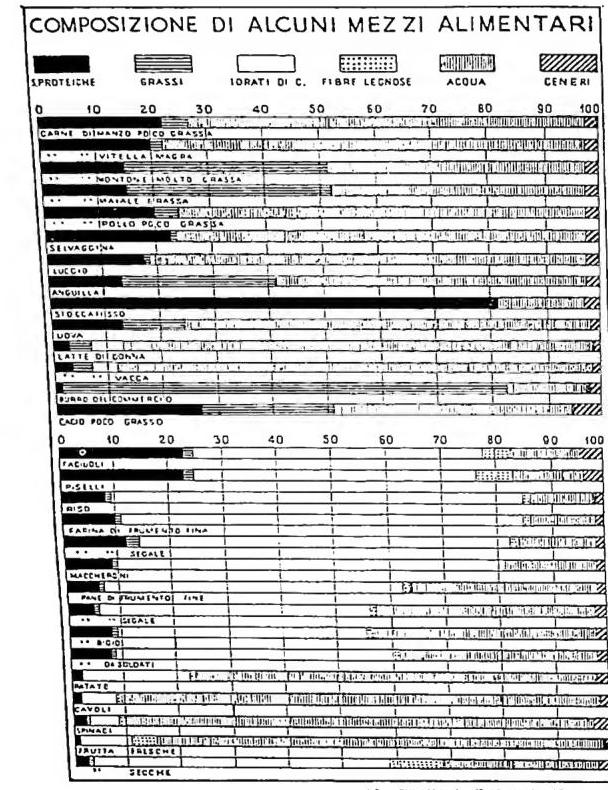
It is easy to realize (vedi table of foods) that valuable protein substances, far from being lacking, are also abundantly contained in vegetable foods (beans contain more of them than meat itself); thus, even while completely excluding meat from one’s diet, one can easily obtain a daily quota of 80–85 g. of protein and approximately 2,500 calories from bread alone (250 g.), pasta (100 g.), one egg, cheese (100 g.), milk (250 g.), potatoes (200 g.), pulses (50 g.), with suitable additions of fats (50 g. of butter and oil combined), sugar (20 g.), fresh vegetables, fruit, and lemon juice to supply the necessary vitamins.
From the qualitative point of view, it is currently held that one third of all the proteins consumed should be represented by proteins of animal origin, so that particular amino acids indispensable to development (histidine, leucine, lysine, methionine, tryptophan, etc.) may be obtained; these are absent from vegetable proteins, and the human organism is unable to synthesize them by itself. Even when meat is excluded, however, these amino acids can be abundantly supplied by foods of indirect animal origin (milk, cheese, eggs) or by fish—foods, especially the former, commonly consumed by ordinary vegetarians and by Catholics even during the periods of strictest abstinence.
Many hold that a meat-based diet is necessary, or at least very useful, for intellectual workers, because it is more stimulating and energizing. We have already stated how the strictest vegetarianism was favored by pagans famous for their intelligence, who attributed their achievements to it; thus Seneca the moralist, who states (Epistle 108) that after a year on a vegetarian regimen his intellectual faculties had developed even further. Porphyry, the Neoplatonist, maintains (De abstinentia) that the vegetarian regimen is best suited to sharpening philosophical intelligence. Many holy Fathers of the Church and many great monks of the patristic age, through their vegetarian and abstinent regimen, extending to fasting, demonstrated by their powerful and penetrating intelligence that meat is not absolutely necessary for the development and proper use of intelligence.
It must be said that a regimen that is not completely, but at least tendentially, vegetarian is the most advisable for so-called intellectuals, whose characteristic is a sedentary life ordinarily carried on in poor hygienic conditions, because it involves little muscular exercise and little pure breathing in the open air. The fundamental defect of such a way of life is in fact the tendency toward endogenous and exogenous intoxication, to which must be added the harmful effects of substances taken for stimulating and pleasurable purposes (coffee, alcohol, tobacco). Moreover, a meat-based diet is the organism’s strongest source of uric acid; therefore those suffering from, or predisposed to, lithiasis (calculosis), gout, and arteriosclerosis—especially if they are intellectual and sedentary—should turn toward vegetarianism. Another advantage is that it gives rise to very few toxic putrefactive processes in the digestive tract and, conversely, to more abundant waste products which, by stimulating intestinal peristalsis, combat constipation, so frequent among those who work more with their minds than with their arms.
Numerous experiments conducted with every scientific rigor by physiologists and students of nutrition have demonstrated that a diet, even a strictly vegetarian one, besides increasing to the utmost the potential and duration of physical work (proverbial is the strength of the porters of Salonika and Constantinople, who nourish themselves solely on cereals, rice, and fruit, especially figs, with complete exclusion of meat and wine), is fully compatible with excellent intellectual capacity and a high level of mental performance.
Finally, particular emphasis must be placed on a specific advantage of an alimentation poor in, or even entirely devoid of, meat foods: reduced excitability and easier control of the sexual function. The whole of Christian antiquity unanimously recommends abstinence from meat and wine in order to make chastity easier. Origen (PG 13, 518), s. Atanasio (PG 28, 264-65), s. Girolamo (PL 22, 892, 897, 1116: «Si vis perfectus esse bonum est vinum non bibere et carnem non manducare»), s. Bernardo (PL 183, 1096-97: «...abstinebo a carnibus ne dum nimis nutriunt carnem, simul et carnis nutriunt vitia»), s. Tommaso (2a-2a, q. 147, a. 8), and many others likewise extol the anaphrodisiac virtue of a sober and abstemious diet.
Modern studies on the physiology of material and energy metabolism and on nutrition have demonstrated, as has already been said, that a meat-based diet possesses the characteristic of being, for equal volume, more energetic than a vegetarian diet, of giving rise to a greater quantity of toxic waste products (urea, uric acid), and of more readily predisposing to intestinal stasis because of the small volume of non-assimilable residues (the woody, cellulosic portion of plant foods). Hence there is a greater likelihood of slipping into excess, both protein and energetic, in alimentation; a greater danger that the organism will remain intoxicated through overloading of renal function (unequal to the elimination of urea) or through the accumulation of purine waste products (uric acid) in the blood; and deficiency of the intestine’s excretory function because of more frequent constipation. This whole set of injuries represents a strongly negative element in the struggle that the individual must wage against the attacks of the overbearing sexual function. Indeed, if a metabolic balance that does not end in deficit is necessary for the body’s good state of health, every alimentary exuberance, both qualitative and quantitative, sooner or later ends by harming not only the physical organism but also that proper relationship which must link the body’s energy to the strength of the spirit. Such excess is more likely in the intellectual, who, in relation to sedentary life, requires a considerably smaller number of daily calories than the manual labourer (2200–2400 calories as against 4000–5000), and who more readily nourishes himself on meat and richly seasoned foods. It is also well known that intestinal stasis (constipation) readily leads to congestion of the organs contained in the small pelvis, among which must be included the sexual organs (prostate, seminal vesicles, ampullary portion of the vasa deferentia; ovaries, fallopian tubes, uterus).
Undoubtedly, alongside a hygienically healthy life in which exercise, fresh air, suitable muscular activity, and a well-balanced distribution of work and rest, of wakefulness and sleep, are regulated according to soundly natural principles; an alimentation that is simple, devoid of or very poor in stimulants, sober, protected from an energetic overload (calories taken in) and a qualitative overload (excess of proteins and purines), into which, as has already been said, one can more easily slip through a meat-based diet, particularly among intellectuals devoted to sedentary life—such an alimentation represents an excellent aid chastity (v.).
Abstinence from meat, therefore, particularly from that of land animals, just as the Church imposes it on particular days or during particular periods, is in no way harmful to human health; on the contrary, it is a source of certain physical benefits («... in multis enim escia erit infirmitas... Propter crapulam multi obierunt; qui autem abstinens est adiciet vitam » - Eccl. 37, 32 -), and of moral benefits as an excellent aid in the struggle against the concupiscence of the flesh («... corporali ieiunio vitia comprimis, mentem elevas, virtutem largiris et praemia » - prefazio di Quaresima -).