
EDESSA (Eδεσσα). - Originally Orhai, whence the name Osrhoene given to the region of which it was the capital, it was situated in northwestern Mesopotamia on the Scirtus river; by the Arabs it was called ar-Ruhā, today Urfa. It was founded by King Seleucus I, who gave it the name
I. CHRISTIANITY IN E
Abgar (v.) and Addai, it must be believed that Christianity, probably introduced in apostolic times, was already organized in E. by the middle of the 2nd century. In addition to the testimony of the epitaph of Abercius, Eusebius (Hist. eccl., V, 23) reports on a Synod of Osroene around 197, which sent a letter concerning the Easter controversy. The opinion that King Abgar IX (179-216) and the court became Christians is unfounded. What is certain is that around that time E. received its first Catholic bishop, Palût, from Serapion of Antioch. With this consecration, the Church of E. entered into the orbit of the Greek Churches, having probably been part of the Judeo-Christian current until then.E. became the center for the radiation of Christianity in eastern Syria and consequently also in Persia during the 3rd century. Its Aramaic dialect, namely literary Syriac, served for the direct Syriac version of the Old Testament called péšitá, which likely saw the light there around the beginning of the Christian era. Later, Tatian composed his Diatessaron in Syriac, perhaps in that same place. The persecutions of Decio and Diocletian produced martyrs in E., among whom should be remembered: Sarbī, Gūrā, Sēmānā, and Habbīb. Ajullāhā (Ethiopia), bishop of E., participated in the Council of Nicaea. During the 4th century, the Edessene Church was illuminated by the work of S. Efrem (v.). Christological controversies brought severe disturbances to the Church of E.: Rabbūlā (412-35), a staunch defender of orthodoxy, was succeeded by Hibā (435-57), who was absolved by the Council of Chalcedon, but was the author of the letter to Mārī condemned in the Fifth Ecumenical Council. However, with Jacob Baradaeus (541-78), Monophysitism was established there, and from then on there was almost always a dual hierarchy (Monophysite and orthodox) in E. Of the Latin hierarchy established there at the time of the Crusades, the present titular metropolitan see of E. in Osroene remains as a memory. A similar see, also titular, exists for the Syrian Catholics. There are few Latins (cared for by the Capuchins) and also few Maronites, Chaldeans, and Armenian Catholics.
For the Christian monuments of E., V. OSROENE.
II. SCHOOL OF EDESSA
It is the direct daughter of the ancient school of Nisibis (v.) and the mother of the new Nisibene school. When in 363 Jovian ceded Nisibis to the Persians, a part of the Christian population went towards the East; thus the school founded by
In 457, under the episcopate of Nonnus, the Monophysites recovered, and the Nestorians, predominantly of Persian origin, returned to Nisibis and re-established their ancient school. In 480, at the instigation of Bishop Cyrus, the school was destroyed by order of the Emperor Zeno.
The rules of the neo-school of Nisibis (496) have come down to us, which probably faithfully reflect those of the school of E. A monastic life was led there, directed by a superior and a steward. The subjects taught were: literature, writing, chant, and the commentary on Holy Scripture; the Bible formed the essential basis of instruction.
Numerous and detailed articles deal with the conduct of the pupils (v. E). It is an exaggeration to attribute the entire literary movement of the 4th, 5th, and 6th centuries around this city solely to the school of E. It is perhaps the finest manifestation of this movement, but the great merit attributed to it is perhaps due to the fact that the oldest Syriac manuscripts preserved to us in the beautiful carangēlā script refer to the epoch of the flowering of this school and to the city of E. Among the original works of Syriac literature that can be referred to the Edessene are a part of the poems of St. Ephrem and Narsaj (those written in E.), the works of the disciples of Ephrem (Catalona, Isaac of Amida, Isaac of E.), those of contemporary Edessenes
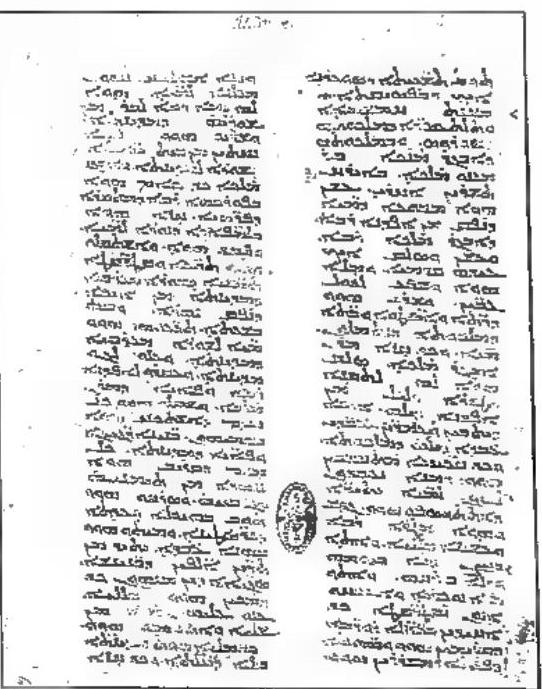
It appears that the school of E. created a movement in favor of Greek studies, as attested by the numerous translations of ecclesiastical works from the Greek; among them are the following: Recognitiones, a Syriac translation in a London manuscript, written at E. in 411; Discourses of Titus of Bostra against the Manichaeans, ibid.; Theophany of Eusebius, ibid.; Ecclesiastical History of Eusebius, in an E. manuscript of 462 in St. Petersburg. Rabbula, bishop of E., translated the De recta fide of Cyril; Ibas the works of Theodore of Mopsuestia and Diodore of Tarsus.
In essence, the school of E. had the merit of transmitting to the Syrians in their own language the theories of the schools of Alexandria and Antioch, preserving for us numerous works whose original Greek has been lost.
III. CHRONICLE OF EDESSA
This is a chronicle written by an anonymous author, most likely an Orthodox cleric, around the middle of the 6th century and preserved in a 7th-century codex (Vatican syr. 163). The author describes the history of the city from 133 to 540 and frequently draws upon official documents, such as the notarial account of the flood of 210, which mentions the "church of the Christians."Ignazio Ortiz de Urbina
EDESSENI ATTI, v.: ATTI DEI MARTIRI ORIENTALI.