
OSROENE. — The Christian province of O. was constituted within its definitive boundaries only quite late, around the middle of the fifth century: its eastern boundaries were formed by the course of the Hâbûr from its confluence with the Euphrates at Circesium, and then by the course of the latter from Circesium as far as the latitude of Samosata. A region with an Aramaic population and strong Arab infiltration, it had highly distinctive characteristics from antiquity onward: its capital, Ôrhâi (today Urfah), called Edessa by the Romans (v.), was an important centre of culture and one—and perhaps the most notable—of the places where Syriac rose to the status of a literary language.
Having been penetrated by Christianity even before the Peace of the Church, it elaborated a series of legends, culminating in the see of s. Tommaso, whose relics were supposedly transported there around 220, and these legends brought it great renown in the East. At the same time, nearby Carrhae (Harrân) remained profoundly pagan, preserving its cult well into the Middle Ages. Concerning Edessa, documents relating to its religious history, and consequently also to its Christian monuments, are abundant, beginning with the Chronicon Edessenum, compiled from the Church’s official documents. Unfortunately, the abundance of philological data is not matched by an equal, or even lesser, abundance of archaeological data, since all the city’s churches have disappeared. Around 1507, an anonymous Venetian merchant still saw many of them; his account was published by Ramusio: “This city was regal, magnificent, and miraculous, as can be seen from its ancient monuments and its buildings and palaces. There are ten or twelve very large churches, built of marble of such a kind that I could not express it in words.” Christian epigraphy, both in the city and in the nearby convent of S. Giacomo (largely in Syriac), though by no means poor, likewise presents no outstanding archaeological data. We are therefore reduced to lists of church dedications, important for the history of worship, but saying nothing about the structure and decoration of these monuments.
The most notable Christian monument of Edessa was the Great Church, which Muslim writers, beginning with al-Muqaddasi, number among the wonders of the world. Fortunately, a Syriac poetic text, probably composed in the seventh century, gives a fairly extensive and clear description of the form it assumed following the rebuilding carried out by Bishop Amidonius in the Justinianic period. The church was then a domed building of Byzantine rather than Mesopotamian type, probably very similar to another building that is still preserved and well known, namely S. Clemente of Angora. Inside, the church was entirely covered with decorative mosaics, probably aniconic.
(courtesy of Monsignor J. P. Frutasi)
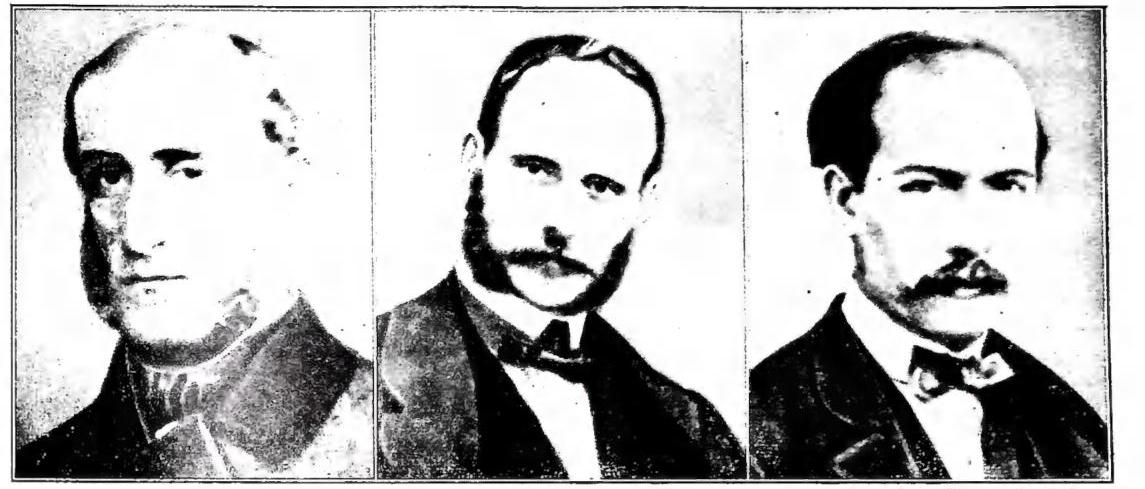
OSSERVATORE ROMANO, L'. — Portraits of former directors: Nicola Zanchini, Giuseppe Bastia, Augusto Baviera.
was built in 456 by Bishop Abramo, and another in 513 under Bishop Samuele, as two inscriptions report. Virán Şahr has still preserved the ruins of the region’s only paleo-Christian monument. This was a large round church, having within the first outer circular enclosure a second enclosure concentric with it, consisting of eight enormous pillars forming the corners of an octagon. Along two perpendicular axes there were three square porticoes in front of the church’s three entrance doors, and on the fourth side a long apsidal choir. It is not known whether the central octagon was covered by a pyramidal roof or a dome.
At Edessa there was preserved a miraculous image of Christ, copies of which, disseminated also in the West, are of considerable importance for the iconographic history of the Messiah.