
MARONITI. — A Christian people of Syrian origin, found especially in the Republic of Lebanon, Syria, Palestine, Cyprus, and Egypt.
I. S. MARONE. — Of S. Marone it is known that he lived as a hermit on a mountain situated probably in the region of Apamea. The gift of miracles spread his fame and drew people to his hermitage. At his death, when a fierce dispute arose among the neighboring villages over possession of the venerated remains, the inhabitants of the largest village prevailed and built around that precious relic a most sumptuous temple (Theodoret, Religiosa hist.: PG 82, 1418). Here S. Marone is called “the Great,” “the Highest,” and “the Divine” (loc. cit., 1395, 1431, 1454, 1491). S. Giovanni Crisostomo sent him a letter written, as its contents show, between 404 and 407
and Theodoret, writing his work between 423 and 458, speaks of a church of S. Marone that had already become exceedingly sumptuous, and of the worship rendered to him; this makes it reasonable to hold that S. Marone died ca. 410. The date of his birth remains unknown.
II. THE MONASTERY OF S. MARONE. — Many saints are called by Theodoret disciples of s. Marone. It was probably around the aforementioned church that a monastery was erected, since after Theodoret no further mention is made of that church, whereas many documents speak of the monastery. Abū 'l-Fidā' (d. 1331), in his pre-Islamic history (ed. H. Fleischer, Leipzig 1831, p. 113), says that the monastery of S. Marone was enlarged by Marcian in 452. Abū 'l-Fidā', who governed Homs, had near or within the sphere of his jurisdiction the region of Apamea, where the monastery was located. According to Procopius of Caesarea (De aedificiis Dn. Iustiniani, V, Venice 1729, p. 9), Justinian carried out some restorations in the same monastery; and according to Eutychius, patriarch of Alexandria, Heraclius visited it in 628 and bequeathed property to it (PG 111, 1089). During the reign of Heraclius, many Jacobite churches passed to the Maronite monks, and Heraclius did not wish them to be returned (Bar Ebreo, Chron. Eccl., I, Louvain 1872, pp. 270–74). In the London manuscript Brit. Mus. add. 17, 169, f. 126ᵛ, it is stated that it was acquired in 745 for the monastery of S. Marone (cf. F. Nau, Bulletin de st Luis des maronites, 1903, 3469). Timothy I, Nestorian patriarch, wrote a long letter in 791 to the monks of s. Marone (Vat. Borgiano 81). The Jacobite patriarch Dionysius of Tellmahrē (d. 845) says: “the M. remained as they are today: they ordain patriarch and bishops from their monastery” (Chronique de Michel le Syrien, trans. J.-B. Chabot, II, Paris 1910, p. 511).
There are letters published by Mansi (vol. VIII), whose dates range between 517 and 536, in which the position or wording of the signatures of archimandrites or monks of S. Marone proves that this monastery in Second Syria was the principal one, or the exarchate. From the foregoing it emerges that, from the middle of the 5th century to the middle of the 9th, the monastery of S. Marone was flourishing and pre-eminent.
Thomas, bishop of Kefartāb (11th century), says that this monastery stood on the banks of the Orontes and was inhabited by 800 monks (Paris Syriac ms. 203, f. 97 V.
in al-Manārah, 7 [1936], p. 97). al-Mas'ūdī says the same, but elsewhere specifies that it was situated east of Ḥamāh and Ṣajzar, now Ṣajgar (Le livre de l'avertissement et de la revision, trans. Carra de Vaux, Paris 1897, p. 211). An ancient manuscript published by F. Nau (Opuscules Maronites, II, Paris 1900, p. 22) confirms this. The monastery “consisted of a magnificent building surrounded by more than three hundred rooms inhabited by monks, and possessed objects of gold, silver, and precious stones in great quantity. It was destroyed by the raids of the Arabs and the injustice of the sultan”
(courtesy of Mons. Slair) MARONITI — Interior of the cathedral of S. Elia of the M. — Aleppo.
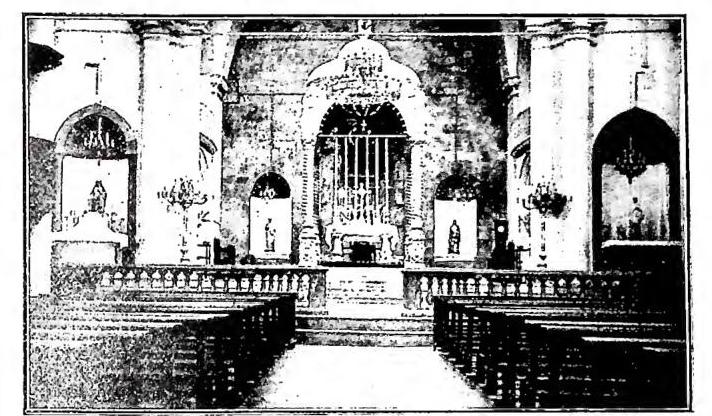
III. EXPANSION OF THE M
The monastery of S. Marone and others dependent upon it gave the name M. to those Aramaic Christians who began to form a compact community around them (H. Lammens, in al-Mašriq, 6 [1903], p. 131). At first, according to al-Mas'ūdī (loc. cit.), they spread in Apamea, Ṣajzar, Homs, and Ḥamāh; according to Bar Ebreo (Chron. eccl., I, pp. 270–74) and Eutychius (PG 111, 1078), also in Hierapolis, Qinnašrīn, and al-'Awāšim. In the second half of the 7th century the emigration of the M. toward Lebanon began because of intense rivalry with the Jacobites (H. Lammens, in al-Mašriq, 2 [1899], p. 267). Later, the caliphs also persecuted them (Dionigi di Tellmahrē, in Chronique de Michel le Syrien, II, p. 511). At first they must have inhabited the district of Batrūn, whence they spread into that of Ġubajl; they were numerous, as attested by the churches they erected there in the 8th, 9th, and 10th centuries. There they found and absorbed many Christians who, like them, spoke Syriac and had been evangelized by the monks of S. Marone (H. Lammens, in al-Mašriq, 4 [1901], pp. 728, 1018; PG 82, 1428). The M. are also very ancient in Aleppo, since Dionigi di Tellmahrē (loc. cit., pp. 429–96) speaks of a struggle between them and the Melkites. They were soon found also in Mesopotamia. Bar Ebreo (Ta'rīh muḫtaṣar ad-duwal, ed. Ṣalḥānī, Beirut 1890, pp. 219–220) speaks of the Maronite Theophilus of Edessa, chief astrologer of al-Mahdī (775–85) in Baghdad, who wrote a history and translated the Iliad and the Odyssey into Syriac; and Ricoldo de Monte Crucis (Peregrinationes Medii Aevi quatuor, ed. Laurent, Leipzig 1873, p. 126), a writer of the 13th century, encountered between Mosul and Baghdad a community of M. headed by an archbishop. As for Cyprus, there are two inscriptions, one from 1141 and the other from 1154, concerning the M. of that island (M. Le Quien, in Oriens Christianus, 3 [1740], pp. 49–76). According to L. Macheras (Chron. de Chypre,(Courtesy of Mons. Sfair)
MARONITI - Celebration of Holy Mass in the Cathedral of St. Elijah - Aleppo.
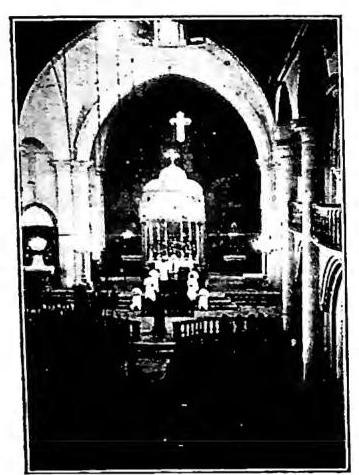
From Jerusalem, where they were very numerous and had several churches, the M. emigrated to Cyprus, as stated, to Rhodes in 1310, and to Malta in 1530 (P. Mas'ad, ad-Durr al-manẓām, Lebanon 1863, p. 158; H. Lammens, in al-Mašriq, 6 [1903], p. 170).
IV. ESTABLISHMENT OF THE PATRIARCHATE
In 685 the M. elected their first patriarch. This was asserted by the Maronite patriarch ad-Duwajhī, elected in 1670 (as to whose authority, or lack thereof, cf. P. Sfair, La Messa siro-maronita, p. 120 ff.), and confirmed by the text cited in the annals of Dionysius of Tellmahrē (d. 845), preserved for the most part in the chronicle of Michael the Syrian (ed. cit.), which was discovered in 1887. The Maronite patriarch bore the title of “Antiochene” before Innocent III, as appears from a passage in the bull of the latter, Quia divinae, of 3 January 1215 (but concerning the title of the Maronite patriarch cf. P. Chebli, in Rev. de l’Orient chrétien, 8 [1903], pp. 138–39; G. Dib, in DThC, X, col. 28).As for the see, between the year of its establishment and 1440 the patriarchs changed it thirteen times (Synodus Montis Libani, anno 1736, III, VI, 5). From that year onward, the see was at Qannūbīn, first in practice and later by decree of the aforementioned Synod of 1736. The Synod of Bikurli transferred it in 1790 to that same monastery, and the S. Congregation of Propaganda Fide confirmed this decision on 11 June 1793 (P. Sfair, Codificazione can. orientale. Fonti, 1ª serie, XII, n. 1155).
V. SOTTO I CROCIATI
Occupata Tripoli nel 1098, i Crociati domandarono ai fedeli Siri di quella parte del Monte Libano, discesi per congratularsi con loro, quale fosse la strada migliore per arrivare a Gerusalemme, e quindi seguirono la via della costa sotto la guida di alcuni di quei fedeli (Guglielmo di Tiro, in PL 201, 198-99). Come si è visto, detti fedeli non potevano essere che i M., e lo stesso Guglielmo altrove (PL 201, 855) li chiama M. aggiungendo: «... ed erano uomini forti e valorosi nel combattimento... e per i nostri furono utilissimi». Stabilitisi a Gerusalemme, i Crociati si impegnarono a occupare le città costiere che avevano oltrepassato senza espugnarle. Nell'occupazione di Tripoli e di Beirut, furono aiutati dai M. (H. Lammens, in al-Mašriq, 6 [1903], p. 214; G. Darjan, Nabḍat ta' riḥijjah, Beirut 1919, pp. 79-80, ove cita autori arabi). Sotto i Crociati i M. vissero tranquilli, edificarono chiese e conventi (H. Lammens, in al-Mašriq, 4 [1901], p. 170; id., La Syrie, Beirut 1922, pp. 261-262; E. Renan, Mission de Phénicie, Parigi 1864, p. 227) e cominciarono a fare uso delle campane (G. de Vitry, Historia Hierosolimitana, I, 1094; ad-Duwajhī, Annali, 1112), e i loro vescovi a portaremitra, pastorale e croce pettorale (G. de Vitry, ibid.). Nel Libano i Crociati trovarono il sistema feudatario e lo mantennero (G. Darjan, loc. cit., pp. 81-82). Quando il regno crociato tramontò, « un misero avanzo del clero e popolo fedele si ritirò tra i gioghi inaccessibili del Libano abitati da M. cattolici... Il patriarca Simone accolse amorevolmente lo smarrito gregge, scrisse ad Alessandro IV e ne ottenne il titolo di Antiocheno » (B. Terzi, Siria sacra, Roma 1695, p. 52). Benedetto XIV nel Concistoro del 13 luglio 1744 parlò nello stesso senso.
VI. IN THE AGE OF THE MAMLUKS
Under the Mamluks (1291–1516), Syria and Lebanon together were divided into five parts called vice-kingdoms. In Lebanon, in every major population centre, there was a Maronite muqaddam (administrator), who governed under the authority of the nā'ib, or viceroy, of Tripoli. The muqaddamīn (plural of muqaddam) were nearly independent in their fiefs, received the subdiaconate, and held the first place in church after the priest. From this one can understand the importance the patriarch had at that time. Fearing a return of the Crusaders, until the middle of the fifteenth century the Mamluks kept watch over the coasts, which made relations with the Holy See difficult (ad-Duwajhī, Annali, 1439, and Kitāb al-iḥtiǧāǧ, of which there is a Latin translation in ms. Vat. lat. 7411, ch. 11, under the title Vindicia Maronitarum). Later, it seems that the situation changed, and Fra' Gryphon was among the Maronites as a pontifical legate from 1450 to 1475.VII. AFTER THE TURKISH OCCUPATION
In 1516 Selīm I occupied Lebanon. In 1527 the patriarch and the episcopate invited Charles V to liberate the country, promising him the support of 50,000 fighters, but in vain (A. Rabbath, Documents inédits, II, Paris 1910, pp. 616–23). From Ġubajl downward, Lebanon was divided into three parts governed by three non-Christian princes. Fahr ad-Dīn II of the Ma'nites obtained the government of Sūf in 1585, but succeeded in extending the territory under his control from Antioch to Aǧlūn; he placed governors over the districts from the Maronite family Hāzin, which had educated him, as well as others. This Druze prince built convents for the Capuchins in Sūf (A. Rabbath, op. cit., pp. 464, 494), and Abū Nawfīl Hāzin built the first Jesuit house in Lebanon at 'Ajnūrā (Kisrawān: Lettres édifiantes et curieuses, I, Paris 1829, pp. 221–23, 232 ff.).The Ma'nites were almost entirely independent, Turkey being content with the tribute. There was, however, some persecution, though not on the part of the Ma'nites, who ruled until 1697, but on the part of the Turkish pasha of Tripoli. Thus the most influential M. notables, Abū Karam al-Ḥadati (1640) and Jūnis Abū Rizq (1697), mounted the scaffold after repeatedly refusing to abjure their faith (ad-Duwajhī, Annali, 1840 and 1897; J. De la Roque, Voyage de Syrie..., II, Paris 1722, p. 263). In 1695 the order of the M. Antonines arose, and in 1700 that of the Antonines of St. Isaiah.
After the Ma'nites had declined, the Muslim Šihāb succeeded them; they governed Lebanon until 1841. Under them, as the m. served as ministers, counsellors, secretaries, etc., the M. enjoyed peace and security (C.-F. Volney, Voyage en Syrie et en Egypte, I, Paris 1825, p. 467). The Melkites converted to Catholicism in Aleppo in 1725, the patriarch Tanās in 1726, and the Syriac patriarch Ġarwah in 1783 took refuge in Lebanon to escape persecution. The Armenian Catholic patriarchs lived in Kisrawān from 1730 until the second half of the nineteenth century. In 1736 the Maronite Synod was held, whose acts remain to this day the official code of the patriarchate. Benedict XIV approved it in a special form in 1742. Included in it is the privilege that the patriarch should elect the bishops in his Synod, as well as the order of Innocent III (Quia divinae, 3 January 1215) that priests should use Latin vestments. After the fall of the Šibāb, Turkey established two prefectures (qā'immagāmāt) in Lebanon, one Druze and the other Maronite. But disturbances occurred, culminating in 1860 in massacres of Christians, among them the three Massabki brothers, beatified by Pius XI (10 July 1926). In 1861, following the intervention of the European powers, Lebanon was given a new constitutional organization, under which the M. lived in peace until the First World War.
In 1865 the Congregation of the Lebanese Missionaries was founded; they were also called Krsimites, after their place of origin. For the present situation V. LIBANO.
VIII. THE QUESTION OF THE ORTHODOXY OF THE M
The thesis that made the M. defenders of Monophysitism in antiquity has now been abandoned. Indeed, to say nothing of the “monks of St Maron” martyred by the Severian Monophysites in 517 (v. Mansi, VIII, 426), letters from the sixth century are preserved (ed. F. Nau, op. cit., pp. 343 ff., 367 ff.) in which Monophysite monks call the M. “shoots of Leo” and adherents of the Council of Chalcedon. Moreover, Bar Ebreo in the Chron. eccl., p. 269 ff., drawing on Dionysius of Tellmahrē (d. in 845), speaks of disputes between the M. and the Monophysites.There are, however, still many scholars who maintain that the M. were once adherents of Monophysitism. It seems, nevertheless, that the witnesses cited are not especially reliable and that the evidence to the contrary carries weight.
Timothy of Constantinople is cited (PG 86, 65), but he wrote ca. 600, that is, before Monophysitism had flared up: he makes the M. opponents even of the Fourth Council, which cannot be true, as has just been seen. St Germanus of Constantinople agrees in the same assertion, but then contradicts himself by admitting that the M. reject the Fifth and Sixth Councils, while accepting the Fourth. It should also be added that the author, more than ninety years old (PG 98, 82), was writing these recollections in prison without the aid of written sources. St John Damascene swears that he wants nothing to do with the heterodox, especially with the M. (PG 94, 1432), and in a letter, alluding to the “qui crucifixus est,” says: “We become Maronites if we add...” (PG 95, 33). It is strange, however, that the same author, in his list of more than 100 heresies (PG 84, 679-80), does not mention the M. Moreover, the first citation seems scarcely consistent with the context (v. S. Assemani, Bibl. iuris orientalis canonici et civilis, V, Roma 1766, p. 502), and the second is given in the Paris manuscripts 1829 and 2442 and in the manuscript used for the edition of Basel with παραννήσαμεν, “we rave,” instead of μεραννίασαμεν. Even less confidence can be placed in the dubious testimony of Abū Qurrah, which is not free from contradictions and was transmitted in a copy made in 1735 by the Melchite bishop B. Finān (ed. C. Bāšā, Beirut 1904). That of Eutychius (Sa'id ibn al-Bīṭrīq; cf. PG 111, 1078) is negligible; William of Tyre depends on him (PG 201, 212), as do many later writers, and he mingles obvious errors concerning the M. (PG 201, 845-56), who, according to him, were converted in 1181, precisely when the Latin kingdom was declining. Innocent III, in the bull Quia divinae (3 Jan. 1215), speaks instead of the conversion of the M. in 1203 before Cardinal Pietro. The M. are said to have admitted the primacy of the Pope, the Filioque (yet no one ever attributed to the M. the heresies opposed to these dogmas); the two wills, and so forth. It should be noted, however, that this bull is addressed jointly to the Greeks and the M. Nor can it be ruled out that the popes at that time were not well informed about the doctrine of the M. (v. Dandini, Missione al Patriarca e M. del Monte Libano, Cesena 1656, p. 98). Blessed U. de Romanis, Master General of the Dominicans, reported in an encyclical to the Order in 1256 that the Dominicans had converted the M., who had been schismatics for many years (B. M. Reichart, Monumenta Ordinis Praedicatorum historica, Roma 1897). Thus there would have been three conversions in less than a generation! As for the
Annals of Dionysius of Tellmahrē (op. cit., II, p. 412), it has been wished to accept (cf. S. Vaillhē, L'Eglise maronite du Vᵉ au IXᵉ siècle, in Echos d'Orient, 9 [1906], p. 261) the claim that Heraclius proposed to the Jacobite patriarch Ananias the Camel-driver (d. in 631) the acceptance of the Ecthesis, at the Synod of Mabbug, obtaining it also from the m. monks. The anachronism should be noted, since the Ecthesis was promulgated in 638. Bar Ebreo, on the other hand, depending on the same Dionysius, states that Heraclius obtained from them adherence to the Fourth Council (Chron. eccl., col. 274).
What can be learned from the sources is that Dyothelitism penetrated only in 727 and not through an official channel into Lebanon, which was occupied by the Arabs and had no communication with Constantinople before that time, and that there was a certain misunderstanding between the M. and the Maximites, because the former accused the latter of maintaining in Christ two wills capable of discord, whereas the M. thesis emphasized the moral unity of the wills without detriment to their physical duality. Such, for example, is the doctrine of the celebrated Kitāb al-hudā (ed. P. Jahed, Gunjh 1935), the true code of the M. during the Middle Ages.
IX PRINCIPAL WRITERS. — H. Lammens (La Syrie, p. 111) maintains that the document concerning the dispute between the M. and the Jacobites before Mu'āwijah, published by Th. Nöldeke (Mansi, VIII, 426), is the oldest document of Maronite literature. But there is also the letter of the M. monks to Pope St. Hormisdas, likewise cited. It further emerges from the aforementioned letter of Timothy I that the M. monks had written to him, and that before him they had corresponded with his predecessor. All these letters have been lost, as have the works of Theophilus of Edessa mentioned by Bar Ebreo (loc. cit.), and those of Qajs, of whom al-Mas'ūdī speaks (loc. cit.). The aforementioned Kitāb al-hudā, translated in 1058 but written earlier by an unknown author who is described in the translator’s preface as « the holy father », also belongs to Maronite literature, as do the aforementioned Ten Chapters of Thomas of Kefartāb, the works of G. Ibn Qilā'i (d. in 1516), and those of Farhāt (v.). The Maronite College of Rome (v. COLLEGI ECCLESIASTICI), with Patriarch S. ad-Duwajhī (d. in 1704), Abraham Ecchellensis, P. BENEDETTINI (v.) or Mubārak, the Assemani, Faustus Naironius (d. in 1711), and many others, made a major contribution to culture. Among those of the nineteenth and twentieth centuries worthy of mention are Fares Sidjāq, the Bustānī family, the Sartūnī family, the Carmelite Father Anastasius (Anistās), Bishops G. Debs and G. Darjān, G. Gubrān, and A. Rīhānī.
X. THE MARONITE RITE
It is a branch of the West-Syriac rite. Originally the particular rite of the monastery founded over the tomb of St. Maron, at the beginning of the fifth century it developed there in a manner similar to the rite of the Antiochene region; but, remaining orthodox during the Christological controversies amid many monasteries that had passed to monophysitism, it had to preserve a character of its own. From these ancient times there has been handed down an anaphora proper to the Maronites, called by its first word: Sarrar, published in the 1592–94 Missal with the complete text, and used from the 1716 edition onward on Good Friday in the Mass of the Presanctified (cf. the study of the text by H. Engberding, Urgestalt, Eigenart und Entwicklung eines altantiochenischen eucharistischen Hochgebetes, in Oriens Christianus, 7 [1931], pp. 32–48); and probably also the properly Maronite recension of the anaphora of the Twelve Apostles (cf. A. Raes-A. Rücker, Anaphorae Syriacae, I, Rome 1940, pp. 205–27).It is certain that this rite did not become Byzantine, as did that of the Melkites, but, as regards formulas, gestures, and the construction of offices, it regulated itself according to the usage of the West-Syriac rite, which had long been undergoing development. Documents for following this development are lacking. In the twelfth century, through contact with the Crusaders, it underwent the first Latin infiltrations, which are fairly easy to recognize: the form of Baptism, Confirmation reserved to the bishop, mitre and ring for bishops, amice for priests, and the use of bells (cf. the bull of Innocent III of 1215, Quia divinae sapientiae, and other documents in T. Anaissi, Bullarium Maronitarum, Rome 1911).
Liturgical manuscripts of the fifteenth and sixteenth centuries reveal a marked influence of the Syriac rite, made evident by a series of prayers and hymns in various offices that duplicate the ancient formulas (especially in the Pontifical), and, from the sixteenth century onward, after the foundation of the Maronite College in Rome and the training of priests in Western seminaries, a new Latin influence: a kind of confiteor in the Mass, the words of consecration translated literally from the Roman Mass, a change in the epiclesis that caused this formula to lose its primitive meaning, new feasts in the calendar, the blessing of a church distinct from its consecration, the use of the corporal and the pall, and the composition of a new, shorter anaphora, inspired in some of its prayers by the canon of the Roman Mass and therefore entitled, by its author A. Iscandar, Anaphora of the Roman Church. The Synod of Mount Lebanon of 1736, following those of 1580 and 1596, despite a weak attempt at correction due, among others, to the patriarch ad-Duwajhi, could not halt the movement. It was necessary to wait until recent years to find courageous men, imbued with a liturgical spirit, who, under the guidance of the hierarchy, could carry out a radical change of direction; proof of this is the Ritual of Beirut of 1942, which restores the rite for the most part according to the ancient codices. An edition of the Pontifical and the Missal according to the same principles is in preparation.
The general ordering of the Mass and many of its customary formulas and gestures are identical with those of the West-Syriac rite. The Ordo communis, or fixed parts, is nevertheless proper to it (cf. E. Renaudot, Liturgianum Orientalium collectio, II, Paris 1716, pp. 12–20); the beginning is somewhat intricate; there are only two scriptural readings; eight anaphoras are used in the latest editions; the prayer of the fraction is separated from the fraction itself and placed after the Pater noster, as among the Latins; the Communion of the faithful is under one species, with hosts like those of the Latins and made of unleavened bread, though this peculiarity may be ancient.
For the Sacraments there are often formularies proper to the Maronites, even though the structure of the Office is similar to that of the Syrians.
The Divine Office, divided into seven hours, consists of a few psalms and many poetic compositions belonging to the same genre as those of the Syrians: qālā, bawtā, madrālā, sāgītā. A festive Office is distinguished, which was printed only once and only in part, from the ferial Office, which, having often been printed, serves for the private recitation of the Breviary but contains only a few Offices. One may compare a calendar of 1673 (cf. R. Griveau, Un ancien calendrier de l'Eglise maronite, in PO 10, 345–56) with the present Calendar (cf. N. Nilles, Kalendarium utriusque Ecclesiae, I, Innsbruck 1896, pp. 485–89) to observe how today the saints fill many, though not all, the days of the ecclesiastical year. This is divided into liturgical periods like that of the Syrians. The first liturgical language is Syriac, the second, at least in theory, Arabic (v. the legislation of the Synod of 1736, in Mansi, XXXVIII, 120, part 2°, chap. 13, no. 11).
The Missal and the Sēhimtā (= Ferial Office) have had many editions; the other liturgical books far fewer; the Pontifical, the Proper of Lent, and the Tešmet (which contains about fifty Offices for the feasts) none as yet.
Stefano ad-Duwajhi, Manārat al-uqdās (= Lampada dei santuari v.), 2 vols., Beirut 1895–96; there exists in Arabic an explanation of the rites (Māna'ir at-uqdās, ibid. 1909), attributed to the patriarch Giovanni Maro, who is said to have lived in the seventh century: it is inspired by Dionysius bar Šalibi’s explanation of the Mass and was not written before the thirteenth century. Latin version of many texts in J. A. Assemani, Codex liturgicus, Paris 1902. For the anaphoras cf. E. Renaudot, Liturgianum Orientalium collectio, Paris 1716; Rome 1940. For all the Sacraments: H. Denzinger, Ritus Orientalium..., Würzburg 1883; S. Buringer, Die verschollene dritte römische Ausgabe des maronitischen Missals von Jahre 1763, in Jahrb. für Liturgieussensik., 8 (1929), pp. 239–46; J. M. Hanssens, Institutiones liturgicae de rithus orient., II–III, De Missa, Rome 1930–32; G. Cachin, Mode facile di seguire la Messa siro-maronita, ibid. 1943. On the Arabic versions of the Maronite liturgical books: G. Graf, Geschichte der christl. arab. Literatur, I, Vatican City 1944, pp. 193–92, 657–61; an excellent version with notes by P. Sfair, La Messa siro-maronita, Rome 1946; A. Racs, Introductio in liturgiam orientalem, ibid. 1947; M. Rajji, De la liturgie Maronite, in Proche-Orient Chrétien, 1 (1951), pp. 71–85. Alfonso Racs