Machine translation of the 1948–1954 Italian original. The original text is authoritative.
CAPRANICA. – Two cardinals of this name. DOMENICO, born at Capranica (Rome) on 31 May 1400, died at Rome on 14 Aug. 1458. At the age of fifteen he attended the University of Padua, where he was a pupil of Giuliano Cesarini (later a cardinal), and then that of Bologna, where he received his doctorate in law. Martino V Colonna, who was his relative, appointed him, at only twenty-two years of age, Chamberlain and brought him into his secretariat, where the most noted humanists were to be found. In 1423 he was sent, together with Leonardo Dati, to the Council of Siena, in order to urge the legates to dissolve II. In 1424 he was appointed apostolic protonotary and in December was named bishop of Fermo. He acted as peacemaker between the Florentine Republic and the duke of Milan (1426), governor of Emilia, legate in the war of Bologna (1428), and legate to Perugia (1430). On 8 November of that year, Martino V, who had certainly designated him cardinal sub secreto pontificio before 1426, proclaimed him cardinal deacon of the title of S. Maria in via Lata. But since the Pope died before C. had gone to Rome for the customary ceremonies in consistory, when he appeared to take part in the Conclave, the majority of the cardinals, who were hostile to him because he was a partisan of the Colonna family, refused to recognize him and re-
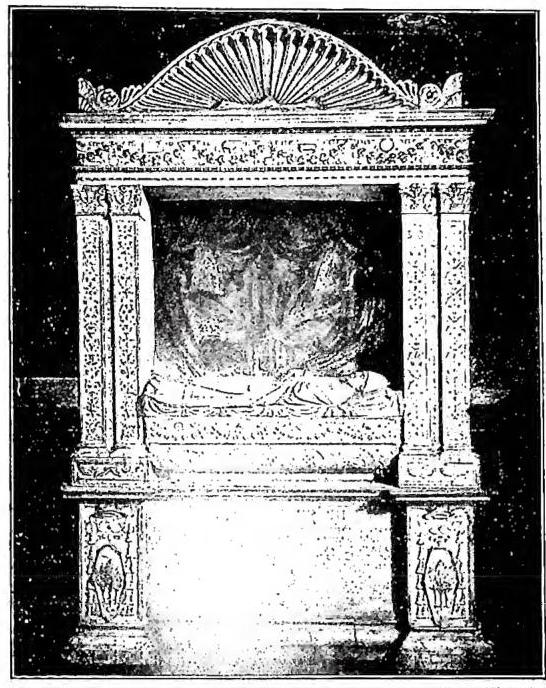
CAPRANICA, DOMENICO – Funerary monument (15th century), Rome, church of S. Maria sopra Minerva.Before C. had gone to Rome for the customary ceremonies in consistory, when he appeared to take part in the Conclave, the majority of the cardinals, hostile to him because he was a partisan of the Colonna family, refused to recognize him and sent him back to the legation of Perugia. Although this was contrary to the concistorial decree of 24 May 1426, he obeyed. Nor did the new pope, Eugenius IV, wish to recognize the legitimacy of his appointment. Rome was meanwhile prey to the anti-Colonna faction, and so C. took refuge on Soratte, vainly awaiting a change in the Pope’s conduct. Since the Council of Basel had opened in those days, C. went there, not to accuse but to defend himself. Indeed, while the Council recognized him as a cardinal, the Roman commission declared him deprived of the cardinalitial dignity, the bishopric of Fermo, and the legation of Perugia, and had his property and palace confiscated (1432). Despite the wrong done to him, C. was moderate toward his adversaries and reverent toward the Pope, with whom an opportunity for an agreement arose only two years later. A new judgment was held, and on 13 July 1434 Cardinal Albergati imposed the hat and ring upon C.: the condition of reconciliation was abandonment of the Council, which had become schismatic. Having thus regained the Pope’s favor, he received many important assignments. He took part in the union of the Greek and Latin Churches (1439); he was extraordinary legate in the war against Francesco Sforza, during which he was also wounded in the battle of Montolmo (19 Aug. 1443) and taken prisoner together with Piccinino. It was chiefly thanks to him that Germany broke away from the schismatic faction of Basel and returned to its former allegiance to the Roman Church. He was a friend and collaborator of Nicholas V (who, among other things, entrusted him with extraordinary embassies to various Italian states for the organization of the war against the Turks [1453]), and of Callistus III. Outstanding in works of piety, he always had the clergy’s morals at heart, and a project of his for the reform of the Church is found in cod. Vat. lat. 4039, f. 16°–18. Concerned with sound scholarship and the formation of an educated and well-prepared clergy, he founded
at the end of 1456 the Capranica College (v. COLLEGI ECCLESIASTICI). A good humanist and collector of manuscripts, he assembled a library of more than 2,000 volumes, now for the most part transferred with the Rossiano collection to the Vatican Library, where his manuscript works, mostly on religious subjects, are also preserved; he is credited with an Ars moriendi, published for the first time at Nuremberg without a date. At the death of Callistus III, popular opinion proclaimed him pope, but he fell ill and died a holy death. He is buried in Rome in the church of S. Maria sopra Minerva.
BIBL.: M. Catalani, De vita et scriptis D. C. card. antistis Firmani, Fermo 1793; J. Haller, Concilium Basilicum, II, Basel 1897; III, there 1900, passim; N. Valois, Le pape et le concile, I, Paris 1909, pp. 184–93 and passim; Pastor, I, passim; F. A. F., Il card. D. C., profilo biografico, in Capranicense (journal of the Capranica College), Aug. 1928, pp. 23–28; M. Morpurgo-Castelnuovo, Il card. D. C., in Archivio della Soc. romana di storia patria, 32 (1929), pp. 1–146; K. Küp, An Italian edition of «Ars moriendi», in Bulletin of the New York Public Library, 39 (1936), pp. 927–30.
The brother of Cardinal Domenico was ANGELO, also a cardinal and his equal in austerity of conduct. He was appointed archbishop of Siponto on 17 March 1438; bishop of Ascoli Piceno on 5 May 1447, and of Rieti on 25 September 1450. During this period he was involved in the canonization proceedings of s. Bernardino da Siena. He was governor of Foligno and then of Bologna; Pius II promoted him to the cardinalate on 5 March 1460. Returning to Bologna as legate, in 1469 he accompanied the Emperor Frederick III to Viterbo. In 1471 (3 Dec.) he was appointed legate a latere, with the task of visiting all the Italian princes to induce them to undertake the Crusade against the Turks. On 11 December 1472 he became bishop of Palestrina. In 1473 he was briefly administrator of the Church of Fermo, where he held a synod. As commendatory abbot of the monastery of S. Bartolomeo of Ferrara, he transferred it (1468) to Bernardo della Casa, a monk of Settimiano, from whom it passed in perpetuity to the Cistercians of the Congregation of Tuscany. He was among the papabili in the Conclave of 1471. He died on 3 July 1478 and was buried at the Minerva.
BIBL.: A. Ciaconius, Vitae et res gestae pontificum romanorum et S. R. E. cardinalium, II, Rome 1677, col. 1035; Ughelli, I, cols. 1211; II, col. 530; P. Fr. Kehr, Italia pontificia, V: Aemilia, Berlin 1911, p. 232; Pastor, I, II (v. indici); E. Goller, s. V. in LThK, II, col. 745. On the two cardinals and the other prelates of the C. family cf. U. Cameli, Il monastero di S. Bartolomeo de «Campo Fullonum» e i prelati di casa C., in Studia picena, 11 [1935], p. 102.
Renata Orazi Ausenda
Cite this article
“CAPRANICA.” Enciclopedia Cattolica, vol. III (1949), p. 432. Azione Romana digital edition, https://azioneromana.com/article/capranica.