
ARS MORIENDI. — An ascetic booklet in Latin, extremely widespread in the early days of typography (15th century), containing exhortations and prayers, together with illustrations accompanied by captions, for preparation for death. It is not a single work, since brief treatises or collections of varied content circulated under the same title (often expanded); the original framework flourished into a nearly «literary genre» of a didactic-devotional character, intended for both high and low people, although also useful to «clerics». Three distinct works disseminated in print are known, each of them connected with reworkings and adaptations, both in Latin and in the vernacular languages.
1) The first printed A. m. (17 m-4 leaves, in the types of Ulrich Zell, without place or date: Cologne? 1465?) is attributed in the «explicit» to Matteo di Krakow (Pomerania), bishop of Worms (d. in 1410). It is a collection of prayers and meditations. The oldest dated manuscript (in Brussels) is from 1466. It had at least eight further editions between 1470 and 1497 (especially in Strasbourg, Augsburg, and Paris), of which the first dated one is from 1478 (Venice, «per Bernardum pictorem et Erhardum Ratdolt de Augusta»), in 20 leaves, under the title Ars bene moriendi. Tractatus brevis et valde utilit de arte et scientia bene moriendi. From this derives the short treatise by Cardinal Capranica and the Spanish vernacular version of the period, Arte de bien morir.
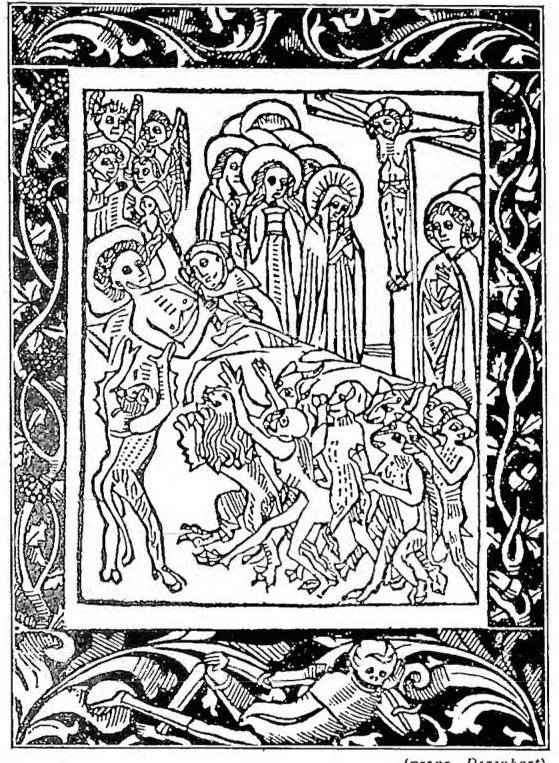
3) Related to the preceding work is a shorter A. m., disseminated (in at least five editions) between 1480 and 1505. It is limited to biblical passages, to which it adapts the figures; it consists of 14 leaves.
From the end of the fifteenth century, the Stimulus timoris Dei ad bene moriendum began to be added to the A. m.; it describes the punishments of hell and purgatory (at times also the Antichrist and the Last Judgment). The Ars bene moriendi was also published as an integration of the Ars bene vivendi (a recent and less fashionable work), following the example of Nic. Lirano in De arte bene vivendi et bene moriendi, and of Giov. Gersone. Eight editions are known of the French L'art de bien vivre et de bien mourir between 1492 and 1540.
The origin of the A. m. is unknown; it has been much studied from the artistic standpoint, but not yet from the literary one. It must have been composed at the end of the fourteenth century, following the terrible epidemics that ravaged Europe in that century. Through the work of Dominican and Franciscan preachers, the «memento mori» was inculcated no longer only in cloisters, but among the masses. Meditation on death became customary everywhere, with its three dominant themes: the transience of earthly splendors, the horrible putrefaction of every human beauty and strength, and the equality of every condition and age before sovereign death (illustrated by the Danze macabre; V. DANZA MACABRA).
The anonymous booklet (the first) has wrongly been attributed to Bishop Matteo di Krakow, or to Cardinal Domenico da Capranica, Archbishop of Fermo (d. in 1458), who adapted it (in 1452): the Arte del ben morire (24 quarto leaves), published in Florence (1477 and 1479), Verona, and Venice (1478; many other editions, with variations in the engravings, until 1513). The original is considerably earlier, and its content may perhaps be traced back to the German Dominicans B. Enrico Suso, who in the Libro dell'eterna sapienza devotes four chapters (part 2, chaps. 21-24) to preparation for death, especially sudden death, NIGERIA (v.), whose De arte moriendi was widely disseminated (two editions around 1465). A fearful description of the agony is already found in Innocenzo III, De contemptu mundi (PL 217, 702 ff.). Gersone, with the Opusculum tripartitum de praeceptis decalogi, de confessione et de arte moriendi (Opera, II, Paris 1606, cols. 258-83; and cf. Sermo III de defunctis, III, cols. 1568 ff.), must have given it its definitive impetus.
The A. m., already very well known in the first half of the fifteenth century, spread everywhere with the aid of printing, in a form revised by many and enlarged with passages by secular authors in prose and verse, biblical or patristic quotations, and exempla. Dionigi Certosino’s De quattuor hominum novissimis (d. in 1471; Opera XLI, p. 511 ff.; cf. Directorium vitae nobilium, Op. XXXVII, p. 530 ff.) is closely related to II. Besides those mentioned above, the following attached their names to the dissemination of the treatise, which they reworked or reproduced: Rodrigo de Santaella, archdeacon of Reyna (in Spanish, 1470); Alberto di Eyb, with two booklets from 1477 (Praeparatio ad mortem and the dialogue De morte); Nicola Weidenbusch (Saliceto), under whose name a De arte moriendi became popular (posthumously, Paris 1496); and, above all, Geiler di Kaisersberg, who through his zeal and genius breathed new life into the well-known booklet, making it his own text and adding to it the alphabetical rhythm De dispositione ad mortem, with new engravings. Bonifazio da Ceva’s Tractatus de scientia et arte bene moriendi (d. in 1517) seems to have been lost. The subject had long since entered popular literature: the poem Le Miroir de Mort by George Chastellin (1404-75) develops the three themes of meditation on death; La Danse Macabre (Paris 1485, with woodcuts by Guyot Marchant), like its contemporary Spanish counterpart, seems to derive from a Latin original. By contrast, the later treatises, denser in doctrine, on preparation for death—from those of the Bishop of Padua P. Barozzi (d. in 1507, De modo bene moriendi, ed. 1531), Erasmus (1525), Pietro di Lucca (Dottrina del ben morire, 1520), Josse di Clichtov (1520), to those of Ludovico Baer (1551) and Francesco de Hevia (1550), of St. Roberto Bellarmino (De arte bene moriendi, Rome 1621), and of V. Caraffa (Peregrino della terra overo apparecchio per la buona morte, Naples 1645)—caused the ingenuous A. m. to be forgotten, a moving testimony to the salutary eschatological shudder of a bygone age.