
DIONIGI CERTOSINO. – Theologian, exegete, and mystic, b. at Ryckel (Belgian Limburg) in 1402, d. at Roermond on 12 March 1471. His life, absorbed in contemplation and theological work, was simple and uniform. As a child he was a restless shepherd; he entered the Benedictine school at St-Trond, then moved to that of Zwolle, directed at the time by the celebrated Giovanni Cele. He studied at the University of Cologne while its cathedral was being built; at the age of 21 (1423) he entered the Charterhouse of Roermond, where he lived for 48 years.
He lived in seclusion in his cell, intent on making an inventory of the doctrinal tradition and composing works that seemed to him to answer the needs of his time. He made an exception to this programme of isolation only three times: when he carried out the duties of procurator of his monastery or rector of the new Charterhouse of ’s-Hertogenbosch, and when, in 1451–52, he collaborated in the legation of Cardinal N. Cusanus in Germany. The fruit of such exemplary assiduity is a vast theological encyclopedia of incalculable importance.
Taking up one of the most fruitful insights of Chancellor Gerson (d. in 1429), D. teaches that the purpose of contemplation is to govern the whole of intellectual life. For him, “exegesis and theology, the science of Scripture and of dogma, achieve complete development and logical crowning only in the human act par excellence (which is the end of man, here below as in heaven) called contemplation” (A. Mougel, p. 34). This thesis is developed profoundly in the prologue to the De natura aeterni et veri Dei (Op. omn., XXXIV, p. 11), where the Gospel, theology (s. Augustine), inspired mysticism (Ruysbroeck), and philosophy (Aristotle, Plato) are harmonized and fused. D. felt called to undertake a methodical and critical inventory of Scripture and of the entire tradition in order to nourish with living substance a mind tirelessly striving toward contemplation. Unlike Gerson, D. was not prevented by any adversity from completing this design. From this continuity there resulted a considerable and distinctive body of work.
As we know it from the recent edition prepared by the Charterhouse of Montreuil-sur-Mer (1896 to 1913), D.’s work occupies 42 quarto volumes; vol. I contains (pp. XLIX–LXX) the complete catalogue of the treatises, commentaries, sermons, and opuscula, in 187 numbers. A document (vol. XLI, p. 629) lists the lost works: 20 treatises properly so called, not counting many poems, letters, sermons, or various consultations. The surviving work comprises commentaries on all the biblical books, on the treatises of Ps.-Dionysius, Cassian, s. John Climacus, Boethius (De Consol. philos.), and on the 4 books of the Sentent., as well as treatises or opuscula on theology or philosophy, and sermons.
Distinguishing the various elements of this corpus, one arrives at a total of 880 numbers. If the 75 biblical commentaries and then the 690 Sermones are grouped separately (346 de tempore, of which 183 are ad saeculares and 163 ad religiosus, and 344 de
sanctis, of which 195 are ad saeculares and 149 ad religiosus), there remain 115 works or opuscula of dogmatic, moral, and spiritual theology, which at times extend into philosophy.
Since the Opera omnia have not been critically edited, a lengthy treatment would be required even to attempt to establish their chronology. It may simply be observed that the initial work seems to have been a De cute et essentia (lost), composed immediately after his mastership (cf. I, p. XXIX); in 1434 D. began writing in Psalmos (I, loc. cit., p. L, n. 2); in 1457 he completed his biblical commentaries; in 1466 he was still working on the De divinis nominibus (loc. cit., p. IV, n. 1); the entire series of sermons ad saeculares (de tempore and de sanctis) preceded the ad religiosus series (vol. XXIX, p. 5); his last book, a collection of meditations, dates from 1469. A crucial fact is that his commentary on the 4 books of the Sent. (vols. XIX–XXV) does not belong at the beginning but, at least in part, toward the end of his career, as is shown by the statement in III Sent., d. 36, q. 1 (vol. XXIII, p. 588, where D. declares that from the writings of Ruysbroeck—whose influence he therefore experienced from the beginning—he introduced many elements into the treatise de domis Spiritus Sancti, composed 34 years earlier). It is therefore in this commentary that D.’s definitive thought must be sought.
It is not possible to analyze in a brief space so vast and complex a body of work. It will suffice to define the method, determine the sources, and establish the characteristic features of the whole.
In his biblical commentaries, D. follows the sacred text chapter by chapter. When he sees nothing requiring explanation, he is content with an enarratio capituli; otherwise, he proceeds to the expositio, declaratio, explanatio, or elucidatio, according to the literal sense or the various spiritual senses. At the beginning he very often draws on scholastic authors, thereby leading scholasticism back to its source. As he proceeds, however, he increasingly interprets Scripture through Scripture itself. In the Gospel, he adheres to an extremely strict literal commentary, citing only a few Fathers.
His most original contribution consists in the short treatise De causa diversitatis eventuum humanorum, inspi-
In theology, struck by the extreme diversity of the opinions advanced before his time, D. establishes the principle of the equal legitimacy of soundly probable opinions, “when they are not defended with incautious and rash assertion” (Enarratio in Ex., art. 40: vol. II, p. 1 A′). He therefore proposes to cite many authors and to choose freely, while also elaborating mediating theses that gather together all the advantages of the authors consulted: “nempe ex uno solo praetctorum doctorum, non potest huius veritas quaestionis patere” (I Sent., d. 2, q. 2: vol. XX, p. 171). It is a consistent rationalism, consisting not in a demand for conformity to pure reason, but in the search for the closest possible approximation to supra-rational revelation.
In his Protestatio to his superiors (vol. I, p. LXXI ff.), D. lists his principal sources, which reflect the entire theological and philosophical tradition. D. gives prominence to Dionysius the Areopagite, “doctor meus electissimus.” Elsewhere he presents “Ill. mus ille Ioannes Cassianus” as “summus noster philosophus” (Sermo I de comm. conf. non pont.: vol. XXXII, p. 648). He frequently cites Boethius, but names William of Ockham only three times. He vigorously attacks Durandus of Saint-Pourçain (cf. I Sent., d. 36, q. 1: vol. XX, p. 402). He has great respect for Alexander of Hales, “qui ob eminentiam suae scientiae ab alma universitate Parisiensi meruit Doctor irrefragabilia appellari. Ideo eius auctoritas non est parvi pendenda” (I Sent., d. 2, q. 2: vol. XIX, p. 172). He strongly rejects Scotist formalism (ibid.: “Opinio... ceteris irrationabilior esse videtur, et tam philosophicis quam documentis contraria”). His fidelity to St. Thomas undergoes certain crises, since D. ultimately rejects the real distinction between essence and existence (I Sent., d. 8, q. 7, cited by A. Mougel, p. 15), and departs from the Master concerning the relation between the Christian religion and certain cosmological theses (Enarr. in I. Ecclesiasticae, art. 1: vol. VII, p. 215).
One of his most constant sources, the profound axis of his thought, appears in the Neoplatonic notion of processio-conversio and in the thesis explicitly attributed to Proclus: “Omne causatum et manet in sua causa, et procedit ab ipsa, et convertitur ad ipsam” (De lumine christianae theoriae l. II: vol. XXXIII, p. 235).
The essential themes were systematically condensed by D. himself in his two fundamental treatises: Elementatio Philosophica (104 propositions with commentary, in 11 parts: vol. XXXIII, pp. 21–104) and Elementatio theologica (159 propositions, in 16 parts: vol. XXXIII, pp. 105–231).
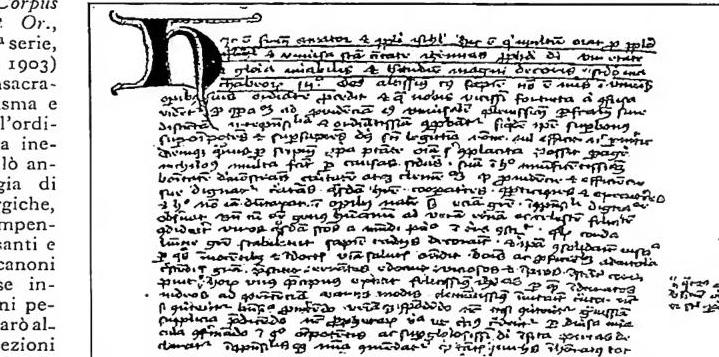
Here, however, is a passage that in summary expresses the whole system of metaphysical and theological optimism from which D.’s doctrine proceeds: “Quum etnum secundum Dionysium” (De cael. hier. 13, De div. nom. 4) divine light, which in its immensity is extended above every countenance of nature, is pure goodness, whose most proper characteristics are to have mercy, to flow forth from itself, to communicate its goodness, and to bestow grace; whenever it finds a soul capable of grace and illumination and worthy of the divine ray, as being free and pure from passions, studious and desirous of wisdom, it immediately diffuses its goodness, sends in the light of grace, and grants wisdom. And just as Christ promised, when that Spirit of truth comes, he teaches us all truth (Sermo I de comm. conf. non pont.: vol. XXXII, p. 648).
All of D.’s work proceeds from this central conviction. Characteristic of D.’s plan and resources are his synthetic works: Summa fidei orthodoxae, id est medulla operum s. Thomae II. IV. A similar synthesis, with apologetic elements (chapter 6: “De Antichristo et fallacis eius”; 7: “De probatione fidei Christianae ex Lege et Prophetis, et de Iudaeorum erroribus”), is the Dialogus de fide: disputatio inter theologum et philosophum, proponente et defendente theologo quod fidei est, philosophus autem quod naturalis ratio dictat (vol. XVIII), as well as the De dignitate et laudibus B. V. II. IV (vol. XXXVI, pp. 17–174).
D.’s authority is asserted chiefly in spiritual theology. Having examined in depth the concrete conditions of Christian life in all its states and the normal development of deiform Grace, imbued both with Cassian’s practical lessons and with the classifications of Climacus and the theories of Pseudo-Dionysius, D. worked out in the treatises Speculum amatorum mundi, L. de fonte lucis et semitis vitae, De oratione, De Contemplatione II. tres a doctrine rich in traditional substance and perfectly balanced. Adopting the tripartite division of spiritual progress, he leads the soul from the purgative way (in which meditation predominates) to the illuminative way (characterized by affirmative contemplation), and then to the unitive way, in which love and negative contemplation reign.
This supreme reign of love does not prevent D. from remaining formally intellectualist. For D., mystical theology “is identical with wisdom, which has its seat in the intellect” (St. Axters, p. 72), so that whatever takes place in “the summit of the will” occurs as a mere complement (“quoad complementum”). For D., divine wisdom is possessed in the manner of knowledge (Summa fidei orthodoxae, vol.: vol. XVII, p. 23).
For D., the two great masters of this wholly supernatural and infused wisdom are Pseudo-Areopagite and the contemplative Jan van Ruysbroeck. No one surrendered himself to the influence of the latter with as much confidence and fervor as D. (De distantia perfectionis divinae et humanae, art. 10: vol. XXXIV, p. 268).
The famous judgment of Alvarez de Paz is therefore not exaggerated: “Dionysius Rikelius, doctor utriusque scholae, mysticae et scholasticae, clarissimus.”
Not only do all “the school” speak through the innumerable pages of D.; their systematic study is an essential requirement for the history of Christian thought as it reached the boundary between the Middle Ages and modern times.