
BONIFACE VIII, POPE. — Benedetto Caetani, Supreme Pontiff from 1294 to 1303, was born at Anagni between 1220 and 1230 to noble parents. He went to Rome at a young age and soon showed an uncommon inclination for legal studies. His rapid rise in the curial circles was certainly due to his lively intellect and tireless activity, as early as 1264 he is found in England in the retinue of the legate Cardinal Ottobono Fieschi, the future Adrian V. Later, in 1280, he successfully concluded with Cardinal Matteo Rosso degli Orsini the negotiations begun in Germany by Bishop Niccolò of Tripoli for resolving the dispute over the dominion of Provence between Rudolph of Hapsburg, King of the Romans, and the Angevins of Naples. Created a cardinal deacon of S. Nicola in Carcere by Pope Martin IV the following year, he was entrusted by the same pontiff two years later with the difficult task of preventing the concerted and scandalous duel between Charles of Naples and Peter III of Aragon, who had become irreconcilable enemies after the Sicilian Vespers of 1282, which had driven the Angevins from the island and secured it for the Spaniards. When both sovereigns died in 1285, the combined diplomatic efforts of Cardinals Caetani and Gerardo da Parma easily led their successors, Charles II of Anjou and Alfonso III of Aragon, to conclude the Treaty of Tarascon in 1291, not without the intervention of Philip IV the Fair, an open protector of the former. This agreement, glorious for the papacy and very useful to Charles II—who, after so many defeats, obtained full freedom for himself and his sons and found himself undisputed lord of Sicily—was too humiliating for the victorious Aragonese and the disappointed islanders to be truly constructive and lasting. Caetani was promoted in the same year to the presbyterial title of SS. Sylvester and Martin. From then on, besides being an eminent jurist, he began to distinguish himself among the other members of the Sacred College for his evident diplomatic skill, as well as for many other qualities. He did not, however, obtain the tiara until after the resignation of Celestine V (q.v.) in 1294. It was precisely Caetani who, when the inexperienced pontiff, after only five months, desired to return to his longed-for hermit life and asked his advice on the lawfulness and advisability of a possible resignation, did not hesitate to encourage and comfort him, without resorting to those artifices of which he was later so unjustly accused, and which the very Villani so readily believed.
Thus, after the famous resignation on 13 December 1294 in Naples, in the conclave convened there ten days later according to the Gregorian provisions restored by Celestine V, a few ballots led to the proclamation as pontiff, with a large majority of votes, of Cardinal Benedetto Caetani (24 December), who took the name of Boniface VIII. This was therefore an absolutely canonical and regular election, achieved without the simoniacal intrigues to which Dante alludes.
The fundamental aims of the new Pope were to restore the complete freedom of the Church and to pacify the Christian people. He immediately demonstrated a profound and jealous love for the independence of the papacy by freeing himself from the insinuating influence of the Angevins by transferring himself at once to Rome, where the solemn coronation took place on 23 January 1295, and where he also issued the first measures aimed at restoring the splendor of the Eternal City, a splendor much diminished by so many wretched events. He nevertheless remained faithful to the traditional relations of good friendship with the Angevins, who did not cease to defend Guelf interests against the immoderate imperial enthusiasms of the Ghibellines. In this sense must be viewed and judged many of the most controversial moments in the history of Boniface’s pontificate, and especially the events concerning the defense of the Angevin dynasty in the Kingdom of Sicily, the struggle against the Colonnas, and the conflict with Philip IV, King of France. As to the first, we recall that, having already absorbed much of the Pope’s work while he was still a cardinal, it continued to preoccupy him throughout his pontificate, since in 1291, upon the death of Alfonso of Aragon, succeeded by James II, who entrusted Sicily to his younger brother Frederick, it became impossible for Boniface, under the terms of Tarascon, to satisfy both the Aragonese and the Angevins. After laborious and lengthy negotiations, however, he was able to conclude at Anagni in 1295 a treaty similar to the first, by which, while Aragon was freed from the French threat justified by King Philip with alleged rights of reprisal against the occupation of Sicily granted by the Holy See, James renounced dominion over the islands of Corsica and Sardinia, of which the Pope disposed as lord. It remained, however, to induce the young Frederick to renounce the Sicilian crown; and Boniface nearly succeeded in this at a meeting in Velletri, with the vague hope of splendid marriages and uncertain imperial succession. But against so much effort arose the fierce opposition of the Sicilians, who were decidedly averse to French rule, so much so as to force the prince to have himself crowned in Palermo in 1296 in defiance of the Pope, the Angevins, and even his own brother James II, who, urged by the Pontiff, went to war against Frederick while he lived in Palermo with their common mother Constance, daughter of King Manfred. Indeed, it was Boniface who had negotiated the marriage of James II to Blanche, daughter of Charles II of Anjou, and two years later, in 1297, in the presence of the Aragonese in Rome, he had granted him the promised investiture of Sardinia and Corsica, naming him moreover standard-bearer and admiral of the Churches and thus putting him in a position to personally lead all the land and sea forces for the recovery of Sicily in favor of his father-in-law and to the detriment of his brother Frederick III, who had in the meantime been excommunicated by the Pope.
But although the famous admiral Roger of Lauria abandoned Frederick and transferred his fleet to the service of the Angevins, the intrepid monarch, with the support of the faithful Sicilians, so valiantly sustained the unequal struggle against the coalition that he wore down the King of Aragon in 1299. And when the latter, urged by the Pope, resumed the war the following year, and by Boniface’s invocation Charles of Valois, the unfortunate peacemaker of Florence, came from France to support the Angevins, Frederick did not falter and resisted until the Peace of Caltabellotta in 1302. The Pope too, not without hesitation, gave his consent to the peace, hoping that, according to the letter of the agreements, Sicily would at Frederick III’s death definitively return to the French dynasty, which not only did not happen, but a century later the Aragonese drove the Angevins even from the Kingdom of Naples.
The intervention of Charles of Valois proved, as noted, no happier even in relation to Florence, torn by adverse and irreconcilable factions. The Whites had already been severely struck by the first papal legate, Matthew of Acquasparta, a former general of the Franciscans, who clearly inclined toward the Blacks; but matters worsened when the French prince and condottiere, in 1302 openly taking the side of the Blacks, did not hesitate to drive the Whites from Florence. As is well known, this misfortune involved Dante himself, who sided with the Whites and later took revenge in his immortal poem on Acquasparta, Valois, and principally on Boniface.
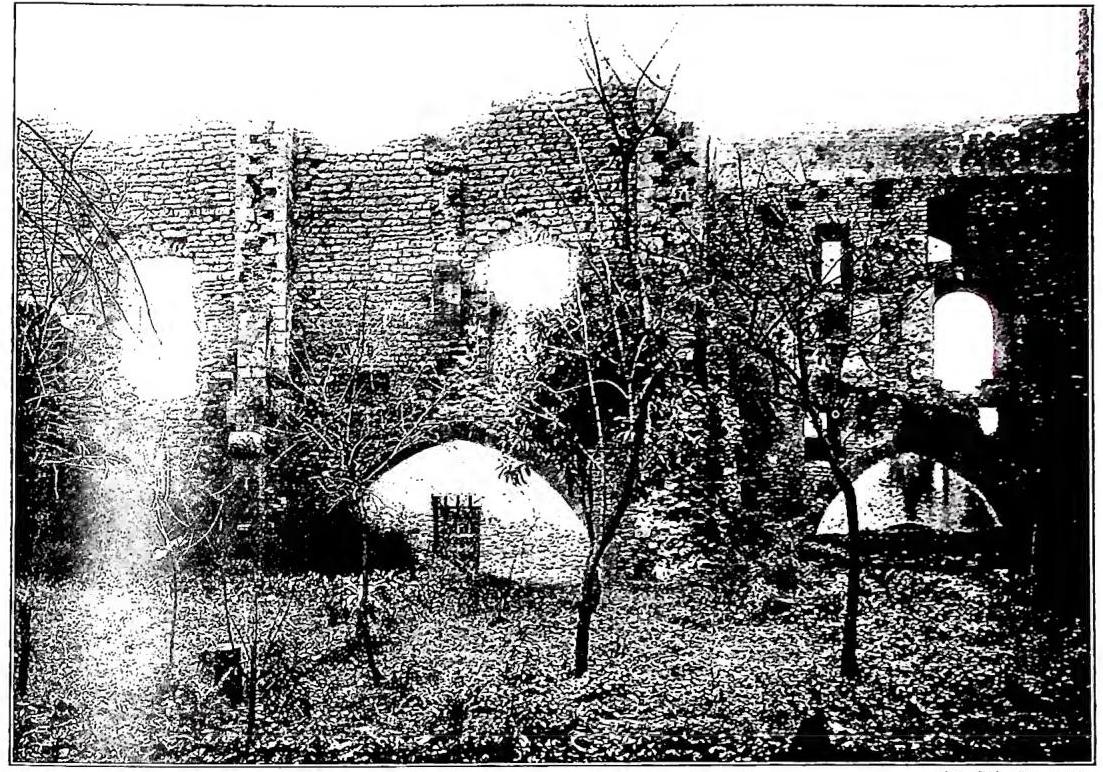
(photo Gab. fot. 1862.)
Yet the pontificate of B. was marred by tragic events owing to the rebellion of the Colonnas and the struggle with Philip IV, King of France. The former is linked with the hostile attitude of the Franciscan Spirituals, who in their turn aimed to depose the Pope. The resignation of Celestine V, an almost unique event in history, gave rise in the minds of many contemporaries to doubts about the legitimacy of that divorce between the Pope and the Church of Christ, His mystical spouse. Moreover, the humble and retiring gesture was bound to displease not only the Angevin court, which had so much expected from the inexperienced hermit of Isernia, but also all who shared the mystical views of the latter in the government of the Church, so that
many soon came to regret the yielding and humble conduct of Celestine when compared with the inexorable justice and iron-clad intransigence of his successor. The first rumours about the alleged illegitimacy of B. spread precisely within the circle known as the Spirituals among the Friars Minor, where the mystical and popular poet Jacopone da Todi stood out, while the finest intellect among them, Olivi, did not share such an erroneous opinion at all. This view, however, found fierce and obstinate defenders in Ubertino da Casale and others, who could not forgive B. for suppressing the exemption already granted by Celestine V to the Marchigian Spirituals.
The direct responsibility for having stirred up a wave of resentment against the Pope devolves upon the Colonna cardinals James and Peter, who did not even refrain from exploiting to their own advantage the pitiable case of the imprisonment and death of the resigning Pope. It is well known that B., justly fearing that the wicked would take advantage of the simple-mindedness of the humble hermit, ordered the abbot of Monte Cassino to bring him to Rome. After a vain attempt at escape, the old man was seized and taken to Anagni in the Pope’s presence, who had him guarded in the nearby fortress of Fumone, where, in a poor cell, he piously expired on 19 May 1296, not by a violent death, as was falsely asserted among others by the Colonnas. Between Colonna and Caetani there is no trace of genuine antagonism before that year. And the two cardinals James and Peter had cast their votes for Caetani in the Neapolitan conclave. Among the Colonnas, however, Cardinal James acted as a despot, even considering himself entitled to enrich his nephews—among them not least Cardinal Peter and the impetuous Stephen—with the administration of the common property, to the great detriment of his brothers, who, discontented and resentful, appealed to B. Thus the Pope found himself constrained to take sides in this most delicate family affair and ordered Cardinal James to cease administering his brothers’ patrimony, thereby incurring the enmity of the two cardinals and their adherents. B. moreover suspected that a family so closely tied to the Aragonese of Sicily against the interests of Charles of Anjou, protected by the Church, might wield its power in a way contrary to papal policy.
(photo Anderson)
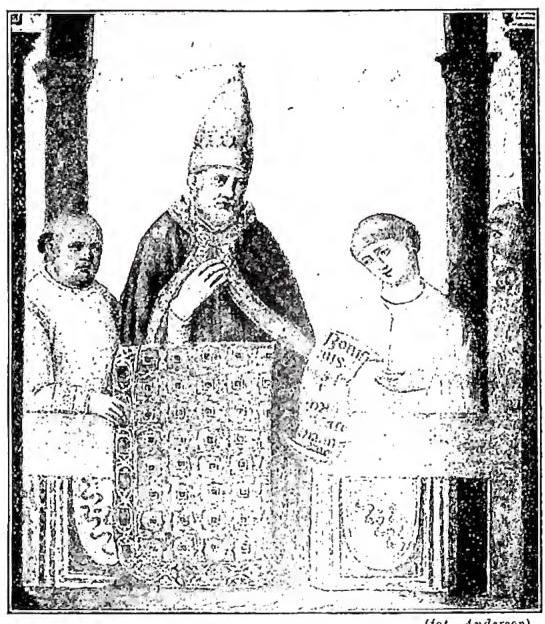
BONIFACE VIII — The Pope publishes the bull of the Jubilee of 1300. Fresco attributed to Giotto, restored — Rome, basilica of St John Lateran.
The legates sent by the Pope at the beginning of 1295, cardinals of Albano and Palestrina, negotiated a truce between Edward of England and Philip IV the Fair, a truce soon broken by the latter’s fault. The worst was that the two sovereigns, lacking funds to sustain so costly a war, laid hands on tithes and other ecclesiastical revenues, so that some French bishops begged the Pope to remedy such abuse. Boniface replied with the bull Clericis laicos of 25 Feb. 1296, in which, after deploring the excesses of lay power against church property and the culpable compliance of ecclesiastics in this matter, he launched excommunication ipso facto against those who, without apostolic licence, granted anything of the sacred patrimony to laymen under any pretext; with the same censure he then struck laymen of any rank, even royal or imperial, who without prior permission of the Holy See exacted such tributes or donations. These decrees in essence repeated those of the Lateran ecumenical councils, but these were little observed and, moreover, were not formulated with such rigour and severity, especially regarding civil authority. King Edward took offence and sought to react, but finally yielded to right before the firmness of the English episcopate; thus Boniface’s constitution entered into force in that realm and elsewhere, but not in France. King Philip, stung to the quick and seeing a rich source of revenue closed to him, immediately retaliated by forbidding the export of money and other precious objects, thereby indirectly striking at the economy of the Roman Curia, sustained by contributions from the whole world. The Pope then judged it prudent to show greater favour to the king, especially since many malcontents claimed that feudal dues rightly owed to the monarch were also included in the papal prescriptions; so with the new bull Ineffabilis he declared such an interpretation erroneous and, regarding spontaneous donations, allowed them to be granted by the clergy and, in case of great necessity judged by the king and the state, ecclesiastical tributes might be exacted even without apostolic faculties. Thus, for a time, harmony was restored between Philip and the Holy See, and Boniface could present himself as a welcome arbiter for concluding an Anglo-French armistice, and, the Sicilian war being temporarily suspended, he could announce in a nearly general peace the first Jubilee of the Holy Year of 1300, which brought to the Eternal City an unprecedented multitude of faithful from all the world.
Yet given Philip’s haughty character and his scant scruple in ecclesiastical matters, new clashes with the zealous and energetic Pope were to be expected, although Boniface was making every effort to exalt the French princes of Anjou and Valois, and although with the canonization of St Louis, grandfather of the king, celebrated in Aug. 1297, he had given splendid proof of affection for that nation. An occasion for fresh conflict arose in 1301 with the ill-advised appointment of Bernard Saisset, bishop of Pamiers, who was little pleasing to the king because of a prior dispute. Saisset was to repeat to the monarch the grave complaints of the Holy See regarding the continual infringements of canon law on ecclesiastical immunity and tithes in France. Against the worthy legate, who had fearlessly delivered the perilous papal mandate, Philip proceeded as against one guilty of lèse-majesté, having him imprisoned by the archbishop of Narbonne and demanding his deposition by the Pope. The latter, deeply displeased, in Dec. of the same year issued the bull Salvator mundi, communicated to the king with another, Nuper ex rationalibus causis, wherein he declared the privileges lately granted void and demanded immediate satisfaction for the affront. In the letter Ausculta fili, moreover, he paternally but sternly admonished the monarch to show himself a more worthy son of the Church. These letters and the summons to French prelates and doctors to appear in Rome for the reform of so many abuses and the defence of ecclesiastical liberty in that nation infuriated the sovereign and his court, while Pierre de Flotte and then Guillaume Nogaret drove Philip to extreme measures. Instead of the bull Ausculta fili, publicly burned, another forged one was circulated in which the Pope was made to speak with coarse and harsh words against the king. At the same time an answer by Philip of outrageous irreverence toward the Pope was put into circulation. In Apr. 1302 the monarch convened a parliament of the three estates in Paris, and there Flotte and others maliciously accused Boniface of tyranny toward France, thereby securing the nobility and bourgeoisie to side entirely with the king to defend what they called the liberty of the nation. The prelates and clergy, without reaching the excesses of the other two estates, likewise yielded to the sovereign’s demands, afterwards recommending to the Pope greater benevolence toward their homeland. More serious still was the tenor of the nobility’s letter to the Sacred College, in which Philip’s complaints against the Roman Curia were justified. Boniface replied to the ecclesiastics with the bull Verba delirantis filiae, censuring their lack of zeal for the interests of the Church; to the letter of the nobility the cardinals replied defending the Pope’s conduct in the dispute, and Boniface echoed this in the consistory of Aug. and in the Council of Oct. of the same year 1302. Meanwhile the Roman synod proved memorable, where despite King Philip some French prelates attended, and one of the most famous bulls in history was issued, the Unam Sanctam, perhaps the work of Giles of Rome, setting forth and clarifying Catholic doctrine on the unity of the Church under one head, on spiritual and temporal power—this subordinate to the former in moral matters—and finally on the obedience owed by all the faithful to the Roman Pontiff.
Yet although this document was naturally directed to the whole Church and without any particular aim, it was received with hostility at the French court, where after the death of Pierre de Flotte enormous influence had been gained by the counsellor Guillaume Nogaret, a bitter enemy of Boniface, and upon whom the two Colonna cardinals then sheltered by Philip also easily exerted leverage. Nogaret therefore proposed that an assembly of French prelates and nobles declare Boniface an intruder and urge the summoning of an ecumenical council. And indeed in June 1303 the meeting of the Louvre took place, where Guillaume Du Plessis presented twenty-nine articles against the Pope, containing accusations of heresy, immorality and superstition. The outcome of this unworthy scene was the demand for a general council, subscribed to by much of the episcopate, the university and other corporations in accordance with the wishes of King Philip. In the consistory held in Aug. at Anagni, Boniface rejected all the calumnies and errors with which the French charged him, justifying his actions with love for truth and the liberty of the Church; regarding those appealing to the council he issued a series of punitive measures, while at the same time preparing the bull of excommunication and deposition of the monarch, which was to be published on 8 Sept., had not the infamous sacrilegious assault at Anagni intervened the day before—a deed that Dante himself inflexibly stigmatized.
Il Nogaret and Sciarra Colonna, having gathered armed men among the Italian Ghibellines, presented themselves on the 7th of that month at the gates of Anagni, and after storming the papal castle, seized the head of the Church, who received them clad in sacred vestments with admirable calm and dignity. It cannot be proven that Colonna laid hands on the person of the Pope; nevertheless, he was detained with threats of being taken to France until, three days later, the people of Anagni rose up against the invaders and restored his freedom. BONIFACE, struck by the very grave outrage suffered, returned to Rome a few days later, where on 11 October of the same year he died piously and not despairingly, as his enemies later claimed, who did not refrain from persecuting even his memory. The greatest responsibility for what followed falls upon the king of France, who arranged everything so that the Anagni Pope would be condemned by the too compliant CLEMENT V, who, among other things, allowed the accusations against BONIFACE to be heard, and a kind of shameful trial to be initiated at the ecumenical council of Vienne, although it was limited to the rehabilitation of the Colonnas, the canonization of Celestine V, and, for the king, the undeserved papal declaration that he had acted in good faith in the Bonifacian affair. The bulls of BONIFACE against the king were erased from the papal register.
History, far more just and dispassionate, has now judged BONIFACE a Pope exceedingly worthy, endowed with great talent and uncommon wisdom, an intrepid and steadfast defender of the freedom of the Church, although certain imprudent acts and words—source of the ruin of noble but perhaps anachronistic designs—cannot be admired.
— Vedi Tav. CIX.