
EGIDIO ROMANO. — One of the great masters of scholasticism, superior general of the Augustinians, archbishop of Bourges, born in Rome, in the Colonna district, around 1243, died at Avignon on 22 December 1316. Giordano di Sassonia, who had studied in the Augustinian convent of Bologna between 1320 and 1330, calls him de nobili genere Columnensium; Ambrogio da Cori (v.) in 1481 simply calls him de regione Columnae; but in the oldest documents the appellation Colonna is not found.
I. LIFE
Having entered the convent of S. Maria del Popolo as a young man, around 1260 he was sent to Paris to complete his studies, where around 1263 he was baccalarius artium, around 1266 magister artium, and around 1272 baccalarius biblicus. In 1278, following the condemnation of Aristotelianism by the bishop of Paris, Stefano Tempier (7 March 1277), E., who appeared to be Aristotelianism’s most capable defender, was ordered to retract certain propositions; he refused and was forced to interrupt his academic career. In June 1279 he was designated definitor of his province at the General Chapter of Padua (1281), where he took part and disputed 20 questions. In 1285, furnished with a letter from Pope Onorio IV, he returned to Paris, made an act of submission, and was declared a doctor. From 1286 to 1292 he held the chair of theology, surrounded by great admiration: qui modo melior de tota villa in omnibus reputatur, says a contemporary. At the General Chapter of Florence in 1287 he was proclaimed the Order’s official doctor, and at that of Rome, on 6 January 1292, was elected prior general. In 1295 he left the direction of the Order, having been preconized archbishop of Bourges, where in 1296 he began his pastoral activity by convening a provincial council, which he again convened from 1312 to 1315. From this point onward he played a leading role in the religious and doctrinal struggles of his time. Bonifacio VIII often wished to have him near him; he was in fact in Rome in the years 1297–99 and 1302–1303.In 1305 he was charged with examining certain doctrines of the Dominican Giovanni Quidort. In 1311 he took part in the Ecumenical Council of Vienna, where he examined the errors of Olivì.
II. WORKS
E. was highly active in literary work. Of his authentic works, numbering approximately 70, the principal ones are: a) philosophical works: comprising the commentaries on Aristotle, composed from 1263 to 1278, the finest of which are In libros physicorum; In libros metaphysicorum; In libros de anima; In de bona fortuna and In libros de generatione; the important Expositio in lib. causis, from 1290; and the original treatises: Quaest. de esse et essentia; Theoremata de esse et essentia; Contra gradus et pluralitatem formarum; De formatione corporis humani; De regimine principum; De erroribus philosophorum, etc., almost all written between 1275 and 1285; b) theological works: Commentarium in I-II-III Sententiarum (the commentary on the third book reaches dist. 11, whereas that on the second is his strongest work and, among those of scholasticism, the most extensive); Theoremata L de corpore Christi; Quodlibeta sex, valuable for its teaching on the Eucharist; Quaest. X de mensura angelorum; Quaest. XIV de cognitione angelorum; Quaest. VI de comparatione angelorum; Quaest. X de motu angelorum; and the exegetical works In Hexameron; In epp. Pauli ad Romanos et Corinthios; In canticum cami-corum; Postilla super Lucam, etc. c) miscellaneous works: Tractatus contra exemplos; De renuntiatione papae; De ecclesiastica potestate, written in 1302 in defense of the papacy against Filippo il Bello; Expositio in decretalem «Firmiter»; Expositio in decretalem «Cum Marthae»; Capitula fidei christianae; Sermones de tribus vilili mundi; Serm. de tempore; Serm. de corpore Christi, etc. For the complete list, editions, and manuscripts, V. G. Bruni, Le opere di E. R., Firenze 1936.III. THOUGHT
On account of the richness and depth of his doctrine, combined with a clear and always lively exposition, though not always concise, he was called doctor fundatissimus. Numerous disciples gathered around him, forming the first and most flourishing theological school of the fourteenth century, which continued in the fifteenth and sixteenth centuries and was brought back into prominence by Gavardi in the seventeenth century, when a more strictly Egidian current arose alongside the Augustinian school.With regard to St. Thomas, E. may be described as his disciple, critic, and continuator. On many questions he represents a genuine advance. In philosophy, he anticipated the real distinction between essence and existence, which he steadfastly defended against Henry of Ghent. His is the doctrine of the “substantial modes,” later taken up by Cajetan. From Augustinianism he retained the primacy of the will, theology as an affective science, the moral efficacy of grace, etc.
Of particular importance are his political works: the De regimine principum, a work widely read in the Middle Ages, translated into the principal languages of Europe and even into Hebrew, in which, on an Aristotelian-Thomistic basis, he develops an extensive treatise on ethics, economics, and politics; and the De ecclesiastica potestate, which served Boniface VIII in drafting the bull Unam sanctam. In it he directly addresses the relations between temporal and religious power, setting forth, in accordance with the mentality of the time, a theoretical doctrine, specifically the theory of the Church’s direct power over temporal affairs (v. Stato). But the conception is more theological than juridical. The distinction between the end that the prince must pursue in the exercise of his power—an end that is supernatural and therefore directly subordinate to the Church—and the proper end of his power, subject to the Church ratione animae, will help clarify E.’s thought and show that, apart from genuine excesses of style, it is not far removed from the conception of indirect power.
BBL. For his life:
A. Gandolfo, Dissertation historico de scriptoribus Augustinianis, Rome 1704, pp. 30–36;
N. Martioli, Studio critico sopra E. R., ibid. 1896; P. Mandonnet, La carrière scolaire de G. de R., in Rev. der scien. phil. et libel., 4 (1910), pp. 481–99;
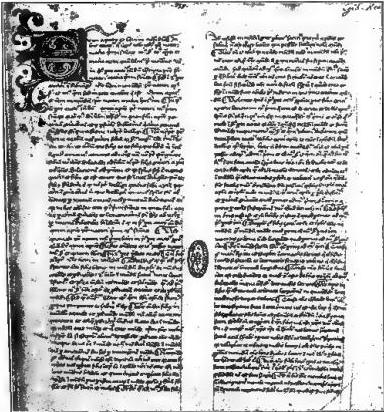
EGIDIO ROMANO - Incipit del Commentarium in librum sententiarum (sec. XVI).
Biblioteca Vaticana, cod. Vat. lat. 838, f. 17.
Tolentino 1942; G. of R., De erroribus philosophorum. Critical text with notes and introduction by T. Koch. Milwaukee 1944; D. Guiderze, La bibliografia de los escolisticos durante el ultimo decenio, in Ciudad de Dios, 156 (1944), pp. 17-48; G. Suárez, El pensamiento de E. R. en torno a la distinción de esencia y existencia, Salamanca 1945; R. Kaiters, De Summi Pontificis potestate secundum E. R. Roma 1940. Manca tuttora una studio complessivo sul pensiero di E. R. Agostino Trapè