
MANUZIO, FAMIGLIA. — ALDO the ELDER, celebrated publisher and humanist, was born at Bassiano (Rome) in 1449. He studied in Rome and Ferrara and was tutor to the Pio princes of Carpi, from whom he was granted permission to assume the surname. From Carpi he moved to Venice around 1490 in order to establish a printing press there. From 1494 to 1515, with some interruptions, he published approximately 130 editions, chiefly of Greek and Latin classics (27 editiones principes). Famous among them are the Aristotle in 5 vols. (1495–98), the Aristophanes (1498), the Poliziano (1498), the Epistles of St. Caterina da Siena (1500), the Demosthenes (1504), and the Plato (1513), dedicated to Leo X. From Aldo’s printing press there also emerged in 1499 what, on account of its splendid woodcuts, was called the most beautiful book of the Renaissance, namely the Hypnerotomachia Poliphili: an archaeological-allegorical romance by the friar Francesco Colonna. For the classical editions, some of them of great philological value, Aldo joined forces with several of the leading humanists of the period: Erasmo da Rotterdam, Scipione Forteguerri, Marco Musuro, Giambattista Egnazio, etc., whom he brought together in an Academy (1502), named Aldina after its founder. Beginning in 1508, the printer Andrea Torresano officially appears as his partner; Aldo had married his daughter in 1505. He died, worn out by his immense labors, on 6 February 1515.
Aldo, a universally admired apostle of the dissemination of the classics and the study of Greek in Italy and Europe, made Venice the most important center of classical culture. He was also a brilliant innovator in the field of typography, above all for having devised the small octavo format (“enchiridii forma”) with the elegant italic type (Aldine), engraved for him by the Bolognese Francesco Griffi. The editions in this format and type: the Virgil and
IN ORATIONEM
CICERONIS
PRO P. SEXTIO
commentarius,
AD ANTONIVM, AELIVM,
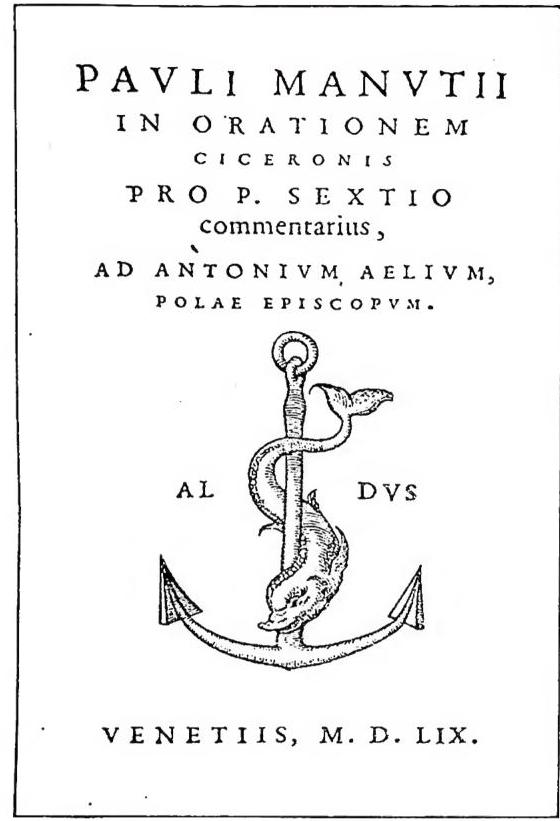
VENETIIS, M. D. LIX.
(from Ch. H. Ktenkens, Die Kunst der Litter, Lipsia 19/6, p. 38) MANUZIO, FAMIGLIA - Frontispiece of the Pro P. Sextio commentarius. Edition by Paolo M., Venice 1559.
enormous success and found admirers and counter-
feiters (despite the papal and Venetian Senate
privileges) outside Italy as well. The celebrated Aldine
device of the anchor with the dolphin appeared for
the first time in the Poetae christiani veteres (1502).
As an author, Aldo was above all a grammarian.
He wrote numerous prefaces to his own editions,
some Latin poems; he translated from Greek into Latin.
PAOLO, humanist and printer, son of Aldo, born
in Venice on 12 June 1512.
He reactivated his father’s printing house in 1533,
publishing new editions of the classics, especially Latin
ones. In 1561 he accepted the assignment, procured for him by
Cardinal Girolamo Seripando, of going to direct in Rome
a printing house desired by Pope Pius IV so that it
might publish corrected editions of the Fathers of the Church,
for the purposes of the anti-Protestant polemic. But after the
accession of St. Pius V, the printing house, managed by the
Roman People, increasingly confined itself to official editions
arising from the Council of Trent (Canones et decreta,
Catechismi, Indici and Breviari). In 1570, weary, Paolo
obtained from the Pope the rescission of the contract. He returned
to Rome in 1573 and died there on 6 April of the following year.
A humanist and Ciceronian, Paolo M. always regarded
his activity as a printer as secondary. His
commentaries on Cicero, studies on Roman antiquities,
prefaces and Latin epistles, repeatedly reprinted,
established his reputation as an eminent Latinist.
ALDO il GIOVANE, scholar and printer, son of
Paolo, born in Venice on 13 February 1547.
He collaborated with the Torresani in the Aldine printing house
beginning in 1568, and after 1574, following his
marriage to Francesca Lucrezia Giunta, joined the
Giunta printers in various publishing enterprises. At
the same time he taught eloquence at the University
of Padua, from which he moved in 1585 to Bologna, suc-
ceeding C. Sigonio, then to Pisa (1587), and finally to Rome
(1588), having been called there to occupy the chair left
vacant by the death of M. A. Mureto. In 1590
Pope Clement VIII entrusted him with the direction
of the Vatican Printing House. With his death (28 Oct.
1597), the illustrious family of the M. became extinct.
Of exceptionally precocious and lively intellect, but
rhetorical in character, and of an inconstant disposition, he
left, together with many secondary writings on philology and
antiquarian studies, his principal works: Vita di Cosimo I de' Medici (1586), *Le at-
tioni di Castruccio Castracane (1590), and 300 Lettere
volgari* (1592).