
TIPOGRAFIA. – The discovery of printing, whose consequences were to be incalculable, was encouraged by the circumstance that the copyists could no longer satisfy the commissions of the lords, increasingly captivated by admiration for the classical world, and also by the spread among the people of a love of letters and of the need for books. Industrious and ingenious minds thus turned their interests and studies toward
overcoming the crisis arising from the imbalance between demand and supply, and solving the problem of multiplying by industrial processes copies of works most sought after by the reading public.
The discovery of printing was therefore not the sudden inspiration of a genius, but the technical development of elements that already existed. Some have traced the historical process of this discovery back to woodcutting or engraving in wood, and later to the loose sheets bearing images of saints (such as the S. Cristoforo in the Spencer Collection, 1423) and to the so-called woodcut books (v.) and chiroxylographic books (the Bibla pauperum and other works of a religious character, the Speculum humanae salvationis, the Opera nova contemplativa, and works of a secular character, such as the various Calendriers and Almanacis and the Mirabilia Urbis): these, however, are independent of the earliest documents of printing with movable type, or types, as they are called in book composition.
The idea of a new system for the mechanical reproduction of the manuscript, other than the woodcut method, now seems certainly to Gutenberg (v.) of Mainz, although from chronicles and documents of the fifteenth and sixteenth centuries it is known that experiments in this direction must also have been carried out in parallel in the Netherlands (v. COSTER) and France. The French tradition rests on several notarial documents from the years 1444–46 discovered at Avignon: contracts of the Prague goldsmith Procope Waldfoghel, in Avignon from 1444, concluded with scholars and artisans in order to teach them « artem scribendi artificialiter ». These documents seem to indicate that Waldfoghel constructed a kind of primitive typewriter capable of reproducing, one by one, the letters of the Latin and Hebrew alphabets, but not of multiplying a text into numerous copies. In any case, this was a process entirely different from that conceived by Gutenberg, and it was only two years later that printing was introduced into France. Nor was Italy without its own legend, based on a report handed down by a seventeenth-century chronicle of Fr. Cambriuzzi, author of the Storia di Feltre, according to which the invention was to be Castaldi (v.). But documents and testimonies of far greater authority support the Gutenberg tradition, among them the Cronaca di Magonza in the German language for the years 1459–84, where under the year 1462 it is written that Giovanni Gutenberg was « der erste Buchdrucker zu Meinze », the first printer of Mainz; the Cronaca di Colonia, and the Cronaca di Eusebio, printed in Venice by E. Ratdolt, where under the year 1457 one reads: « A Joanne Gutenberg zum Jungen, equite Maguntiae Rheni, solerti ingenio, librorum imprimendorum ratio 1440 inventa ». One may also cite a letter from Guglielmo Fichet, a master of the Sorbonne, addressed in 1477 to Roberto Gaguin, in which the great services rendered to humanity by German printers, and especially by a certain Giovanni Bonomontanus, that is, Gutenberg, to whom the art of rapidly printing books with metal type was owed, are praised.
The new discovery spread rapidly; already flourishing in 1470 in nineteen German centers, it passed into Italy and became established in the principal cities between 1465 and 1473, in Switzerland in 1468, in France and the Netherlands in 1470, in Hungary, Bohemia, and Poland around 1473, and at approximately the same time in the Iberian Peninsula; in England in 1477, in Denmark and Sweden in 1482, and in Montenegro in 1493. Alongside works of a humanistic, popular, or scientific character, legends of saints, miraculous tales, moral works, and theological and liturgical booklets were also widely published, above all Bibles. In Italy, especially through the work of the Germans Corrado Schweynheim of Mainz and Arnoldo Pannartz of Prague (v. SUBIACO), the invention was encouraged and perfected; typographical characters lost the harshness of Gothic types and acquired new forms and elegant designs modeled on the Carolingian script of the tenth and eleventh centuries. The new, rounded type developed particularly with Vindelino da Spira and then with Jenson and Ratdolt, continuing through Giovanni di Reno, Dionigi Paravicino, Lorenzo di Francesco Alopa,
The discovery of mechanical printing was due to the German Friedrich Koenig, who in 1810 constructed the first mechanical press which, after various attempts to replace the first Gutenberg (v.), was able, through a series of improvements, to produce large print runs in a very short time. The typographic machines that industrialized an activity until then carried out by skilled artisans were classified, according to their various systems of production, as flat-bed, flat-cylinder, and rotary presses. The latter, operating at continuous rotational speed and with high output, were first constructed in 1846 and later perfected by Ippolito Marinoni and Giulio Derriey, and were generally used for the simultaneous printing of several sheets of a newspaper.
As for composing machines, the first to conceive of a “machine with type” was Roberto Gaubert, who in 1826 experimented with a rudimentary system for moving and distributing type, later perfected by John Mac Millian (1884). Once the prejudice that printing could be done only with type already prepared had been abandoned, special machines were developed in the nineteenth century which subsequently proved particularly useful in the printing industry: punch machines, which impressed the signs onto a plastic substance intended to serve as a matrix for casting the type; and matrix, or concave, machines, which cast the type letter by letter or line by line. These are the so-called monotype and linotype machines. The former was developed, after a laborious succession of attempts, by the American Tolbert Lanston (1897), and consisted of a keyboard and a composing-casting machine; the latter was created by the German watchmaker Othmar Mergenthaler (1885), and constructed so that in a single block it carried out the composition, justification, casting, and distribution of the matrices, completing the entire working cycle almost always without the intervention of labor: the “linotypist” need only strike a keyboard which, together with the so-called matrix magazine and the casting apparatus, constitutes the or-
(fot. Esc. Catt.)
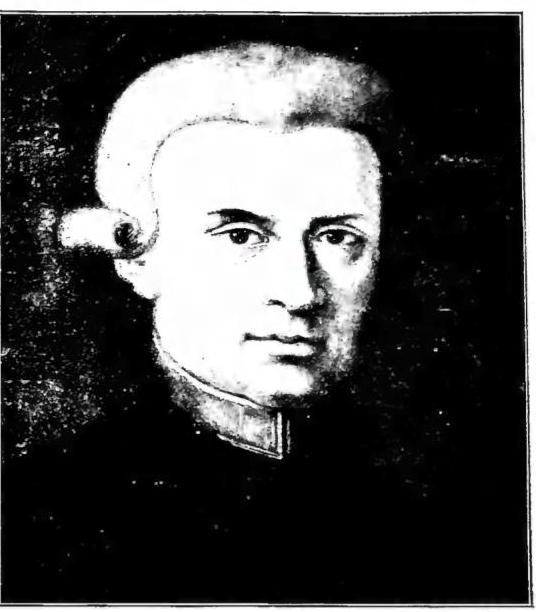
TIRABOSCHI, GIROLAMO - Portrait - Rome, Biblioteca Angelica.
the essential organ of the machine. The entirely mechanical process of placing the matrix in the composing machine, in the melting chamber where the line of type is formed, in the distributor, and then in the channel from which it emerged, permits a production of seven to eight thousand letters per hour. Other machines were subsequently constructed on the same principle, such as the typograph, the barotype (1890), and the intertype (1913). Taking advantage of phototechnics, further improvements were made to printing machines. In 1915 Bawtree and Lee created the photoline, which reproduces type photographically by using, for transparency, glass disks 25 cm in diameter on which the characters are arranged concentrically. Uniformity of type size is obtained by moving the matrices nearer to or farther from the sensitive surface, as with an ordinary camera. Robertson achieved better results with his machine (1922), using glass strips rather than disks, with the image of the letter transparent against a black background. With the teletypesetter (1929), an attempt was made to apply to printing the system of long-distance transmission used for telegrams. This consists of a central transmitting apparatus connected with other receiving apparatuses by telegraph or wireless, whose signals, emitted at a distance, perforate a roll of paper connected to the receiver and attached to a linotype equipped with an automatic control mechanism.
Other systems of mechanical composition include Max Ullman’s orotype (1935), the typar, the thothmic of the Englishman Hunter, and the uhertype of the German Uher, who thereby opened new horizons for the technology of book production. - Vedi tav. XV.