Machine translation of the 1948–1954 Italian original. The original text is authoritative.
STELE (= stela, στήλη, στήλις, ἰδος, dim. στήλιβιος, rad. sta, cf. ἰστήμι = erigo). — The term was used by the Greeks for every boundary stone, burial marker, boundary marker, and also for those columns or stone slabs displayed publicly on which laws, notices, decrees, treaties, and records of notable events were inscribed.
More particularly, they were those thin and slender slabs of stone or marble, slightly tapering from bottom to top, set upright and secured on a base, which were erected over tombs bearing the name of the deceased. Generally they had an architectural crowning in the form of a flower and leaves (ἀνθύμια), in relief or painted, or else a pediment with acroteria. The surface of the s. could contain relief representations relating to the life of the deceased; a very popular subject was the farewell of the dead person to his loved ones. Related to the s., especially in Attica, were marble funerary columns with inscriptions, crowned with capitals bearing acanthus leaves; they were customarily encircled with ribbons and wreaths. A Greek funerary s. is in the Museum of the Abbey of
(phot. Anderson)
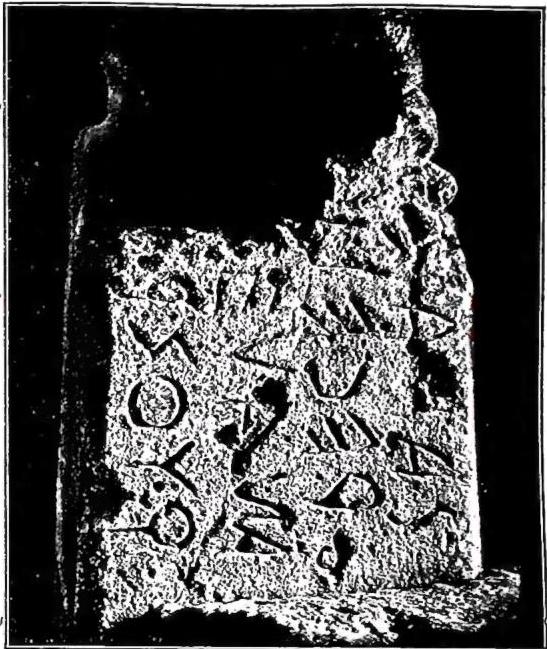
STELE – Cippus or stele with an archaic Latin inscription, engraved boustrophedonically (ca. 500 B.C.) – Rome, Roman Forum.
Grottaferrata, in which a naked young man is depicted in profile, seated on a stool and reading a scroll; crouching beneath the stool is a panther. Famous is the stele of Rosetta, discovered by Napoleon’s expedition in Egypt, on which was engraved the trilingual inscription that enabled Champollion to decipher the hieroglyphs (in 1821). The designation stele is also given to the well-known rectangular tuff cippus discovered in the Roman Forum in 1899, bearing on each of its sides and on a bevelled corner an archaic inscription with formulas of sacred ritual, dating from the seventh and sixth centuries B.C.
BIBL.: L. Conze, Die attischen Grabreliefs, 4 vols., Vienna 1893–1932; G. Perrot-Ch. Chipiez, Histoire de l'art. VIII, Paris 1903, passim; H. Diepolder, Die attischen Grabreliefs des 5. und 4. Jahrh. V. Chr., Leipzig 1931. Gioacchino Mancini
Cite this article
“STELE (= STELA, ΣΤΉΛΗ, ΣΤΉΛΙΣ, ἸΔΟΣ, DIM. ΣΤΉΛΙΒΙΟΣ, RAD. STA, CF. ἸΣΤΉΜΙ = ERIGO).” Enciclopedia Cattolica, vol. XI (1953), p. 797. Azione Romana digital edition, https://azioneromana.com/article/stele-stela-stele-stelis-idos-dim-stelibios-rad-sta-cf-istemi-erigo.