
IGNAZIO of LOYOLA, saint. — The youngest son of Beltrán Yáñez de Oñaz y Loyola and Marina Sáenz de Licona y Balda, he was born in 1491, before 23 October, in the palace-fortress of Loyola near Azpeitia (Guipúzcoa, Spain), and died in Rome on 31 July 1556. He was called Iñigo López de Loyola (not Recalde), though he almost never used the surname López, and changed his name from Iñigo to IGNAZIO between 1537 and 1542.
Raised in the deeply Catholic faith and the Basque customs of his family at Loyola until the age of 12–13,
he then served (1506?–17) as a page to Juan Velázquez de Cuéllar, treasurer to King Ferdinand the Catholic, residing with the court at Arévalo and Valladolid. During these years he read chivalric romances and indulged in sinful adventures (Azpeitia trial, 1515), yet also developed a love for music and sacred songs (a poem to St Peter and prayers to the Madonna during tournaments). After Velázquez’s fall (1517), he did not, as has been claimed, become a captain in the royal army, but rather a gentleman in the service of his kinsman the Duke of Nájera, viceroy of Navarre. In this capacity he took part, with prudence and high spirit, in the pacification of Nájera and Guipúzcoa and in the defence of the fortress of Pamplona, where he was gravely wounded by the French (20 May 1521).
During his convalescence at Loyola, while he still dreamed of winning the hand of a noblewoman (perhaps Doña Caterina, sister of Charles V?), divine grace transformed him into the perfect knight of Christ described in the Flos sanctorum and in Ludolph of Saxony’s Vita Christi, which he was reading. For love of this new king, he set out on pilgrimage to Jerusalem at the beginning of 1522; but he interrupted it for nearly a year, first spending a brief time at Manresa, then living as a hermit on the mountain of Montserrat and in a cave near Manresa, and later residing for many months in that Catalan city. There he became one of the most authentic mystics of the Church and the author of the Spiritual Exercises (q.v.), which he refined in Alcalá, Paris, Venice, and Rome (1522–41). After his pilgrimage to the Holy Land (1523), he began long studies to prepare himself to save souls and to gather companions for the apostolate, first in Barcelona (1524–26), then in Alcalá and Salamanca (1526–27), later in Paris (1528–35), Bologna, and Venice (1535–36). At Alcalá and Salamanca he was imprisoned, tried, and acquitted by the diocesan vicars Figueroa and Frías, not, as is often said, by the Inquisition. At the University of Paris, which he praised highly, after visiting Flanders and London he earned the degree of Master of Arts (April 1534). It was also in Paris that he finally gathered his first great companions (Faber, Xavier, Laínez, Salmerón, Bobadilla, Rodrigues) and, through the Spiritual Exercises, instilled in them the spirit of the vow of Montmartre (15 August 1534): an apostolate of poverty and chastity, if possible in Palestine even to the point of martyrdom for Christ; if that failed, wherever the Vicar of Christ wished, among believers, unbelievers, or Protestants, though without any direct anti-Protestant design. Up to 1539 IGNAZIO avoided founding an Order, not, as has sometimes been claimed, out of Erasmian leanings, but from fear that an ancient rule might be imposed on him that would clip the wings of his new-style apostolic ideal. The impossibility of reaching Palestine (May 1537–May 1538), the example of the recently founded Clerks Regular whom he first encountered in Venice (the Theatines), the protection of Paul III through Dr Ortiz and Cardinal Contarini, and finally his mystical experience at La Storta (November 1537) led him in 1539 to attempt the foundation of a new Order: the Society of Jesus (q.v.). This was followed by the Pope’s first verbal approval at Tivoli (3 September 1539), the written approval in the bull of 27 September 1540, then IGNAZIO’s election as General and the first solemn profession at St Paul’s Outside the Walls (8 and 22 April 1541).
The second phase (1550–56) opened with the new approval of the Society by Julius III (21 July 1550), which more explicitly described its aim—now consciously anti-Protestant—and its internal structure. This was followed by the approval of the Constitutions by the professed members and IGNAZIO’s resignation as General, which he offered (he claimed) because of his sins and infirmities (30 January 1551). He believed he had completed his personal mission and perhaps wished to remove any present or future pretext for the suspicion that he had introduced perpetual generalship for his own advantage, contrary to the practice of other Orders and of Gian Pietro Carafa. The resignation was rejected by all the professed except Oviedo, and he had to continue in office, though with even greater reliance on Polanco and Nadal. In these final years he founded the Roman College (1551) and the German College (1552); he so greatly expanded the pedagogical apostolate that he made the Society, in a new design, a teaching Order; he promulgated the Constitutions for the provinces (1553–55), giving the text a third revision and adding the letter on obedience (26 March 1553), the Summary of the Constitutions, and much of the Rules; at his disciples’ request he dictated the account of his life to Fr González de Cámara (1553–55) in a prose that created a new type of autobiography, no longer humanist in style; and finally he laid down important norms on how to give the Exercises, how to win over Protestants with conviction and love, and how to bring about the union of heretics and schismatics in Ethiopia. Thus, when IGNAZIO died, he had done for the Society perhaps more than any other founder was able to do for his Order in the time allotted to him. He had done so in the firm conviction that he was thereby rendering the greatest possible service to the Church and to the papacy. Through the Society he effectively added to the Church’s reform programme two features largely missing from the celebrated Consilium de emendanda ecclesia of 1537, and which were later of immense influence: the spread of a spirituality
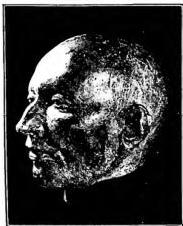
(courtesy of Fr P. Leturia, SJ)
IGNAZIO OF LOYOLA, saint — Plaster mask of the face of St IGNAZIO taken from the corpse — Rome, Archivio della Postulazione S.I.
centred on the service of faith and the defence of the papacy, and the creation of an international body of highly trained priests ready for any mission.
organically transformative as those of the Spiritual Exercises
and the wise organization of the education and instruction of youth, especially those destined for the priesthood; this simultaneously in Europe, America, and the Far East.
I. is one of the most genuine mystics of the Church, as is revealed by the almost habitual Trinitarian experiences recorded in his Spiritual Diary (from 2 Feb. 1544 to 27 Feb. 1545). From these lofty heights one understands his strong and tender love for Jesus and the Madonna, for the hierarchical Church “quae Romano est,” the Mystical Body of Christ, the Spouse of the Holy Spirit and our Mother; and for the souls redeemed by the blood of the divine Son. But his personal mysticism is joined to a great reserve in speaking of it, and to a great insistence on founding the Spiritual Exercises on the most conscious abnegation and solid asceticism: it is precisely there that the soul, with the help of Grace, gives to God what it can or prepares itself for true apostolate. Also characteristic of I. is the union of the supernatural with the highest esteem and use of natural forces, indeed of all those honest means (languages, science, the art of conversation, penetration of the spirit of the age, suitable and flexible organization, etc.) that often serve evil but can and must serve good instead. Loyola also succeeded in fusing into a unity of action the highest appreciation of the Church’s ultranational universality with the esteem and use of many national values, often opposed to one another. One need only consider his relations with the conflicting Catholic sovereigns of his time and with the often rival universities, and the understanding he was able to establish in his communities among Frenchmen, Italians, Flemish, Germans, and Spaniards. In unifying these forces for the Catholic Reformation, overcoming their antagonisms, he revealed himself as a true practical genius of organization. It is true that in the overall character of I. there stands out less the naive and sweet spontaneity of a Francis of Assisi or a Philip Neri; yet neither did his reflective consequentiality lack flexible and amiable attraction. Proof of this is the cordial love that his sons have professed for him, even when often strongly reproached by him, as were Lainez, Nadal, and Loarte. The latter beautifully defined him: “Father I. is a fountain of oil.” From the point of view of national psychology, I. succeeded in achieving the most successful union of the realistic, reflective, and tenacious spirit of the Basques with that ideally chivalrous and ecumenical spirit of the Castilian nobility of the sixteenth century.
St. I. was beatified on 27 July 1609 and canonized on 12 March 1622. His feast is celebrated on 31 July.
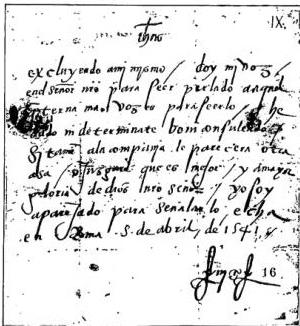
IGNAZIO DI LOYOLA, saint – Autograph vow of St. I. for the election of the Prepositus General (5 Apr. 1541) – Roman Archive of the Society of Jesus
ICONOGRAPHY. — There is a wax death mask and a plaster cast reproduced in these columns. The earliest and most authentic portraits are three: the first, painted in Rome by Jacopino del Conte, spiritual son of St Ignatius; the second, executed in Madrid by Alonso Sánchez Coello under the direction of Ribadeneira; the third, by an anonymous artist highly esteemed by Manareo and the Belgian Fathers. In the rich artistic iconography of Ignatius, notable works include the statues by Montañés, Hernández and P. Le Gros, the bas-reliefs by Alessandro Algardi and Renato Fremin, and finally the paintings by Rubens, Roelas, Carracci, Gaulli, Brother Pozzo and Salaverria. — See pl. XCVIII.
Pietro de Leturia