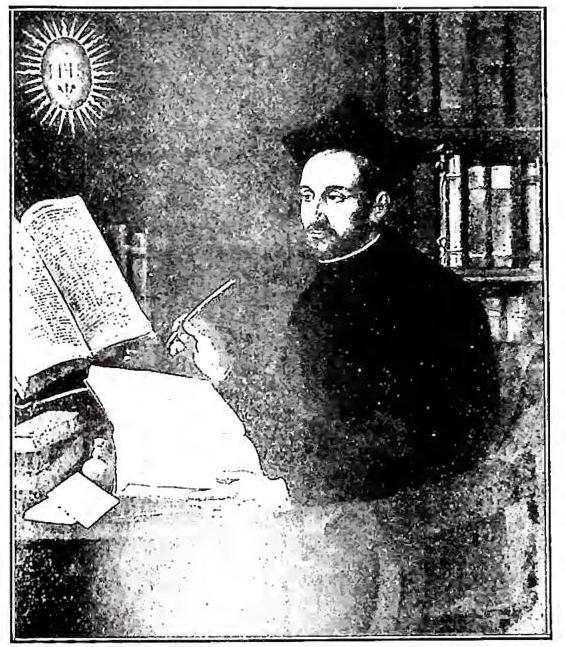
LAÍNEZ, DIEGO. – Theologian, second Superior General of the Society of Jesus, born in 1512 at Almazán (Castile), died on 19 January 1565 in Rome. Of great speculative intelligence, and endowed with no lesser gifts of government and practical ability, he completed his humanistic studies at Soria and Sigüenza, and his philosophical studies at the University of Alcalá (1532, Master of Arts); he went to Paris to study theology, attracted also by the desire to meet Ignazio di Loyola, soon becoming his admirer and disciple. Having received the Spiritual Exercises (late 1533), he resolved to embrace his master’s ideals of poverty, apostolic preaching, and active life, pronouncing his vows on 15 August 1534 at Montmartre with the eight companions who constituted the first germ of the Society of Jesus.
In November 1536, without obtaining his degree in theology because of the outbreak of war between France and Spain, he went with his companions to Venice, where Ignazio was awaiting them for the pilgrimage to Jerusalem. On 24 June 1557 he was ordained a priest there. When the journey to Palestine proved impossible, after preaching in the Veneto, he presented himself to Paul III, who commissioned him to teach scholastic and positive theology at the Sapienza in Rome, and then sent him to preach reform in Parma and Piacenza.
He was present at the Roman deliberations of Lent 1539, from which arose the draft of the Rule later approved by Paul III in a bull in 1540. Astute, learned, and studious, he was willingly heard by the founder, but his influence on the genesis and elaboration of the Constitutions of the Society of Jesus did not go beyond general counsel and proposals for concrete solutions, including the very important one of founding internal colleges for the Order’s young candidates who lacked education. His initial positions, unfavorable to humanistic studies, were expressly rejected by s. Ignazio.
When the Council of Trent opened (1545), he was sent there by Paul III as papal theologian and adviser to the cardinal legates presiding over it; there he displayed his assured scholastic doctrine, united with a prodigious knowledge of the Holy Fathers and Protestant writers. Active in the elaboration of the decrees on Justification, he was no less active in preaching and in giving spiritual exercises to prelates, in accordance with the instructions he had received from s. Ignazio. Still active at Bologna, and subsequently during the Council’s second period under Julius III, he spent the intervening years preaching in Venice, Florence, Sicily, Padua, and elsewhere, achieving extraordinary successes.
Elected vicar general upon the founder’s death (1556), he succeeded in overcoming internal difficulties in convening the General Congregation, which elected him superior (1558); but Paul IV immediately imposed on him the choir and the three-year term of office of the superior general. He obeyed, but obtained from Pius IV the restoration of the earlier concessions, with the choir abolished; and in 1561, at the end of the three-year term, when he wished to resign the office of superior general, against the opinion of the Order, Pius IV ordered him to continue holding it, thereby suppressing Paul IV’s command.
Sent by the same Pope in the retinue of Cardinal Ippolito d’Este to the religious conference at Poissy (1561), organized by Caterina de’ Medici between Catholics and Huguenots, he distinguished himself through his energy and learning. He took advantage of the occasion to extend the Order in Piedmont, France, and Flanders, and then, in 1562, was sent by order of the Pope to Trent, to the Council, as papal theologian and superior general of the Order. He took an especially forceful part in the debates on reform and on the jurisdiction of bishops, obtaining for the Society a singularly honorable mention (sess. XXIV, ch. 16).
His government was gentle and energetic, above all in removing less suitable subjects. Besieged by requests to open colleges and houses everywhere, he had to reject very many and accepted many others, perhaps overburdening the resources of the young Order, which was nevertheless developing vigorously: he had found it (1556) with approximately 1,000 members and left it with 3,500 in 130 houses, together with an increase in the number of provinces. He was aided by his personality, by the favor encountered everywhere by the Order’s activity, and especially by the complete confidence of Pius IV and of the cardinal nephew Carlo Borromeo.
He firmly supported the full implementation of the Ignatian Constitutions, approved with the force of law by the First General Congregation. Absorbed by his duties and by the government, he left occasional writings and was unable to carry out the project dreamed of for him by s. Ignazio: a Summa theologica adapted to the needs of the times. He was open to these needs and spared no effort to persuade kings and prelates of them. Death