
BAMBERGA (BAMBERG), ARCHDIOCESE of. — In Bavaria; it comprises Upper Franconia, the north of Central Franconia, part of Lower Franconia and the Upper Palatinate, and the former duchy of Koburg. It has 1,910,000 inhabitants, of whom 717,000 are Catholics, and is divided into 2 urban deaneries (B. and Nuremberg-Fürth) and 20 rural deaneries; it has a metropolitan chapter and an auxiliary bishop, 285 parishes, 561 secular priests, and 124 religious priests. Patrons: St George and St Henry the emperor. The city of B., predominantly Catholic and built on the banks of the Regnitz, is first mentioned in 902 and was dependent on the lords of Babenberg. In 906 it came under the direct authority of the Crown. In 973 Otto II ceded it to Henry I, duke of Bavaria. It then passed to his son, the emperor Henry II, who, intending to make it a centre for evangelization among the Slavs, obtained from John XVIII, on 1 November 1007, its elevation to an episcopal see. Benedict VIII consecrated the church of St Stephen there during his journey to Germany in 1020, and Henry wished the new diocese to be placed under the immediate dependence and lordship of the Holy See; this bond, however, was dissolved by St Leo IX in 1052. It had to endure the opposition of the bishop of Würzburg, from whose territory it had been carved out; this opposition was overcome only by granting that bishop certain territories in the March of Meiningen and the right of jurisdiction over certain parishes (cf. Hefele-Leclercq, IV, pp. 909 and 915). The diocese rapidly acquired considerable importance, thanks to the rich donations of its founder, who secured its economic standing: its very first bishop enjoyed the privilege of minting coins and levying tolls; it became a principality of the German Empire in 1230 by order of Frederick II, and in the sixteenth century it was placed in charge of the Franconian Circle. Because of their mild and peaceful character, the bishops Georg III Schenk von Limburg (1505–22) and Weigand von Redtwitz (1522–56) were unable to offer resistance to the Reformation.
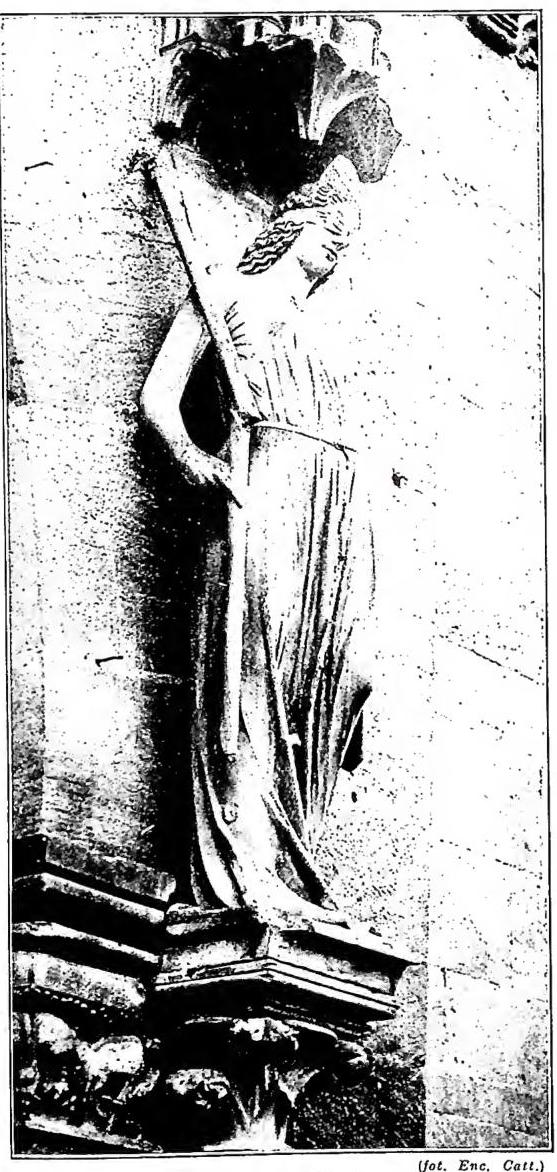
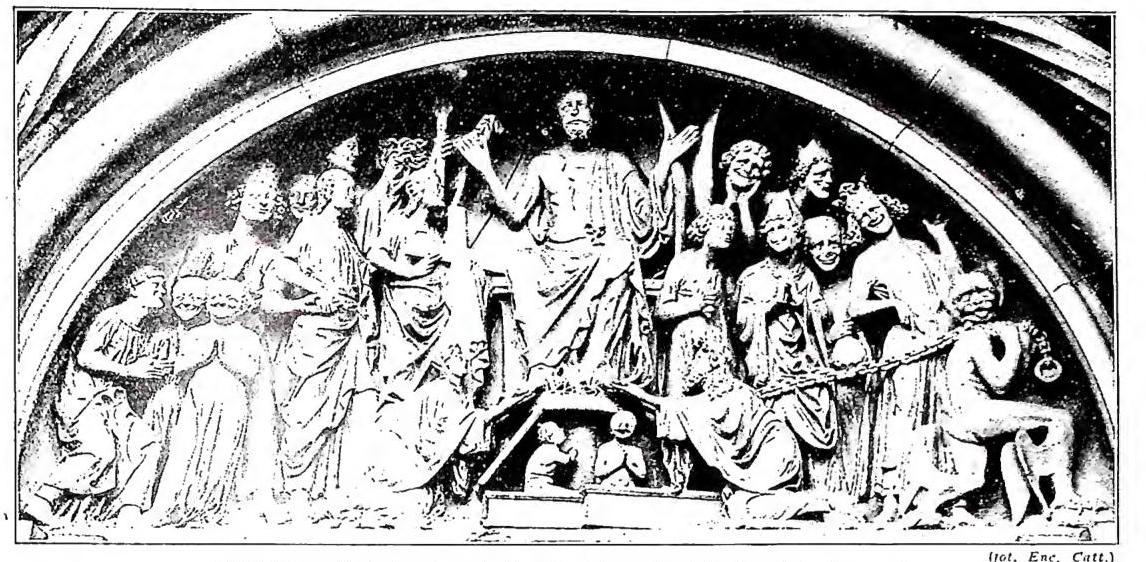
(phot. Enc. Cott.) BAMBERGA - Last Judgment. Lunette of the Cathedral portal (13th century).
Among the bishops of B. the following should be remembered: Everardo I (1007–40), who was chancellor of Henry II (1005), founded the collegiate chapter of S. Stefano (1009), and converted the pagan Wends; Suidger (1041–47), who became pope under the name of Clement II (1046), but retained the government of his diocese; s. Ottone I (1102–39), who was a true renewer of the diocese, founding and restoring about 30 monasteries; his name became famous for the conversion of the Pomeranians (1124–27); Giovanni Goffredo von Aschhausen (1609–1622), under whom the Catholic Reformation made good progress; he brought the Jesuits into the diocese (1611), and they took charge of the higher schools and the seminary; he arranged pastoral visitations, introduced popular missions and Marian sodalities, and was also bishop of Würzburg (1619); Federico Carlo von Schönborn (1729–40), vice-chancellor of the Empire, who was also bishop of Würzburg; he is renowned for the magnificent buildings he commissioned (the Chapter palace, the civic hospital, the seminary, the restoration of the Town Hall, the residential palace at Würzburg, and Werneck Castle) and for his generosity toward all cultural works; under his administration the diocese enjoyed a period of genuine religious prosperity; Francesco Luigi von Erthal (1779–95), one of the greatest princes of his time, likewise brought the two bishoprics of B. and Würzburg together in his hands. He visited all the parishes and founded various institutions of a cultural and social nature, showing himself a forerunner of modern social assistance.
THE SYNODS OF B. — The most effective expression of ecclesiastical government was provided by the assemblies and synods held up to 1200. Two popes attended them: Benedict VII (1020) and Leo IX (1052). In 1135 Emperor Lothair was reconciled during the Synod with the Hohenstaufen, thereby securing the unity of the empire. During the Synod of 1147, the body of St. Henry II was transferred to the Cathedral, and in 1200 the canonization of St. Cunegunda was celebrated. In 1451 CAUSA (v.) attended the Synod in order to settle the disputes between the secular clergy and the Mendicant Orders concerning Easter confessions.
ABBEYS AND MONASTERIES. — The following are noteworthy: Michaelsberg, a Benedictine abbey founded by Everard I (1015), which was renowned in the 11th century for its school of painting. Secularized in 1803, it now serves as a civic hospital. Banz, a Benedictine abbey founded by the Margravine Alberada (1069), destroyed during the Thirty Years’ War, was rebuilt under Abbot Ottone de La Bourde (1664–67). After secularization it was sold to the dukes of Bavaria (1814). From 1920 to 1926, the German Trappists, expelled from Alsace, found refuge there. Michaelfeld, a Benedictine abbey founded by St Ottone I (1119), now converted into an institute for the deaf and mute. Vierzehnheiligen, one of the most famous pilgrimage sites in Germany (120,000–150,000 pilgrims a year), founded in 1448. The present church was built (1743–72) to a design by Balthasar Neumann.
INSTITUTIONS OF CULTURE AND MONUMENTS. — As a center of culture, B. had a university founded by Bishop Melchior Ottone Voit von Salzburg (1648). Bishop Federico Carlo von Schönborn added the Faculty of Law, and Francesco Luigi von Erthal that of Medicine. It was suppressed in 1803. The principal monument is the Cathedral which, standing atop a hill, dominates the entire city and its surroundings with its four bell towers, 81 meters high. Together with the old and new episcopal palaces (sixteenth-century Renaissance and Baroque of 1704) and the old canons’ houses, it forms a harmonious ensemble. Founded by Enrico II, it was consecrated in 1019. After the fires of 1031 and 1185, it was rebuilt in its present form, in the transitional style between Romanesque and Gothic, and consecrated again in 1237. In 1924, the ninth centenary of the death of s. Enrico, it was elevated to the rank of minor basilica. It has two choirs and is exceedingly rich in sculptures. Noteworthy is the so-called B. Knight, an equestrian statue in the choir of S. Giorgio, whose author and the name of the person represented are unknown. The monument to the founder of the Cathedral and his consort, s. Cunegonda, is the work of Tilman Riemenschneider. Among the many funerary monuments, the tomb of the Emperor Corrado II and that of Clemente II, the only Pope buried in Germany, are especially noteworthy. — Vedi Tav. L.