Machine translation of the 1948–1954 Italian original. The original text is authoritative.
CURIOSITÀ. – An excessive desire to know and to acquire knowledge, both in the intellectual sphere and in the sensory-experimental sphere.
The desire for knowledge is natural to man, who is thereby impelled to acquire, even with effort, all those notions necessary for the preservation, well-being, orientation, and comforts of his existence; and to form and increase his own culture. But just as the desire to eat is in itself a good thing, yet can become disordered and excessive, so too can the desire for knowledge. When it remains within due limits, there is the virtue of studiousness (Summ. Theol., 2a-2ae, q. 166); when it errs through excess, there is c. (ibid., q. 167); when it errs through deficiency, there is culpable ignorance.
C. may be exercised: 1) In the intellectual sphere: a) when one applies oneself to the knowledge of truth for an evil purpose, e.g., out of pride or in order to commit evil; b) when one seeks to attain knowledge by unjust and illicit means (spiritism, occultism, divination, vain observance, theosophism); c) when one claims to know truths or events beyond one’s intelligence or reserved by God to himself (the end of the world, the mysteries of faith, the secrets of the future, God’s future free dispositions); d) when, for the sake of vain and pleasurable study, one neglects more important studies required by duty and one’s profession (cf. the reproach of s. Girolamo to the ecclesiastics of his time, who «neglected the Gospels and the prophecies in order to read comedies and sing bucolic songs [Epist., 21: PL. 22, 386]). 2) In the sphere of sensibility, when our senses, especially sight, hearing, and touch, are used to know and learn about good things, but for an evil purpose, and especially things that are unnecessary and at the same time dangerous (looks, reading, theaters, films, dances, etc.). Nor, especially in this matter, is the pretext of «wanting to know everything» or «trying everything» valid, just as it is neither valid nor applicable to foods and beverages, which are instead consumed by carefully distinguishing the beneficial from the harmful. 3) One sphere in which c. is exercised with the greatest ease and serious harm is constituted by the affairs of others. «To observe and take an interest in what others do, in a good spirit, either for one’s own benefit (to derive from it an incentive toward the example of good), or for the benefit of one’s neighbor (to correct him according to the rules of charity and the duties of one’s office), is praiseworthy; but to consider the defects, failings, and vices of others in order to despise one’s neighbor or give oneself over to detraction is deplorable and readily offensive to charity and justice» (Sum. Theol., 2a-2ae, q. 167, a. 2, ad 3ae).
(phot. Enc. Catt.)
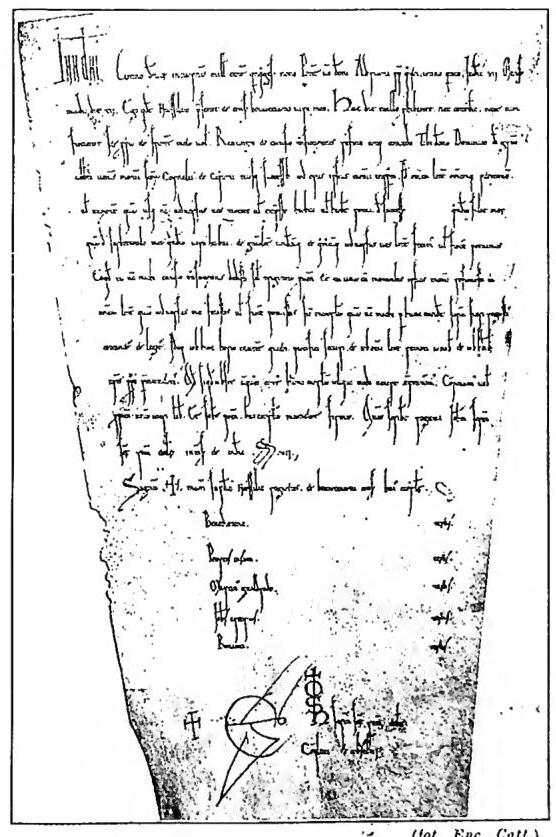
CURIALE, DOCUMENT — Deed of renunciation by Nassilia in favor of the monastery of SS. Cornelio e Cipriano (12 May 1159). Rome, State Archives, Fondo SS. Cosma e Damiano: parchment no. 128.
BIBL.: T. Pègues, Commentaire français littéral de la Somme de s. Thomas d'Aq., XIII, Paris 1931, pp. 634–643; O. Zimmermann, Lehrbuch der Ästhetik, Freiburg im Breisgau 1929, pp. 389–390. [Celestino Testore]
Cite this article
“CURIOSITÀ.” Enciclopedia Cattolica, vol. IV (1950), p. 641. Azione Romana digital edition, https://azioneromana.com/article/curiosita.