Machine translation of the 1948–1954 Italian original. The original text is authoritative.
PISANELLO, ANTONIO PISANO, so called. — Painter, draughtsman, and medallist, born in Pisa before 1395, died probably in Naples in 1450.
Having moved with his mother to Verona, he came to be called P., and Stefano da Zevio was probably his first master. In Venice (around 1415), P. painted, in the Doge’s Palace, a now-lost fresco beside Gentile da Fabriano, who may be regarded as his second master. In 1420 he was in Mantua; in 1424, once again in Verona; in 1432 in Rome, where he continued the frescoes left unfinished by Gentile in S. Giovanni in Laterano.
Among P.’s earliest works is the so-called Madonna della quaglia (Verona, Museo civico), in which the influence of Stefano da Zevio is dominant, while at the same time revealing an initial contact with Gentile’s ornamental and chromatic taste. Typical of P. is the sensibility that characterizes the drawing of the quail and the two birds at the sides of the throne, as well as of the two suspended corners, with a rhythm of Gothic linearism such as is found in the famous frescoed Annunciation beside the Brenzoni monument in S. Fermo in Verona (around 1424). Other works in which Gentile’s impression tends to replace that of Stefano are the fresco with the History of s. Eligio in S. Caterina at Treviso, and four small panels with the Stories of s. Benedeito, respectively in the Museo Poldi Pezzoli in Milan and in the Uffizi in Florence. The s. Girolamo of the same period (London, National Gallery) was claimed as a work of the young P., on account of its features recalling Lombard painting and Gentile, by Adolfo Venturi, who considered the signature apocryphal: Bonus ferrariensis pisani discipulus.
P.’s «animalistic poetics» is further affirmed in the Visione di s. Eustachio (London, National Gallery), in an incisive, draughtsmanlike, and medallist’s vision that, together with his profound portrait intuition of character and customs, recurs in all the artist’s works: from paintings to drawings (among which the group in the Louvre, originating from the Vallardi collection, predominates in number and quality), and finally to medals. Among the latter, mention should be made of those of Cecilia Gonzaga (1447), of Giovanni VIII Paleologo; the other for the marriage of Lionello d’Este; and those of Filippo Maria Visconti and Alfonso d’Aragona, etc. Among the paintings that share with the medals a nobly stylized vision of form, the following should be remembered: the Ritratto di Lionello d’Este (Bergamo, Galleria Carrara), that of a Principessa Estense (Paris, Louvre), and the fresco S. Giorgio e la Principessa (around 1436), in the church of S. Anastasia in Verona: here, although the world evoked by the artist is apprehended from the «real», it immediately becomes a legendary, romantic world, as in Gentile da Fabriano. Moreover, in all these works he shows that he can reconcile two formally opposed worlds: «international» Gothic and the aspirations of the Renaissance. Also worth recalling is a painting from the mature period: the Vergine col bambino in gloria, tra i ss. Antonio abate e Giorgio (London, National Gallery), signed Antonius Pisanus, in which the colour is sustained at a higher pitch, with a clarity suggesting connections with Jacopo Bellini. — Vedi tav. CVIII.
(Int. Musel of Rome)
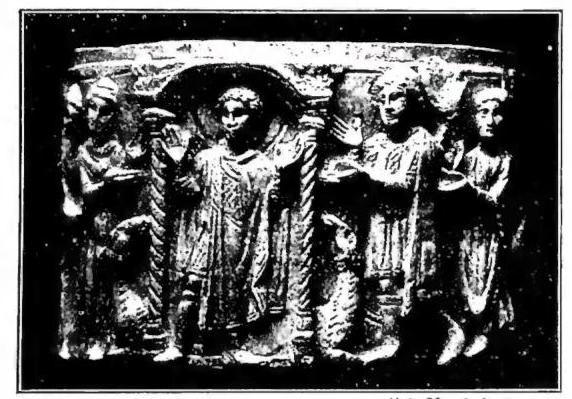
PISSIDE — Ivory pyxis with scenes from the life of s. Mena. The Saint praying between two camels (4th century) — Londra, British Museum.
BIBL.: A. Venturi, Gentile da Fabriano e P. (Le vite del Vasari, 1), Firenze 1896; G. E. Hill, P., Londra 1903; K. Zoege von Manteuffel, Die Bilder u. Zeichnungen des A. P., Halle 1909; J. Guiffrey, Les dessins de P. conservés au Musée du Louvre, 4 vols., Parigi 1911; G. F. Hill, s. V. in Thieme-Becker, XXVII, p. 92, with extensive bibliography; G. F. Hill, Les dessins de P., Bruxelles 1929; A. Venturi, P., Roma 1939; B. Degenhart, P., Torino 1945; id., Un'opera di P., il ritratto dell'imperatore Sigismondo a Vienna, in Arti figurative, 3 (1946), p. 166 ff.; id., Le quattro tavole della leggenda di s. Benedetto, opere giovanili del P., in Arte veneta, 3 (1949), p. 7 ff. Luigi Grassi
Cite this article
“PISANELLO, ANTONIO PISANO, DETTO IL.” Enciclopedia Cattolica, vol. IX (1952), p. 949. Azione Romana digital edition, https://azioneromana.com/article/pisanello-antonio-pisano-detto-il.