
SOMASCHI. – Religious order founded for the care of orphans by the Venetian patrician St. Girolamo Emiliani (or Miani [v.]) in 1528, in the parish of S. Basilio in Venice, with the moral support of St. Gaetano Thiene and of the bishop Gian Pietro Carafa (the future Paul IV), Emiliani’s spiritual director.
Little by little the work grew, and by about 1532 there were eight houses, scattered throughout the Venetian State as far as Somasca (Bergamo), whence the name of the Order. In that year Emiliani, seeing that his work had developed into a religious congregation, gathered his co-workers at Merone for a kind of consultation aimed at coordinating methods and work. This was the first Chapter of the Order, or rather—according to the name the Saint gave it at that time—of the Company of the Servants of the Poor. At the founder’s death (1537), however, the Congregation still had no canonical standing. The most faithful members then gathered in a second Chapter at Somasca and officially elected as their superior Fr. Angiolo Marco Gambarana, charging him to obtain from the Holy See confirmation of the Company. This was granted by Paul III on 4 June 1540 with the bull Ex iniuncto nobis. Six years later, at the request of the S. fathers and of Cardinal Carafa, the same Pope united the two Congregations of the Theatines and the S., while exempting the latter from pronouncing solemn vows. The purpose of this union was to supplement the work of the S., who were too few in number in relation to the orphans they assisted, with Theatine personnel; but it soon became clear that Emiliani’s charitable work would ultimately disappear, given the different mission of the Theatines. Therefore Cardinal Carafa himself, having become Pope, once again separated the two institutions. The S. thus returned to the statutes of Paul III’s bull, which was also reconfirmed by Pius IV through the personal intervention of St. Carlo Borromeo. Finally, St. Pius V, with the bull Iniunctum nobis of 6 December 1568, raised the Company of the Servants of the Poor to the dignity of a religious order under the name, which subsequently remained constant, of the Clerics Regular of Somasca, or S. The first solemn religious profession took place on 29 April 1569, and the aforementioned Fr. Angiolo Marco Gambarana was elected first superior general; the church of S. Maiolo
of Pavia was also established as the mother house. Hence, in certain documents, the wording: « Clerici Regulares a Somascha sancti Maioli de Papia ».
Meanwhile, the orphanages of Veneto had been joined by those of Lombardy, Liguria, Piedmont, Romagna, the Marches, and Tuscany. In Cremona and Milan the Fathers had initiated and adopted as their own the work of Christian Doctrine, thereby acquiring the popular title of « Fathers of the works ». In 1566 St. Carlo Borromeo entrusted the S. with the recently established parish of Somasca and placed a rural seminary there under their full direction. Thus the Order broadened its original purpose. The success of this new direction won complete approval, so that Cardinal Madruzzi, prince-bishop of Trent, entrusted them with the seminary, followed by those of Venice, Alessandria, Rome, Lodi, Naples, Tortona, Treviso, Cremona, and Brescia. When, in 1595, Clement VIII called the S. to govern the largest college in the City, known precisely as the Clementino, for the education of nobles destined for any career, the Order acquired its definitive character, which it subsequently maintained through the centuries: care of orphans, education of youth, and assistance to the secular clergy in parishes.
Subsequently other colleges were accepted: in Brescia, Salò, Bergamo, Venice (known as the Ducal Seminary), and four in Naples. This expansion of Somascan institutions throughout every region of Italy was accompanied by an increase in the so-called « professed houses », that is, houses for religious formation. In 1627 the religious numbered 438 and in 1713, 450; there were approximately 300 orphans, while boarders and other pupils in the colleges numbered more than 1,000. In 1616 the Congregation of Christian Doctrine of France, founded by the venerable servant of God Cesare da Bus, asked to be aggregated to the Order of the S. Paul V granted this, while nevertheless maintaining a certain distinction, so that the superior general had to bear the following lengthy title: superior general of the Somascan Clerics Regular in Italy and of Christian Doctrine in France. In 1626 the union was reconfirmed by Urban VIII, who also approved the Constitutions and rules common to the two institutions. Thirty years later, however, the French Doctrinarians, desirous of recovering their former autonomous form, also because they were excluded from the generalate, asked and obtained from Innocent X permission to reconstitute themselves as a separate congregation. In 1661, Alexander VII ordered the division of the Order into three provinces: the Lombard, comprising the Duchies of Milan, Savoy, Mantua, and Parma; the Venetian, in the Republic of Venice; and finally the Roman, extending from Tuscany throughout southern Italy and including Liguria. Meanwhile, the Order had expanded still further. In 1583 Cardinal Tolomeo Gallio had entrusted the S. with the college in Como that still bears his name, expressly intending it to serve as a bulwark against Lutheranism in the city. During the plague of 1630 approximately one third of the priests died, but a rapid recovery was noted after the terrible scourge, so that the Order’s golden century began almost immediately thereafter. During this period the S. gave the Church 22 bishops, including 4 cardinals; they held chairs at several universities, and when Clement XIV suppressed the Jesuits in 1773, the S. replaced them in some of their institutions, for example, at the Nunziatella in Naples.
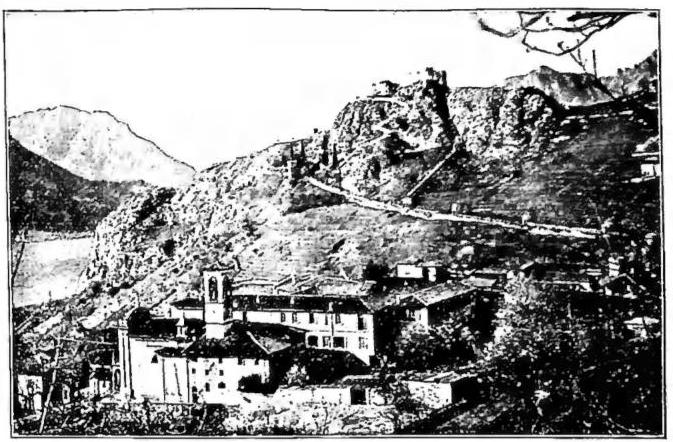
(courtesy of the Somascan Fathers, Rome)
SOMASCHI - The sanctuary of S. Girolamo and the Mother House - Somasca.
In 1769 secularism launched its first attacks. The Republic of Venice forbade the religious to take part in the general Chapters and ordered them to govern themselves separately; almost immediately Austria did the same in Lombardy. Thus the Order was split into three sections, and in 1784 four provinces were created from the territories where it was still free: the Piedmontese, Ligurian, Roman, and Neapolitan provinces. But in 1789 the King of Naples excluded the latter as well. Although it always remained internally united, the Order could not fail to suffer from the lack of unity in its government. Consequently, following the closure of other houses by the French in 1797, the entire Order had to be made into a single province; indeed, in 1810, at the time of the Napoleonic suppression, the S. retained only the house at Lugano.
When Pius VII restored the religious Orders on 22 August 1814, the S. were able to reconstitute themselves fairly easily in Piedmont, Liguria, and the Papal States, chiefly through the efforts of fathers who, at the time of the suppression, had arranged to remain in certain houses as parish priests or as private proprietors of colleges. Four years later the novitiate at Somasca was also reopened, and the Piedmontese, Genoese, and Roman provinces were reconstituted; subsequently, the Venetian and Lombard provinces were also restored and united into a single province. Of the former religious houses, only the Gallio College of Como and the novitiate with the parish of Somasca were recovered. With the suppressions of 1866 and 1874, eighteen houses were lost, including the Clementine College, and 165 religious priests and 65 lay brothers were dispersed.
Various attempts to open houses abroad failed, and only in 1901 was it possible to open a college at Bellinzona in the Canton of Ticino; in 1921, in response to repeated requests from bishops, they established themselves in the State of El Salvador in Central America, and later in Honduras. In 1939 a commissariat was established in Central America. At present the S. number 300; the orphans assisted number approximately 700; the pupils in the schools number more than 1,000; they have 26 houses in Italy, 1 in Switzerland, and 6 in Central America.