
SOMALIA. – S. corresponds to the triangular projection of eastern Africa bounded by the Gulf of Aden, the Indian Ocean, and the course of the Juba.
I. GEOGRAPHY
The country presents itself as a series of plateaus which, from the mountainous rim of Ethiopia extending from Ogaden to Cape Guardafui, decline toward the broad, flat coastal strip, edged by dune ridges. The climate is subdesert monsoonal, with high temperatures, marked diurnal temperature ranges, and scant rainfall, confined to the summer period. The prevailing landscape is woodland or steppe, the latter predominating in the N., where conditions of aridity become more pronounced, while along the mountainous rim precipitation is more abundant and the climate healthier. Overall, S. is a country of livestock raising and nomadism; agriculture is possible only where water is available (wells and, above all, irrigation from the only two rivers that cross S., the Uebi Scebeli and the Giuba), while industry has very limited prospects, given the absolute lack of mineral resources (except salt and a little tin) and energy sources. Across the extensive territory (more than 700,000 sq. km.) barely 1.6 million inhabitants live, almost all Ethiopians, divided into Galla, mostly farmers and sedentary people of the interior, and Somali along the coast, predominantly herders; both are Muslims.Besides spontaneous products (incense and gums), the country produces chiefly cotton, sugar cane, bananas, sesame, castor beans, and peanuts; cereals (sorghum and maize) serve for local consumption. The capital of Italian S. is Mogadiscio (55,000 inhabitants, including 2,500 Italians). On the Gulf of Aden lie the territory (176,000 sq. km.) of British S. (a protectorate), inhabited by 700,000 people, overwhelmingly herders, whose capital is Berbera (20,000 inhabitants), and the small Ethiopian strip (21,000 sq. km.)—strictly speaking, outside S. proper—of the so-called French S., which has 46,000 inhabitants and extends around Gibuti (17,000 inhabitants), where the only railway penetrating the Abyssinian plateau begins. One hundred and fifty miles from Cape Guardafui, in the Indian Ocean, lies the island of Socotra, the extreme northeastern point of S. Broad and desert in its western part, the island is mountainous and covered with woodland in its eastern part. The population (12,000 inhabitants—Arabs, Indians, and Somali) cultivates date palms and aloe, and raises free-ranging livestock. The capital is Tamarida (1,500 inhabitants).
Socotra forms part of the Sultanate of Mara or Qishni, included in the eastern protectorate of Aden.
BIBLI.: A. E. Prase, S., Londra 1902; C. Corni, La S. ital., Milano 1937; A. de la Rue, La S. française, Parisi 1930. Giuseppe Caraci
II. CIVIL HISTORY
The events of Somalia before the spread of Islam are shrouded in obscurity. The hypothesis put forward by some scholars that the so-called land of Punt, mentioned in inscriptions of ancient Pharaonic Egypt, is to be identified with the northern regions of Somalia is not supported by certain evidence.More reliable are the reports concerning the Muslim expansion, which seems to have begun from the nearby Arabian Peninsula in the 7th century, when followers of Muhammad, coming from Yemen, established on the opposite shore of the Gulf of Aden a sultanate centered at Zeila, in present-day British Somalia. Three centuries later, it appears that another wave of Arabs set foot for the first time in Italian Somalia and founded the cities of Mogadishu and Brava. Mogadishu soon became the most important center of the region and, toward the middle of the 12th century, the seat of a hereditary sultanate. At the dawn of the modern age there is vague information about a Kingdom of Adel, stretching along the coasts of English Somalia and including the ports of Zeila and Berbera; in the course of the 16th century this kingdom extended as far as Harrar, only to be subsequently destroyed by invasions of Galla peoples. After a very brief and purely nominal Portuguese occupation of Mogadishu and Brava, carried out respectively in 1503 and 1507 by Triatão da Cunha—whose very possibility was already clear evidence of the decline of Arab rule—there was a revival of the indigenous population which, perhaps in the 17th century, destroyed Mogadishu. Around the same period the Kingdom of Adel fell apart, and was succeeded by various independent emirates and sultanates. Also temporary, after the Portuguese occupation of the early 16th century, was the occupation of the centers of the southern Somali coast by an envoy of the Emir of Oman, whose actual purpose was merely to assert nominal rights of sovereignty over those lands; these rights later passed, as heirs of the sultans of Oman, to the sultans of Zanzibar. The first European power to take an interest in Somalia was Great Britain. With the aim of securing the route to India by acquiring a harbor for its ships, England concluded agreements in 1840 with the Sultans of Tagiura and Zeila.
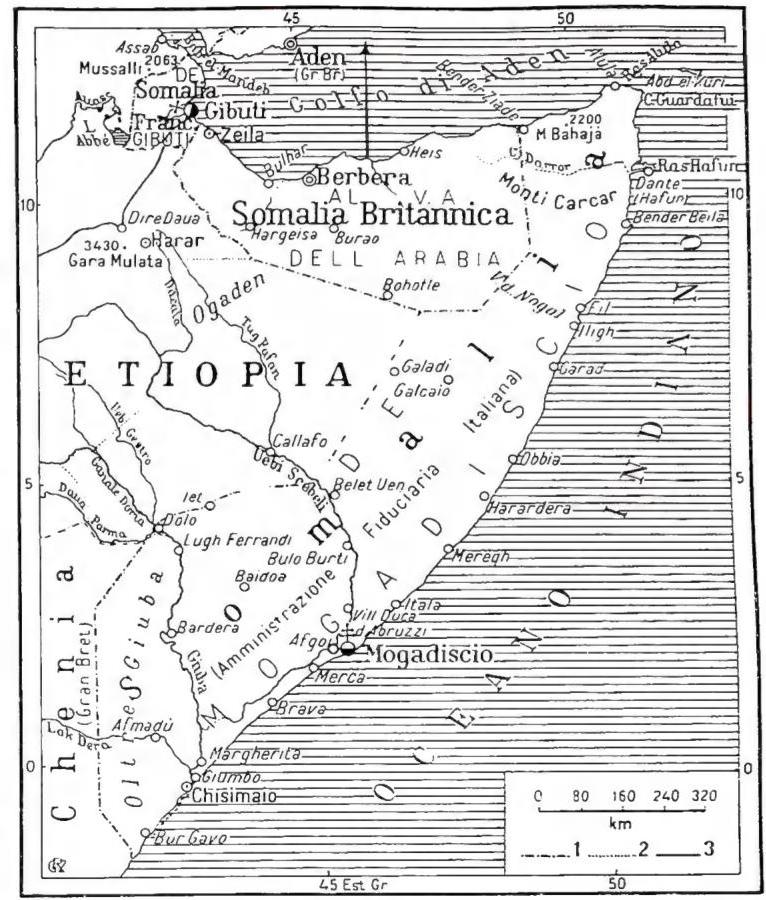
SOMALIA – 1) Colonial boundaries; 2) boundaries of ecclesiastical jurisdiction; 3) railways.
(courtesy of Massimo Pellus)
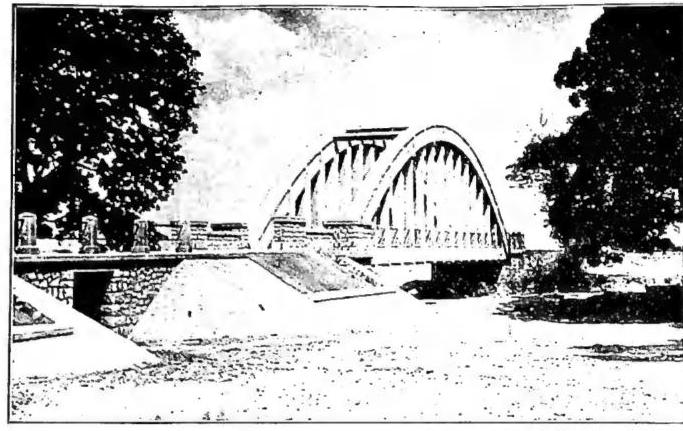
SOMALIA - Concrete bridge over the Uebi Scébeli at Mahaddei.
with particular attention to its agricultural development, with highly gratifying results. During the Second World War, Italian S. was occupied by British imperial forces under the command of General A. G. Cunningham in the first months of 1941. During the same period, England also returned by force of arms to possession of British S., which had been occupied by Italy in Aug. 1940. French S., on the other hand, having remained under the orders of the Vichy government until Dec. 1943, went over to the side of General De Gaulle on the 28th of that month. Following the Paris Peace Treaty of 1947, Italy renounced, under Article 23, its sovereignty over S.; nevertheless, on 21 Nov. 1949 the United Nations entrusted it with the trusteeship administration of S. for ten years, after which the region will be constituted as an independent State.
III. EVANGELIZATION
1. British S. - It depended on the apostolic vicariate of Arabia, based at Aden, and the Capuchins were unable to work there before 1891. A residence was established at Berbera and another at Shimbafaleh. But in 1910 the British government expelled the missionaries, prohibiting any activity among the Islamic Somali. Only in 1931 were the missionaries again permitted to exercise the ministry from time to time among the Catholics living there.2. French S. - It belonged to the apostolic vicariate of Galla. A small station had been established at Djibouti. When the missionaries and Christians were expelled from British S., they found refuge at Urso in French S. In 1913 a third station was founded at Daudah. In 1914 Djibouti was established as an apostolic prefecture and entrusted to the Capuchins. The mission in the three stations numbered 150 Christians in all when, in 1915, it was restricted to the station at Djibouti. In 1925, part of the vicariate of the Galla, Ethiopian S., was united to the prefecture of Djibouti, and four stations were established there. On the occasion of the new organization of the Ethiopian missions in 1937, the prefecture of Djibouti was restricted to French S. and came under the apostolic delegation of Dakkar (v. GIBUTI).
3. Italian S. - In 1904 it was established as an apostolic prefecture under the name of Benadir and entrusted to the Trinitarians. The Italian governor Mercatelli, however, did not grant the missionaries access, and they therefore had to establish the first station on the frontier in British S. Only after 1906, when the governor hostile to the missions had been recalled, were they able to settle in Brava and Dhelih, limiting their activity almost exclusively to ministry among the Italian colonists. This was the sole work of the Missionaries of the Consolata, who assumed the prefecture in 1924, elevated to an apostolic vicariate in 1927 under the name of Mogadishu, and of the Franciscans, to whom it was transferred in 1930. Progress among the Muslim Somali is very slow, and consequently the number of indigenous Catholics in 1939 was 270 out of a total of 13,350. It is very probable that this number had not increased greatly among the 3340 Italian settler Catholics (v. MOGADISCIO).
excellent relations with the local Italian authorities. Naturally, being situated in a Muslim country, the missionary activity, insofar as the indigenous population is concerned, consists above all in an effort at penetration through schools, orphanages, hospitals, and the carrying out of other charitable works, which are highly effective means of directing people toward the religion of Christ. Thus, at very difficult moments for that colony, the Catholic mission proved an indispensable element in the work of pacification pursued by the civil government. - Vedi inv. LXII.