
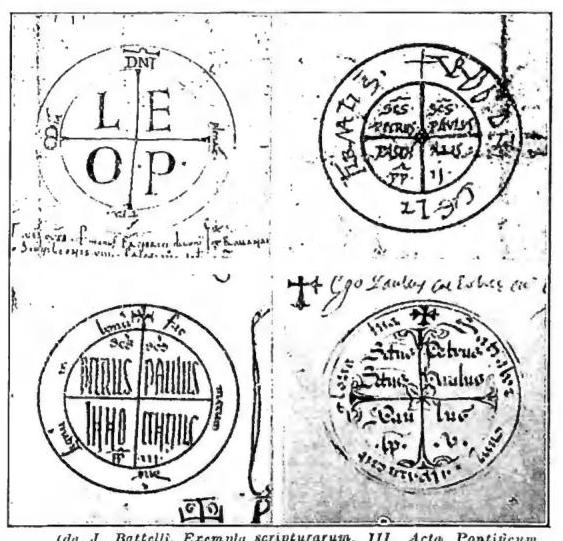
ROTA (signum Papae). — Leo IX (1048) introduced into the subscriptio of privileges an innovation that was to be preserved through the centuries and still endures today; in place of the sign of the cross that normally preceded the ancient formula Bene valet (v.), now reduced to a monogram, he placed a more complex one, commonly called r. from its shape. It consists of a cross surrounded by two concentric circles forming a circular ring suitable for containing an inscription: in the four inner quadrants the pope’s name is marked (L-E-O-P.), and in the ring a scriptural motto (Misericordia Domini plena est terra). This inscription is in the Pope’s own hand, and thus the signum acquires the value of a subscriptio.
Under Leo IX’s immediate successors the r. displayed a variety of forms and inscriptions; but from Paschal II (1099) the type that continues to the present was established: in the upper quadrants are the names of the Apostles SCS PETRUS and SCS PAULUS,
in the lower ones the name of the pope PASCHALIS PP II, and in the ring the scriptural motto, which each pope changes as his personal device, preceded by a small cross. In privileges, which continued until the fourteenth century, the small cross was always in the pope’s own hand, and sometimes the motto as well; subsequently (from the fifteenth century) the consistorial letters revived the ancient signum, now placed at the center below the text, but the cross and the inscription are no longer in the pope’s own hand.
Following the example of the popes, in the eleventh century the archbishops of Ravenna, Benevento, and Trani used the r., as did the Norman dukes of Sicily; in Spain it was also used by the archbishop of Compostela, Diego (1101), and it inspired the rueda or signo rodado of the kings of León (from 1158), which bears at its center the emblem of the lion in place of the cross. The rueda, in color after 1252, was used by the kings of León-Castile until Ferdinand the Catholic and Isabella (1479).
Not all Rote, however, were instituted by the Roman pontiffs; almost all, instead, exercised jurisdiction primarily in the civil forum. It would be of interest to uncover the reason behind the nearly simultaneous emergence of so many similar tribunals; to investigate why that particular name was chosen; to examine, moreover, what possible relations may have existed with the Roman Rota; and finally, to determine all common elements while also highlighting those particular to each. For now, it can only be said that there is no evidence of any relation between the S. Romana Rota and the other particular Rote; no relationship of dependence has been established, though it must be acknowledged that the Roman Rota held a field of universal jurisdiction, whereas the others
ROTA - From left to right: R. of Leo IX (Privilegium Leonis IX, a. 1051) - R. of Paschal II (Privilegium Paschalis II, a. 1116) - R. of Innocent III (Privilegium Innocentii III, a. 1207) - R. of Paul V (Litterae concistoriales Pauli V in forma libelli, a. 1610).

Local R. had a limited territory and a defined, restricted competence.
The first R., in chronological order, established in the Papal States is that of Perugia, requested by the local authorities themselves to Pope Clement VII and granted by him on 28 March 1530 with the brief Exponi nobis nuper fecistis. In early September 1532, the new College began its activity, which lasted, save for a brief interruption under Paul III, until 1798, that is, until the invasion of French troops into the Papal States. Subsequently, there followed the R. of Bologna, instituted by Paul III with the bull of 11 July 1535 Ex iniuncto nobis. The tribunal was assigned five judges, to be chosen outside the city of Bologna, with a five-year mandate. Civil cases could be judged there in any instance, without the need to resort, for appeals, to external tribunals. This R. also remained active until the French Revolution. In Macerata, the R. was erected by Sixtus V, for all the provinces of the Marches, with the bull Romanus Pontifex supremi Iudicis in terris vicarius of 15 March 1589. Its competence was extended beyond the civil forum, encompassing also ecclesiastical cases, mixed cases, and in part criminal cases. The tribunal could be considered almost pontifical, because the Pope himself reserved the appointment of four of the five judges. These, like those of Bologna, were not to be natives of the place and were elected for five years: one per year, in rotation, assumed the functions of president. The rotali enjoyed all the privileges already granted to those of the R. of Bologna. On 22 March of the same year, Sixtus V added to the R. of Macerata a college of five notaries and one of eight cursors. Also in Ferrara, with the bull of Clement VIII of 29 May 1599 In supremo iustitiae throno, an R. was erected, likewise composed of five judges, elected for five years.
(photo: Enc. Catt.)