
VIRUS (ultravirus, infravirus, filterable virus). — These are particular agents of diseases in humans, animals, and plants, characterized by ultramicroscopic dimensions of the order of magnitude of the millimicron (one-millionth of a millimetre = mμ) and by the fact that they can reproduce only on living cells and not on bacteriological culture media.
Although all V. have in common the characteristic of extreme smallness, they differ from one another in size, since some, the largest, reach 250–275 mμ, that is, the limits of microscopic visibility, whereas the smallest so far known measure only about ten mμ, like the larger protein molecules. The largest V. known to date is that of psittacosis, a disease proper to parrots and other birds, which can also be transmitted to humans, although not all authors regard it as a true V. Next in order are the V. of smallpox (approximately 250 mμ), rabies (150–200 mμ), influenza (approximately 100 mμ), yellow fever (20–25 mμ), and poliomyelitis (10–12 mμ). A V. of extremely small dimensions, perhaps the smallest of all, is that of foot-and-mouth disease (a disease proper to cattle and other animals that affects humans only exceptionally), measuring less than 10 mμ.
Because of their minute dimensions, V. are not visible under the optical microscope; only the larger ones are, after suitable staining or by using the dark-field device. These microscopically visible forms of V. are known as elementary bodies and are considered, rather than pure viral elements, to be aggregates of them or V. surrounded by other material. V. become visible with the new type of microscope, the electron supermicroscope, in which the optical apparatus consists, instead of ordinary lenses, of special electromagnetic devices functioning as lenses, and the image of the objects is formed, by means of a beam of electrons, on fluorescent screens or photographic plates. With this instrument, which permits magnifications of more than 100,000 diameters, it has been possible to determine the dimensions of V. and also to learn their shape: some, generally the larger ones, appear polyhedral in form, sometimes cubic; others are spherical or ellipsoidal; and still others appear
as tiny rods or long, more or less flexible filaments.
Again because of their small dimensions, V. all possess the property of passing through special porous materials whose pores are so small as to permit their passage but not that of bacteria and other microorganisms. To demonstrate this property of v., which has earned them the name filterable viruses, special filters are used, known by their shape as filtering candles. These consist of a hollow cylinder of unglazed porous porcelain (Chamberland candles) or of diatomaceous earth made from diatom skeletons (Berkefeld candles). Filtration is carried out by finely grinding the material containing the V. with physiological saline solution (a sodium chloride solution at 9 per 1000) and filtering it under suitable negative pressure; through the porous mass pass the liquid portion and the smallest particles, such as v., whereas the larger particles, such as bacteria and other microorganisms, are retained by the candle. To establish the presence of the V. in the filtered liquid, a portion of it is inoculated into experimental animals. Thus, to demonstrate the presence of rabies V. in a dog that has died of this disease, the animal’s cranial cavity is opened, that part of the nervous substance connecting the brain to the spinal cord, known as the medulla oblongata, is removed and carefully ground in a mortar with physiological saline solution, and filtration is then carried out. The filtrate thus obtained appears as a clear liquid which, on microscopic examination, shows no microorganisms whatsoever; yet, if it is inoculated into a healthy dog or rabbit, it produces rabies after several days. By means of the technique described, it is possible to transmit rabies V. from a diseased animal to healthy animals an infinite number of times, which proves that it is an agent capable of reproducing indefinitely and not a toxic substance that would inevitably be exhausted after several passages. By filtration carried out with a series of filters consisting of colloid membranes with pores of known and progressively graduated sizes, it is also possible to measure the dimensions of v.; these have been found to agree with those obtained using the electron supermicroscope.
The artificial cultivation of V. is carried out on living cells because, owing to their obligate parasitism, they are incapable of independent life and can therefore multiply only within or at the expense of other living elements. In practice, V. are cultivated on tissue cultures, that is, on proliferating living cells, or better still in fertilized hen’s eggs; in these, the V. are inoculated into the yolk sac, the amniotic cavity, or onto the chorioallantoic membrane.
The various V. differ in their resistance to physical and chemical agents; some, such as that of smallpox, are highly resistant, while others, such as that of influenza, are very little so. Most V. are highly sensitive to elevated temperatures, whereas they resist low temperatures exceedingly well, so much so that freezing is one of the best methods of preservation.
There is no agreement among the various authors concerning the nature of V. nature, considering them to be extremely minute microorganisms possessing a form of life reduced to a minimum, which depends to a large extent on the cell in which they are found. Others, however, regard v., especially those of minimal dimensions, as nonliving molecular entities nevertheless capable of multiplying indefinitely in living cells through the agency of the latter, and therefore call them v.-proteins.
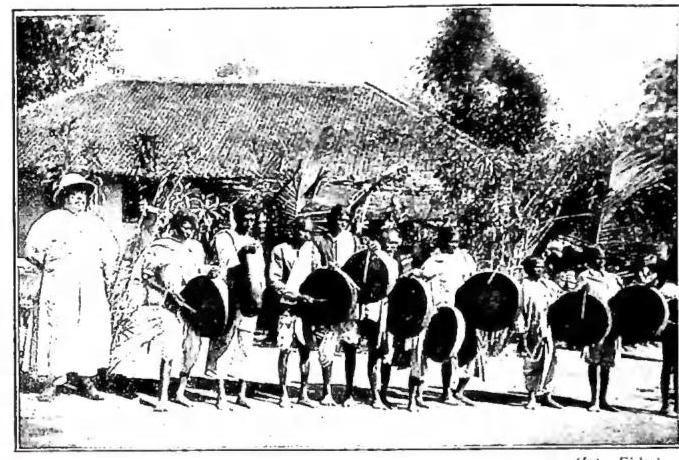
(phot. Fides)
VISAKHAPATNAM, DIOCESE of — The “Band of Drummers,” in a Mission of the Diocese of V.
Other animal V. are those that cause foot-and-mouth disease and cattle plague, swine cholera, infectious anaemia and encephalomyelitis in horses, avian plague, psittacosis, and the so-called polyhedral diseases of insects, among which a particularly important one affects silkworms and is known as “yellows,” because it turns them yellow. Some of these diseases, especially when they occur in epidemic form and spread widely, cause economic damage on a very large scale. The best-known plant V. mosaic, which causes a characteristic disease of the leaves of this plant; the various potato v.; the yellow mosaic V. of the watermelon; and that of the tomato.
A particular group of viruses consists of those that live at the expense of bacteria, multiplying within them until they lyse them; hence they have been called bacteriophages. These are widespread in nature, in the soil, in water, in feces, and especially in materials rich in bacteria. Studied with the electron supermicroscope, bacteriophages appear as small spheres or rods provided with a slender appendage; their dimensions range from a few tens of mμ to one hundred mμ.
Related to viruses in many respects are particular microorganisms known as rickettsiae, named in honor of the researcher Ricketts, who died from a laboratory infection while conducting experiments on them. They appear as small rods or spheroidal bodies ranging in size from one third to 1–2 μ, often characterized by evident polymorphism. The smallest rickettsiae, like viruses, are filterable; the larger ones, on the other hand, are retained by the filters themselves. They cannot be cultivated in ordinary bacteriological media, but, as with viruses, one must resort to tissue cultures or fertilized eggs. Rickettsiae produce several forms of disease in humans, among which epidemic or typhus exanthematicus ranks first in the severity of its symptoms and in its epidemic spread. It presents with high fever and a characteristic hemorrhagic exanthem and is transmitted to humans through the bites of lice that have themselves become infected by sucking the blood of sick persons. Other diseases caused by rickettsiae are Rocky Mountain spotted fever, a distinctly North American disease; Mediterranean eruptive fever; the so-called Q fever, only recently identified in Italy; and others. Diseases caused by rickettsiae, unlike those caused by viruses, are fairly amenable to treatment with antibiotics.