
DRIESCH, HANS. – Biologist and philosopher, born in Kreuznach on 28 October 1867, died on 16 April 1941. He studied in Hamburg, Freiburg, Munich, and Jena, where he graduated (1889) in natural sciences.
He was a disciple of Haeckel, but soon distanced himself from him and became friends with G. F. Wolff and W. Roux. From 1891 to 1900 he worked at the Zoological Station of Naples and then went to Heidelberg, where in 1911 he became professor of philosophy. In 1920 he taught natural philosophy in Cologne, and in 1921 was appointed professor in Berlin. He travelled extensively in China and America and received several ad honorem degrees and distinctions from many academies.
He began his scientific activity under the guidance of Haeckel, but later, while still feeling the influence of the teaching of Wolff and Roux, became the proponent of dynamic vitalism. His doctrine that the functions of protoplasm cannot be explained mechanically was the consequence of his findings concerning the regulative capacity of sea-urchin eggs, which demonstrated that isolated blastomeres can produce complete embryos.
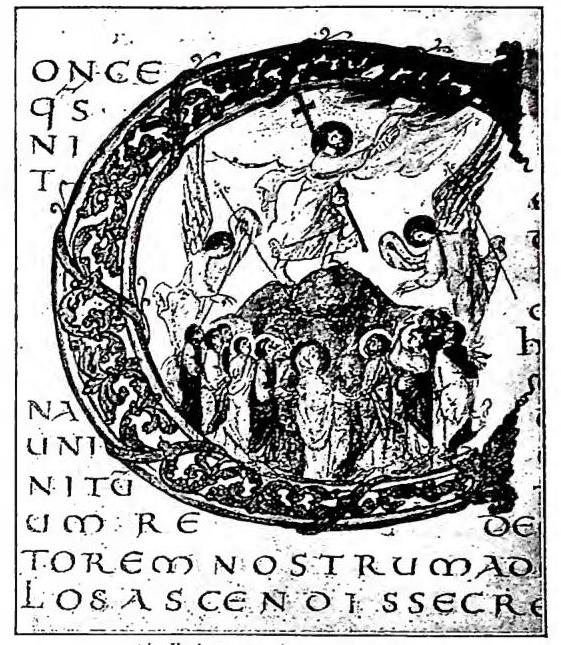
(from V. Leroynais, Les sacramentaires et messieurs avec des bibl. publ. de France, Paris 1927, fasc. 9)
DROGONE – Miniature of the Sacramentary of D. depicting the Ascension, enclosed within the initial C. (9th century) – Paris, National Library, ms. lat. 9428, fol. 71v.
plex. His anti-mechanism in the psychological sphere is expressed in Philosophie des Organischen (2 vols., Leipzig 1909), Analytische Theorie der organischen Entwicklung (there 1894), Science and philosophy of the Organism (Gifford Lectures 1907–1908), History and theory of vitalism (1914), The problem of individuality (1914), Wissen und Denken (Leipzig 1919), Leib und Seele (there 1920).
Together with W. Roux he founded the mechanics of development, which today is more properly called, with G. F. Wolff, developmental physiology. D.’s vitalist conception is today much contested.