
EMBRYOLOGY. – Considered in the strict sense, embryology should deal with the development of the organism until it is contained within the membranes of the egg and is incapable of leading an independent life there, that is, until it derives its energy requirements from the material of the egg itself. In practice, however, embryology also deals with the subsequent phase up to the attainment of the adult’s definitive condition. During this phase, the organism may pass through various conditions of existence, represented by larval stages (including several successive stages living in different environments), or by the fetal stages of viviparous animals, in which the offspring establishes relations with the mother, and by the juvenile stages, in which, although resembling the adult, the processes of growth and organic development continue.
(courtesy of Prof. A. Stefanetti)
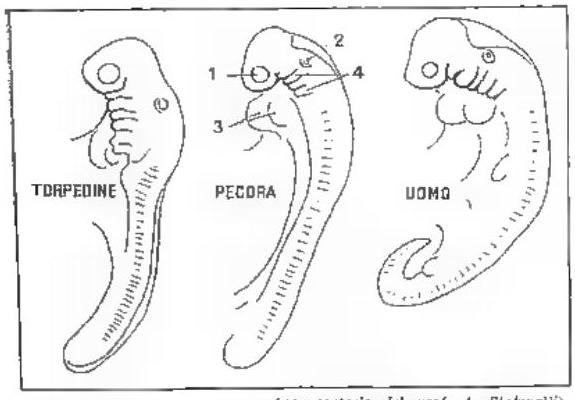
EMBRYOLOGY – Diagrams of fish, sheep, and human embryos (from Ziegler, Bonnet, and His) showing the branchial clefts: 1) rudiment of the eye; 2) of the ear; 3) of the heart; 4) branchial clefts.
But modern e. is not content with these data, although comparison remains the fundamental method of biological research. Through experimentation it seeks to understand the causes that lead to a given sequence of stages or cause an embryonic rudiment to follow a particular course of development: this is the causal approach of experimental e. This approach began in 1893 with the founding, by Guglielmo Roux, of the famous journal on the mechanics of development (Archiv für Entwicklungsmechanik der Organismen), and has continued to the present through the work of numerous scholars, among whom the names of Driesch, Spemann, and Harrison stand out.
It is particularly in e. studied by this method that the two opposing tendencies in the outlook of scholars have become apparent: the mechanistic and the vitalistic. Thus, while the mechanist sees development as a sequence of reactions determined by causal factors of a chemical and physical nature, through an eminently epigenetic process, the vitalist sees development as the expression of a total potentiality already contained in the egg and set in motion according to a pre-established course and toward a determined end. However, the modern vitalist does not conceive of preformationism as it was understood by the ancient ovists or animalculists of the eighteenth century, who held that the individual was already completely formed in the egg or spermatozoon, but extremely small and capable only of growth, comparable to swelling; rather, he considers pre-existent the power of this future individual, that is, its entelechy, in the sense Driesch gave to this Aristotelian word, or that potentiality which makes two apparently similar eggs as different as are the respective adults originating from them. The apparently unbridgeable conflict between these two tendencies has today been overcome with regard to the “manner” in which development occurs; even the vitalist who accepts the concept of an intrinsic vital principle animating matter is convinced that this power expresses itself through epigenetic development, so that each stage of development is relative to and influenced by factors that came to be determined in the preceding stage. Accordingly, experimental e. provides many examples of the possibility of modifying the course of development whenever these factors are in some way altered. Many developmental anomalies, ranging from monstrosities caused by hyperformation, duplication, and so forth, to Siamese twins and the physiologically normal condition of monozygotic twins, are perfectly explained by their experimental reproduction (vedi ANIMAZIONE).
(courtesy of Prof. A. Stefanetti)
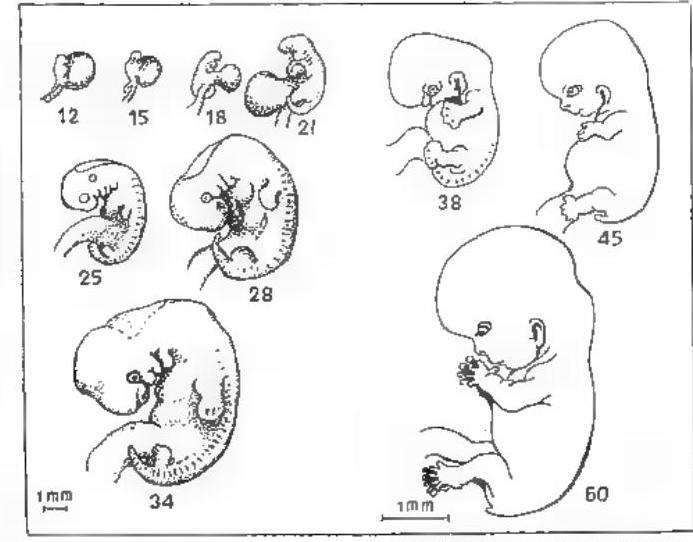
EMBRYOLOGY – Human embryos (from His’s plates). The numbers indicate the age in days.
The fact that two or more embryos, and therefore complete individuals, could be obtained from a single egg seemed the best evidence against the proformist idea and the idea of potency, of which it is the modern exponent. But these experiments in no way destroy such concepts, even though modern authors are too ready to translate the phenomena of life into purely chemical and physical expressions. The more or less profound alterations produced by experiment instead demonstrate (as, for example, the production of several individuals from a single egg) the manifestation of this potency which tends, even under altered experimental conditions (or accidental ones, in cases that also occur in nature), by reacting to such abnormal factors, to bring forth, in the manner permitted by matter, that “whole” which is potentially present in the egg (the holistic conception of development). After the egg has been constricted by the experimenter’s silk thread, it demonstrates how its two halves, rendered independent, independently express, by regulating themselves, that unified whole which was previously present in the undivided egg. But if the separation is incomplete, and a physical obstacle to the free action of the two parts consequently remains, or if other altering factors come into play, or if reciprocal interaction nevertheless persists, the regulative activity, although it does manifest itself, fails to achieve its purpose, and a monstrosity is formed in the vain attempt, obstructed by the excessively altered conditions of the ovular or embryonic material.
(courtesy of Prof. A. Stefanelli)
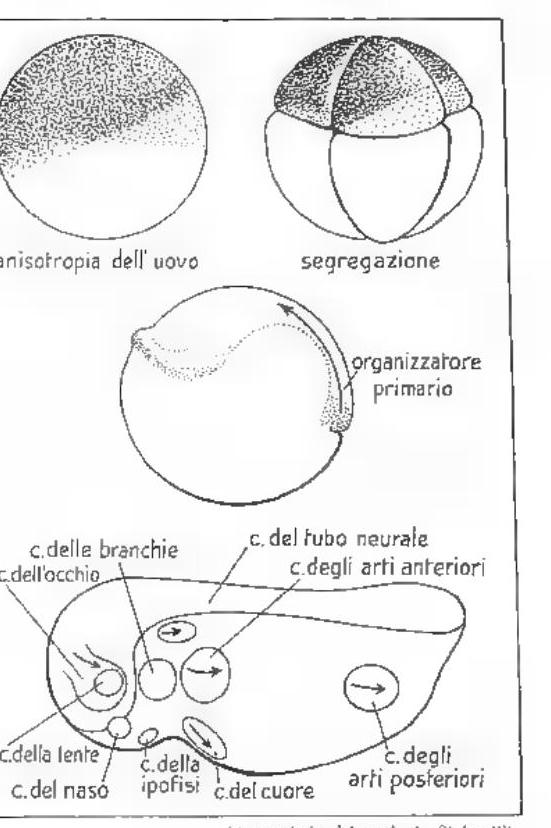
EMBRIOLOGIA - Anisotropy of the egg, segregation, primary organizer, and fields of secondary organization in amphibians.
development and according to a precise finality. The antagonism between biologists who wish to conceive of life and its becoming in development as a sequence of chemical and physico-chemical reactions, governed by the same laws as the physical world, and those who restrict the application of such laws to the material part alone that constitutes living beings, recognizing in life and development other factors that transcend it, remains unresolved; but it has purely speculative value, since, from a practical standpoint, both groups work with the same means and upon the same matter in which life pulsates, for only its material aspect is subject to scientific investigation.
Mechanists say that the vitalist idea removes every incentive to research because, for example, in the embryological field, development would be nothing more than the realization of a design, a potency, an entelechy of an immaterial nature and, as such, inaccessible to experience. Yet in truth, if this conception of life places its first cause beyond experience, it in no way limits the investigation—the only investigation that can ultimately be undertaken—of how phenomena unfold and of the factors that come into play, through an epigenetic mechanism, in the externalization of formative potency.
BIBLI.: C. Bonnet, Oeuvres complètes, 10 vols., Neuchâtel 1779-83; W. His senior, Anatomie menschlicher Embryonen, Lipsia 1880-82; E. Ziegler, Lehrbuch der allgemeinen und speziellen pathologischen Anatomie und Epäthogenese, Jena 1881-82; G. Chiragni, Trattato di e. 5 vols., Milano 1939-42; A. Brachet, L'oeuf et les facteurs de l'ontogénése, Parigi 1931; J. Huxler-R. De Boer, Elements of experimental embryology, Cambridge 1934; P. Wiers, Principles of development, Nuova York 1939; C. Child, Patterns and problems of development, Chicago 1941; A. Dalco, L'oeuf et son dimanche organisateur, Parigi 1941; J. Needham, Biochemistry and Morphogenesis, Cambridge 1942; B. Durken, Biologia dello sviluppo e dismo, Firenze 1943; J. Brachet, Embriologie chimique, Parigi 1947; P. Pasquini, Le forme crestrici dell'uovo, Roma 1947; G. Cotronei, Biologia e ecologia generale, 4th ed., there 1949. Alberto Stefanelli