
GEMELLI. – The children born in the same
birth and from the eggs of a single laying are called
twins. In particular cases, several individuals may also
be born from a single egg; a distinction is therefore made
between polyovular and monoovular twins; in the case of
mammals, in which the egg is enveloped by the chorion,
one speaks of monochorionic and plurichorionic twins
(in the case of double twinning, dichorionic).
Polyovular twins may also be of different sexes, whereas
monoovular twins are always of the same sex and, in the
human species, are extraordinarily alike, often with mirror
similarity. This is due to the fact that, deriving from the same
egg, they have the same hereditary endowment.
The condition of uniparous and pluriparous offspring is
specific to the various animals; the human species is generally
uniparous and exceptionally pluriparous (from two to
5 twins). According to statistics derived by Chiarugi, the
percentage of multiple births in the human species is:
in double twinning, one in 84.6
single births;
in triple twinning, one in 6731 single births;
in quadruple twinning, one in 963,612
single births;
in quintuple twinning, one in 23,608,502
single births.
In cases of monoovular twinning, one speaks of poly-
embryony. This is a normal phenomenon in some
animals, as, for example, among mammals in the tatuzia (an
armadillo), with 4–12 twins. In certain insects, thousands
of individuals may originate from a single egg (cases stu-
died by Marschall and Silvestri in hymenopterans).
Polyembryony has also been studied experimentally in
amphibians. If the first two blastomeres of a dividing egg
or two groups of blastomeres are separated, two distinct
individuals are formed. In invertebrates
(jellyfish), as many as 16 embryos have also been obtained. Through
these investigations, the origin of double
monstrosities (Siamese twins, bicephalous monsters, and
other teratological conditions) has been demonstrated by
provoking incomplete separations between the blastomeres of
the egg. The problem of individuality with regard to these facts
has been discussed elsewhere (v. ANIMAZIONE).
The tendency toward twin births in women depends on the
mother’s constitution and is therefore hereditary in nature.
view: historical, iconographic, in its causal factors, in the
embryogenetic mechanism, in its manifestations and in the mutual
relations of life among the members of the small twin society,
between them and the society that receives them; in particular,
twins may be studied with regard to the manifestations of their
psychic life, both to determine any characteristic behavior and to
use them as subjects for the study of experimental psychology,
for which the fortunate combination of perfectly similar
individuals may be employed, allowing different causes to act
upon them.
The first study of experimental psychology on twins is due to
Galton (1883), who brought to light the enormous similarity
of the psyche of monozygotic (MZ), or monoovular, twins, that
is, those born from the same egg. Among 80 pairs of twins,
so similar that they could be mistaken for one another, Galton
found that in 11 cases “they make the same observations on the
same occasions, begin to sing the same song at the same moment,
and so on; one begins a sentence, the other finishes it...”.
In 1905 Thorndike introduced the system of mental tests into
the psychological study of twins, conducting his research on a
group of 50 pairs of twins drawn from the school population of
New York. From his research he concluded that the resemblance
of twins does not increase with age, but rather decreases; that it
is always considerably less (approximately half the coefficient)
in brothers, even when they are separated from one another by
only a few years (3–4); and that the resemblance is much closer
with regard to those aptitudes more particularly exercised in
school life. From this he concluded that these facts are explained
by the predominant influence of the germ cells, and therefore of
heredity.
Lanterbach (1925) studied 212 pairs of twins not only from the
biological point of view but also from the psychological one,
by means of various tests (tests of intelligence, arithmetic,
handwriting, specific abilities, etc.); he was thus able to confirm
that the correlation is higher among twins than among ordinary
siblings, and higher among twins of the same sex than among those
of different sexes. With regard to handwriting, he found equality
so complete as to prevent individual identification in only a few
cases.
Halon (1926) observed in an 8-year-old (MZ) pair, first living
in different environments and then reunited, discrepancies in
character that later disappeared; he therefore emphasized the
influence of the environment on psychic characteristics.
In 1931 Lortig, from studies of 10 pairs of twins, concluded
that the influence of the environment is slight and that
intelligence, feeling, and will are determined by heredity.
In 1931 Looft, studying the intelligence of twins, noted that
mental retardation is concordant in co-twins, and therefore did
not doubt that hereditary factors are the determining element.
The subsequent studies conducted, likewise on pairs of twins,
with regard to the psychic faculties, by Lenz (1932), Kuhlmann
(1932), Miercke (1934), Brecken (1936), and others, should be
noted for their importance. In 1950 Gedda and Miglio studied the
attitude of MZ twins toward clothing in 112 pairs between the
ages of 7 and 20, concluding that MZ twins, although physically
so similar that they could exchange clothes, and although in
almost all cases (91.9%) wishing to wear identical clothing, do
not use the other’s clothing and their own indifferently, but for
the most part (87.05%) prefer the latter, which is quite readily
recognizable by
(phot. Orlandini)
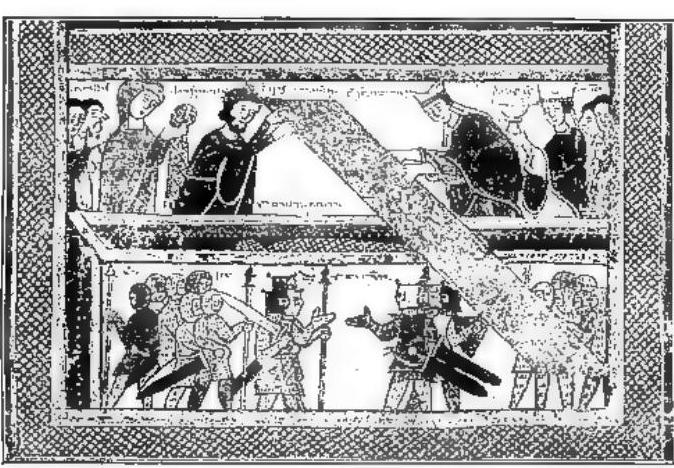
GEMINIANO, saint – Miniature from the Relatio translationis corporis 1. Geminiani (13th century) depicting the opening of the Saint’s sarcophagus, in the presence of Countess Matilde – Modena, Chapter Archives.
small signs that escape outsiders.
Important elements for the study of the psychic similarities of
twins may be drawn from the behavior of their handwriting,
which, in a not very high percentage of cases, is similar to the
point of being indistinguishable even to experts; it would also
seem that the resemblance in handwriting among MZ co-twins
increases steadily with growth, after the age of 14.
A further assessment of the psychological resemblance of twins may be drawn from their “curriculum vitae.” Thus one sees the careers of MZ twins bearing an extraordinary resemblance. One may recall the example of Giovanni Ambrogio Bach (father of the famous Giovanni Sebastiano) and Giovanni Cristoforo Bach, cotwins, both famous musicians, perfectly alike, so much so that even their wives were unable to distinguish them; they were identical in play, pronunciation, thought, and artistic manifestations, loved each other simultaneously, and died shortly one after the other. Other twins may be recalled whose lives unfolded in strikingly similar fashion in their external social manifestations; such was the case with Augusto and Giovanni Picard, famous for their stratospheric careers, and with many others, whom it is impossible to discuss at length, but who, even when the circumstances of life caused them to be separated, likewise had in common a similar “curriculum vitae.” Numerous reports of this kind reveal the importance of the psychological study of twins through a global assessment of their lives; such a study can bring to light the real aptitudes of twins and the existence of their concordance, so frequent among MZ twins, far better than can a merely morphological comparison carried out sporadically; the dynamics of their lives within the social community make it possible to establish a psychological profile of far greater value, which often eludes those who limit their examination to test batteries.
The psychology of twins may be studied from three particular points of view: 1) from the standpoint of the single individual entity constituting the twin group within society, by comparing the psyche of the twin with that of the singleton; 2) in relation to the particular conditions created by coexistence within the small “intrageminal society,” in its internal and external relations; 3) as an experimental means and analogy for the general study of the human psyche.
With regard to the first point, the most important conclusions concerning the psychology of twins may be summarized in four laws: a) the particular psychological situation determined by twin conception does not, from an absolute point of view, diminish the psychic efficiency of the twin human being; b) the MZ twin possesses an individual psychic personality of his own; c) the psychic individuality of the MZ twin in relation to the cotwin is not always proportional to physical individuality; d) various authors postulate different mechanisms as determining the intrageminal differences that individualize the MZ twin (embryogenetic, psychic, etc.).
With regard to the second point, that is, the social psychology which brings the individual cotwins together in an intrageminal society, the conclusion is reached that: a) the members of every twinship constitute a small society that manifests itself spontaneously upon a natural foundation and produces a characteristic psychological sphere, which comes between the individual psychological sphere and the other familial psychological spheres, thus giving rise to a true “intrag geminal society”; b) from the psychological point of view, intrageminal society presents two varieties: monogynistic and polyzygotic; c) intrageminal society is not uniform, but produces a psychological differentiation of the intrinsic and extrinsic society (a differentiation of tasks between one twin representing it externally and another commanding within the intrageminal society); d) conflicts between the members of intrageminal society obey, so to speak, the law of all or nothing: they are either trivial or, very rarely, extremely serious; e) intrageminal society possesses characteristic usages and customs (an hermetic language, etc.).
With regard to the third point, the study and experimentation of twin psychology offer the possibility of assessing how much of the human psyche is hereditary and how much is attributable to the environment. Concerning this subject, the following conclusions are set forth: a) heredity also plays a highly significant part in the psychic sphere; b) the hereditary determinism of psychic activities is greater or lesser according to the functions considered; hereditary influence is felt on a descending scale of importance in intelligence, feeling, will, and temperament; c) the fourth dimension, that is, time, determines modifications in the individual psyche, which appears to be marked by several successive equilibria, in the sense that the polygon of active forces (heredity; environment) registers over time a relative weakening of the hereditary component and a relative increase in the environmental component; d) not only general psychology but also psychology applied to education is concerned with taking constitutional psychic qualities into account, in order to assess the most effective methods; using twin society, the method has been employed (in America and Russia) by influencing only one member with the means under examination and keeping the other as a control; e) various psychic traits prove to be strongly dependent upon hereditary endowment, that is, upon constitution; f) the hereditary determinism of the human psyche is not absolute; that is, although heredity provides the building stones of the structure of individual personality, the latter is also subject to other causal factors, principally free will.
The question of twins also opens the way to the study of important philosophical and theological problems and contributes to the solution of serious doctrinal controversies.
From the past onward, philosophy and theology have concerned themselves with twins; thus Diogenes, Cicero, s. Agostino, s. Gregorio, etc., often with concepts that were extremely imprecise from the biological point of view.
The study of twins may provide arguments of considerable animation (v.) in the much-debated question of the immediate infusion of the rational soul at the moment of conception of the new individual, or rather of its mediated or delayed infusion at the moment when the body has reached such a degree of organization as to render it, at least potentially, suited to intellectual life. This concept of Thomistic philosophy follows Sertillanges, and the late mons. A. Lanza adhered to this thesis of delayed infusion in a monograph (La questione del momento in cui l'anima razionale è infusa nel corpo) published in the Bollettino filosofico (4 [1938], pp. 211 ff.; 335 ff.; 5 [1939], pp. 36 ff.; 206 ff.). The lamented bishop expressed himself in these terms: “It may therefore be held, with some probability, that at the end of the embryonic period, which in man lasts approximately eight weeks, when the process of growth has already acquired a decisive predominance over the processes of formation, the body is sufficiently organized to receive the rational soul, unless a teratological process has arrested or otherwise deformed development... If the human soul is infused by God into the body only after the latter has reached, in its organization, that degree of development suitable for it to be called specifically perfect, it is evident that whenever, for whatever reason, teratological processes arrest this development or otherwise influence it, causing it to end in an organism radically unfit for the functions of the species, the individual resulting from it will not be informed by the rational soul. If doubt may sometimes still remain, it will be predominantly physiological in nature and will concern the degree of vitality of the embryo and its functional independence, where a double monstrosity is involved.”