GAMETI ■ GAMETOGENESI. - In animals the production of the germinal elements may be diffuse, as in sponges, or localized in special organs, the gonads. The gametes, or germ cells, are deputed to reproduction, but in many cases it can also take place through the cells of the soma (agametic reproduction). The germ cells may have an early determination (cells of the germinal line) and sometimes already at the stage of two cells (blastomeres) the one that will give origin to the gametes is identified; but more often, as in mammals and in man, such a difference cannot be detected early.
(propr. Enc. Catt.)
GAMETES ■ GAMETOGENESIS - Fig. 2. Spermatozoa: a) Triton; b) Nereis (annelid); c) Cevia; d) Phyllopneuste (bird); e) Man; f) Bat; g) Castrada (turbellarian); h) Pinnotheres (crustacean); i) Lobster; l) Ascaris (worm).
The gametes may be of a single type (isogamy) or of two types (anisogamy) distinguishable by their behavior (physiological anisogamy) or, as in the generality of cases, also by their morphological appearance.
In this case there are male gametes or spermatozoa or sperms and female gametes or eggs. If the difference consists only in size they are designated as macrogametes and microgametes. While in cases of physiological anisogamy all the gametes are mobile, as in isogametes, because they are provided with flagella that permit the mutual meeting for the constitution, by the copulatory act, of the zygote (v. FERTILIZATION), in the case of morphological anisogamy there is a mobile element, the spermium, and an immo-
bile element, the egg. Such a difference is related to the necessity on the part of the egg to accumulate a certain quantity of reserve substance, the yolk or vitellus, which will serve for the energy needs of the germ in the first stages of development. The accumulation of yolk is more or less abundant in the various animals in relation to their special ecology and to that of their juvenile forms (according to whether the eggs are laid or not, in water or on dry land, according to the duration of embryonic life, according to the presence or absence of a larval life, etc.); therefore the size of the eggs is very varied in the different animal groups.
On the basis of the quantity and distribution of the yolk the eggs are called oligolecithal or alecithal if, like the human egg, they are poor in yolk and therefore quite small; they are called telolecithal if there is an abundance of yolk. These are in turn distinguished into oloblastic telolecithal, if the whole egg segments (as in amphibians), meroblastic telolecithal, if the segmentation is partial, while the mass of the yolk remains unsegmented, at one pole of the cell (as in selachians, reptiles and birds); a particular case of this type of egg is the centrolecithal one of arthropods in which the yolk, after segmentation, accumulates at the center of the egg (fig. 1).
The egg may have only its own cell membrane (acelidoic eggs) or a membrane and shells that are added to it during the passage through the maternal oviducts (cleidoic eggs).
The spermatozoon or spermium is instead characterized by its mobility. It is a quite small cell consisting of a head, in which is the nucleus, a cytoplasmic intermediate piece and a quite long tail that serves as a propelling organ. In the head there is also contained a cytoplasmic organ, the acrosome, often shaped in a characteristic pointed manner, called perforatorium; sometimes, in addition to the flagellated tail, there is also an undulating membrane more or less extended.
The spermatozoa of the various animal species have typical structural characteristics by which they can be distinguished (fig. 2). Besides these typical flagellated spermatozoa there are those without a flagellum and whose movement takes place by means of pseudopodia and processes; characteristic is the amoeboid one of certain worms and those provided with various appendages of many crustaceans (fig. 2). There also exist cases of immobile spermatozoa that are taken by the eggs by means of pseudopodia.
The process of development of the gametes into spermatozoa and eggs fit for fertilization is called gametogenesis, which is therefore distinguished into spermatogenesis and oogenesis (fig. 3).
The primordial germ cells, not yet differentiable into male and female cells, are called protogonia; they are defined as spermatogonia and oogonia when the subsequent production of spermatozoa or eggs is identified. After a period of multiplication of the spermatogonia and oogonia, with a more or less long duration and which for the oogonia is generally much shorter, the cells enter a period of growth and are called spermatocytes and oocytes. At the end of growth, quite short for the spermatocytes, longer for the oocytes since in this period vitellogenesis takes place, there is the stage of spermatocyte of the I order and oocyte of the I order. From this stage begins the period of maturation which consists in the reduction of the nucleus from a diploid condition, such as had been created at the act of fertilization in the zygote, to the haploid one characteristic of the mature germ cells (v. CHROMOSOME). This process is accomplished with two successive cell divisions of the spermatocyte or of the oocyte so that at the end from each cell there are 4 cells. In the nucleus, however, only a single longitudinal division of the chromosomes takes place (v. REPRODUCTION) and therefore a distribution of the number thus doubled into the 4 cells which consequently come to have one half of the original number. Thus from the diploid condition 2n the haploid one n is obtained. With the first division of the spermatocyte of the I order 2 spermatocytes of the II order are obtained and with the second division 4 spermatids. From the first division of the oocyte of the I order an oocyte of the II order and a polar body or polocyte are obtained; from the oocyte of the II order a mature egg and a second polocyte are obtained. The first polocyte sometimes divides into two polocytes (fig. 3). The maturation phase of the germ cells is called meiosis.
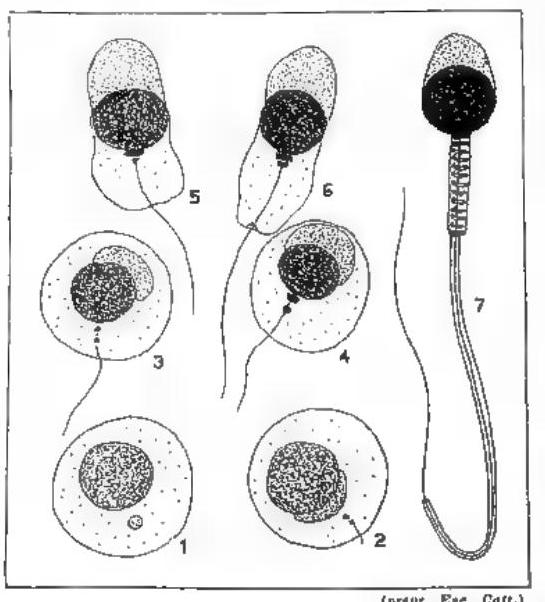
While the mature egg is ready for fertilization, the spermatids, which have the appearance of typical cells, must undergo a functional maturation, that is, they must, by means of a transformation called spermiogenesis, transform into flagellated spermatozoa fit for movement (fig. 4).
From the mechanism of the maturation of the gametes it is observed how against one egg 4 spermatozoa mature. The percentage difference of the gametes of the two sexes is further increased in favor of the spermatozoa by the activity of the spermatogonia which lasts much longer. In the human species the activity of the oogonia ceases already in the fetus before birth while the spermatogonia of the male multiply until a late age.
This enormous number of mobile male cells is to be related to the necessity of ensuring the meeting of the spermatozoon with the egg for the conservation of the species.
In the particular case of man the numerical ratio between eggs and spermatozoa is 1 to 850,000,000.
BIBL.: sources