
CROMOSOME. — Characteristic formations that resolve from the nuclear substances of animal and plant cells when these enter reproductive activity. Whereas the nucleus of a resting cell (an inexact term indicating the temporary or definitive absence of karyokinetic activity) is characterized by a karyoplasm which, with the ordinary means of histological and cytological investigation, appears more or less homogeneous, in a cell undergoing karyokinetic crisis it resolves into a complex of granulations that leads to the identification of small bodies readily stained by basic dyes, having a spherical, elongated, or spindle-shaped form, and which are the chromosomes; their size varies according to the living species, just as their number varies, but among individuals of the same species, number, form, and size are rigorously constant. Thus there are living organisms with two or four chromosomes (ascaris), with 12 chromosomes (pine), with 48 chromosomes (man), and with up to several hundred (radiolarians). The number of chromosomes that a cell possesses as its complement remains constant in all the daughter cells originating from it because, at each division occurring in the cell, the chromosomes undergo longitudinal splitting; they thus undergo a momentary doubling until cytoplasmic division, or cytokinesis, leads to the formation of two daughter cells, each of which will possess as its complement half of the chromosomes formed as a result of the longitudinal splitting. Only in germinal cells does a reduction by half in the number of chromosomes occur.
This chromosomal constitution of the cell is called the diploid complement and is indicated by 2 n. If, for example, one considers an egg of an animal species and supposes that this egg has a diploid complement of 4 chromosomes, all the cells that will originate from the egg cell and that together will constitute the tissues and organs of the adult individual will maintain the constant number of 4 chromosomes characteristic of the species in question. But in an adult individual, besides the cells constituting the tissues and organs of vegetative and relational life, which are called cells of the somatic line, there also exist cells devoted to the perpetuation of the species, whose differentiation culminates with the individual’s sexual maturity, and these elements are called cells of the line
(Enlarged from life)
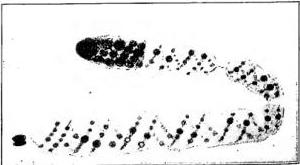
CROMOSOME — Giant C. of Chironomus Thummi in vivo, displaying the characteristic structure of alternating colored (chromomeres) and colorless bands (after Bauer).
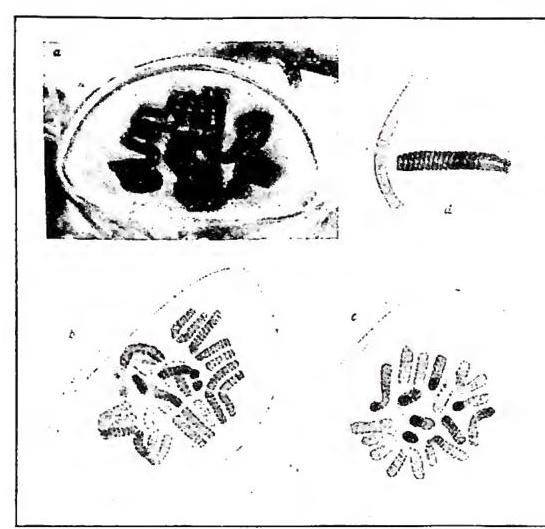
CROMOSOMA - Spiral structure of the chromosomes during the first division of the pollen grain of the Angiosperms: a-c Allium nutans, d Gasteria depressa (Liliaceae): c. anaphase, the others in metaphase (after Geitler).
germinal. Once mature, the germinal cells unite, a male cell or spermatozoon with a female cell or ovum, to give rise to a new individual, thereby ensuring the perpetuation of the species. It is clear that if both the ovum and the spermatozoon retained the diploid chromosome complement, for example 4, the zygote, or fertilized ovum, would have 8 chromosomes, and all the cells derived from the ovum—that is, the entire organism—would have twice the number of chromosomes of the parents. Thus, with each generation of offspring, the number of chromosomes of the parents would double, and in a short time this number would become enormous; instead, there is a relationship between the quantity of nuclear substance and the quantity of cytoplasmic substance in each cell (the nucleo-plasmic ratio), which has limits of fluctuation, beyond which life is impossible. A regulatory mechanism therefore operates in the germinal cells, whereby the sexual elements, following a process called meiosis (Farmer and Moore), reduce their chromosome number to half the diploid number, thereby producing the haploid complement, designated by n. With fertilization, that is, with the union of two cells possessing a haploid complement, a cell with a diploid complement will arise. There are individuals whose cells naturally possess, or in which it is experimentally possible to induce, an increase in the number of chromosomes; within fairly narrow limits, this number is generally a multiple of the diploid complement, and the individuals are called polyploids. This phenomenon belongs to the field of mutations, those hereditary variations that have their seat in the chromosomal complement.
The chromosomes would therefore constitute the topographical and functional site of those entities of submicroscopic and molecular order capable of determining the traits of an individual and transmissible from generation to generation. These entities have been given the name “genes.” Work carried out especially by Morgan’s American school produced results of enormous importance. It was possible to establish experimentally—and the material of choice for this research was Drosophila, the common vinegar fly—that along the chromosomes of the germinal cells the genes determining a large number of traits of this animal species are arranged in a line. Genes function both because of their constitution and because of their mutual position along the chromosome. If, through experimental intervention, chromosome segments or entire chromosomes are destroyed, or a chromosome sector is displaced following breakage and reattachment in a different position, the individual that develops from germinal cells subjected to these processes is altered in its traits and usually displays rudimentary or aberrant organs or systems, or different morphological and functional characteristics. These modifications, which arise and are transmitted hereditarily, have been given the name of mutations. It has also been observed that the sex of an individual is in certain cases determined by a particular chromosome, which has been called a heterochromosome or sex chromosome, and that some traits inherited together with sex have their genes in the sex chromosome. It must nevertheless be remembered that many authors today rightly also attribute importance to the cytoplasm in the transmission of hereditary traits; thus, one speaks of cytoplasmic genes or “plasmapenes” (Caspari).
Recent studies of submicroscopic structures have also taken the constitution of chromosomes and genes as a compelling field of investigation. These researches have chiefly aimed to investigate the molecular structure of the chromosome and to study its chemical composition, while at the same time examining the constitution of genes, also with the purpose of explaining why the cyclical appearance and disappearance of the
(da L. Geitler, Chromosomenbau, Berlino 1933)
CROMOSOMA - Diagram of the structure of a somatic c. The distal region of the right arm is heterochromatic (heterochromatin), a spiral chromonema with chromomeres (after Heitz, from Geitler).
c. Each c. contains one or more spirally coiled fibrils called chromonemata; along these spirals are serially arranged stainable elements known as chromomeres. The chromonemata have a fibrillar, probably polypeptidic structure, while examination under ultraviolet light reveals a protein mass in the chromonemata. Other fundamental constituents of the c. are nucleic acids, the study of which, following the research of T. Caspersson and J. Brachet, has assumed great importance. In the c. there is predominantly deoxyribonucleic or thymonucleic acid and small quantities of ribonucleic acid. It is held that the nucleic acids form, at regular intervals, saline compounds with the protein fibre of the chromonema.
The stainable substances of the nucleus are called by the generic term chromatin, which does not imply a defined chemical concept. It comprises the two aforementioned forms of nucleic acids. Giant c. consist of two distinct portions: in euchromatin there is a regular structure of disks rich in thymonucleic acid alternating with achromatic regions. This regular structure is lost in the more condensed and more stainable heterochromatin, which is composed of both ribonucleic acid and thymonucleic acid. Ribonucleic acid constitutes part of the nucleus and participates in the synthesis of many protein substances.
During karyokinesis, the nucleic acids undergo transformations, demonstrating that they have a readily modifiable structure.
Nucleic acids were regarded as the fundamental substance of the c., but they have a relatively uniform chemical structure, which accords poorly with genetic theories concerning the constitution of genes.
The modern developments of genetics, that is, of the science concerned with the heredity of characters in living forms, have brought the study of the c. to the fore: these are small bodies that arise from the nuclei of the cells in which the genes are located, genes responsible, through a complex probabilistic process, for the transmission of characters from parent to offspring. Today an even more complex mechanism is glimpsed through the interrelationships between chromosomal genes and genes of cytoplasmic nature. Nevertheless, the study of these organelles has not ceased and, although their structure is now fairly well known, researchers still seek in them the solution to one of the most distinctive aspects of living beings: the hereditary transmission of characters (v. EREDITARIETÀ; PROTOPLASMA).