
HEREDITABILITY. – Transmission from parents to children of the characteristics proper to the species, race, and individual.
This transmission takes place through the sex cells and is regulated by complex laws, the study of which is the subject of a particular science: genetics.
The carriers and determinants of hereditary characteristics are considered to be genes, minute protoplasmic particles aligned in the chromosomes contained in the cell nucleus; in some cases, genes have also been located in the protoplasm (plasmagenes).
Each individual carries within himself a double genetic endowment: one of paternal origin and one of maternal origin. If a given hereditary characteristic (e.g., iris colour) is the same in both parents, it also appears in the child; if, on the other hand, it is different in the two parents, one of the two appears in the child (the dominant characteristic), while the other is not manifested but persists, in a latent state, in the individual (the recessive characteristic) and may appear, under certain circumstances, in his descendants. Hence the distinction between the homozygote, an individual who carries in his hereditary endowment, in a pure state, only the characteristic manifested in him, and the heterozygote, an individual who, while manifesting a given characteristic, in reality carries within himself, in a latent state, the opposite, recessive characteristic.
It must be noted, however, that a characteristic is often conditioned by several genes located in different chromosomes, and that, consequently, given the various combinations possible among them, an entire range of intermediate characteristics may appear in the individual (e.g., hair colour).
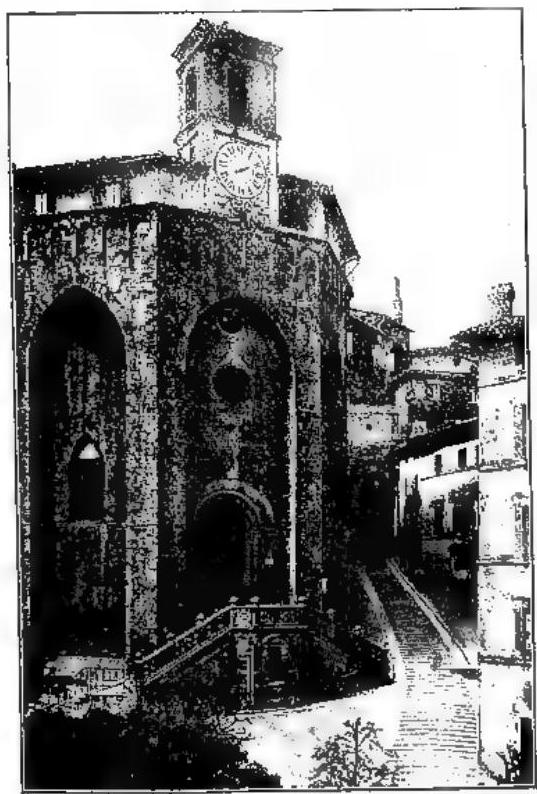
(phot. Alinari)
ERCOLANO, saint – Church of S. E. (1297–1326) – Perugia.
H. refers both to physiological characteristics, which cause the child to resemble his parents, and to pathological characteristics.
With regard to pathological h., it is first necessary to clarify the frequent confusion between hereditary diseases and congenital diseases. A hereditary disease is a disease conditioned by a gene: it must therefore be regarded as a true hereditary characteristic already present in one or both of the germ cells from which the individual originated; it may thus derive from either the mother or the father, and is something inexorable, which cannot be modified. A congenital disease, on the other hand, is a disease contracted during intrauterine life, through contagion from the mother to the foetus. Consequently, it is not a hereditary characteristic linked to genes; it can originate only from the mother and not from the father (from the latter only indirectly, through infection of the mother); finally, it is not something fatal and unmodifiable, but may be avoided and treated like any other disease.
It is therefore clear that an infectious disease may be congenital but never hereditary, and that it is incorrect, for example, to speak of hereditary syphilis, since this is in reality transmitted congenitally from the infected mother to the foetus.
True hereditary diseases have a common characteristic: they lack the dynamism proper to all other diseases, including non-infectious ones, which causes the morbid process to tend to evolve towards recovery or death. Hereditary diseases are instead static and, rather than true diseases, should in reality be regarded as affections or malformations, both morphological and functional. They constitute a locus minoris resistentiae of the organism, such that other causes or other diseases may at a given moment disrupt its precarious biological equilibrium and bring the individual affected by them to disastrous consequences. For example, a haemophiliac (an individual whose blood is incapable of coagulating) may, despite his haemophilia, live to an advanced age like a perfectly normal individual. If, however, trauma occurs at a certain moment and causes haemorrhage, even if not severe, he may, through loss of blood, suffer the most disastrous consequences.
Among the best-known or most widespread hereditary diseases we may mention skeletal malformations (polydactyly, syndactyly, etc.), haemophilia, colour-blindness (inability to distinguish certain colours), albinism (absence of pigmentation), certain forms of deafness and blindness, some cardiac and circulatory-system defects, Cooley’s disease (a form of progressive anaemia associated with skeletal malformations), certain other blood disorders, etc. The so-called “lethal factor” has also been identified, at least in certain animals; this makes life impossible for the individual, even if he may sometimes appear normal.
In addition to these various clearly evident pathological characteristics, others, less conspicuous, may be inherited; these consist in deficient resistance or functionality and in an exaggerated receptivity of a given system, organ, or tissue, such as to predispose the individual to a particular disease or group of diseases (e.g., certain constitutions and certain degenerative nervous diseases, etc.).
In general, hereditary pathological characteristics behave as recessive characteristics and become manifest only when they meet in the offspring of two parents both carrying that characteristic. Consequently, it is understandable why hereditary diseases occur more frequently among the descendants of blood relatives who, deriving from the same stock, are more likely to carry within themselves, in a recessive state, the same pathological characteristic (degeneration of certain lineages in which unions between blood relatives are frequent).
In some cases (haemophilia), the pathological characteristic is sex-linked, inasmuch as the gene determining it is situated in the so-called sex chromosome, that is, the chromosome which also carries the genes conditioning sexual characteristics.
Hereditary diseases, unlike congenital ones, are not curable: they can only be prevented by avoiding marriages between persons carrying the pathological characteristic, even if only in a recessive state (v. EUGENICA). Brenno Babudieri
MORAL AND PASTORAL THEOLOGY. — Once the possibility of an influence of heredity on human activity and consequently on the morality of the act is admitted, two excesses must be avoided.
With the Italian anthropological school, we cannot conceive of heredity as an indestructible chain of effects and causes, whereby our personality is connected to the ultimate origin of things through the indefinite chaining of necessities (T. A. Riboli). Still less can we accept the teachings of the positivist school of C. Lombroso, which reaches the ultimate consequences by annulling every semblance of human freedom under the iron law of heredity. But neither should we fall into the opposite error of the classical school, which considers the will of human beings to be in perfect indifference among the multiple inclinations, including hereditary ones.
The truth lies midway. First of all, hereditary inclinations and tendencies of a moral nature (and it is chiefly these that concern us) may be not only degenerative but also regenerative. To this latter category belongs that heritage of inclinations toward goodness and honesty, of horror of vice, which constitutes the wealth of many Christian generations. Among degenerative tendencies, there may indeed occur extreme cases in which the weight of hereditary tendencies is so great as to render the individual completely abnormal and entirely irresponsible; ordinarily, however, hereditary tendencies, more or less strong, are not unconquerable and, when properly restrained and contained—especially by removing the patient from the environment, harmful influences and occasions—may be controlled and supervised, and at times even nullified in their perniciousness. Nevertheless, we must take them especially into account when it comes to choosing a state of life, which commits us for an entire lifetime. And in the external forum the judge must take them into account in judging the imputability of the crime (can. 3199).
The problem of hereditary tendencies perhaps also provides an explanation for certain wise provisions relating to particular irregularities and specific impediments introduced into ecclesiastical legislation long before so much scientific knowledge on the subject had matured.
This is the case, for example, with illegitimate persons (can. 984, 1°), who are considered irregular with regard to the Sacrament of Orders; and with neophytes (can. 987, 6°), who may not be admitted to it until, in the judgment of the Ordinary, they have been sufficiently formed (can. 987, 6°). Perhaps the same reason, together with others, may also be found at the basis of the matrimonial impediment of consanguinity (can. 1076).
Moreover, the problem of heredity enters into the solution of many moral questions: thus, in eugenics (v.), both positive and negative, sterilization (v.) is also connected; in preparation for marriage and especially in the premarital examination.
Only by keeping firmly in mind not merely scientific theories but also the hierarchy of human values will it be possible to give these problems a proper solution.
1917–48. — For the genetics of human pathological characteristics, V. L. Franzi, L'eredità nella patologia e nella élmita, Bologna 1942. Pietro Palazzini