
VIVIERS, DIOCESI of. — City and diocese in the department of Ardèche (France).
It has an area of 5,527 sq. km. and a population of 232,000 inhabitants, of whom 202,826 are Catholics distributed among 372 parishes, served by 450 diocesan priests and 30 religious priests; it has a major and a minor seminary, 7 male and 35 female religious communities (Ann. Pont. 1953, p. 450). The diocese is suffragan to Avignon; the patron of the diocese is St. Vincent. Following the destruction of Alba Augusta or Alba Helviorum (on whose site Aps arose), capital of the Helvii, by Crocus, king of the Vandals, in 411, the bishop of Alba, Ausonius, took refuge with the population in Vivarum (Viviers), in a castle overlooking the Rhône. The first bishop there was Promotus; later there are records of Venantius (ca. 517–35), a disciple of St. Avitus of Vienne; Melanius II, Longinus, Arcontius; Cardinal Giovanni II (1073–1095), who accompanied Urban II to the Council of Clermont; Guglielmo (1147), Cardinal Pietro di Mortemart (1322–25), Cardinal P. De Sarcenas (1373–75), Cardinal J. Fraczon De Brogny (1383–98), Cardinal A. Farnese (1560–65); later Bonnel (1836–41), succeeded by J. H. Guibert, subsequently archbishop of Paris. V. was often afflicted by religious struggles: in the 13th century by the Albigensians, and in 1627–29 by the Calvinists. The diocese was suppressed by the Concordat of 1801 and re-established in 1823.
St. Venantius, ca. the first half of the 6th century, is credited with having built at V. a church that was later destroyed by the Saracens. Only Leodegarius or Ligerius, bishop of V. between 1096 and 1119, had the present Cathedral, St. Vincent, built; it was consecrated on 27 February 1119 by Callistus II. The portico and the chapels in the ambulatory were added later. Bishop Claudio de Tournon (1498–1542) built a larger choir, providing tapestries to decorate it; further work was carried out by Carlo De Tournon, who succeeded his uncle (d. 1550); in 1562 the Cathedral was sacked by the Huguenots. The Catholics returned to the Cathedral in 1577, but the bishop went to reside at Bourg-Saint-Andéol. The restorations begun in 1598 were completed in 1604. Mons. De La Baume de Suze (1621–90) had the chapels repaired and the choir stalls carved; Mons. De Villeneuve had the high altar and the episcopal residence built ca. 1728. The Concordat
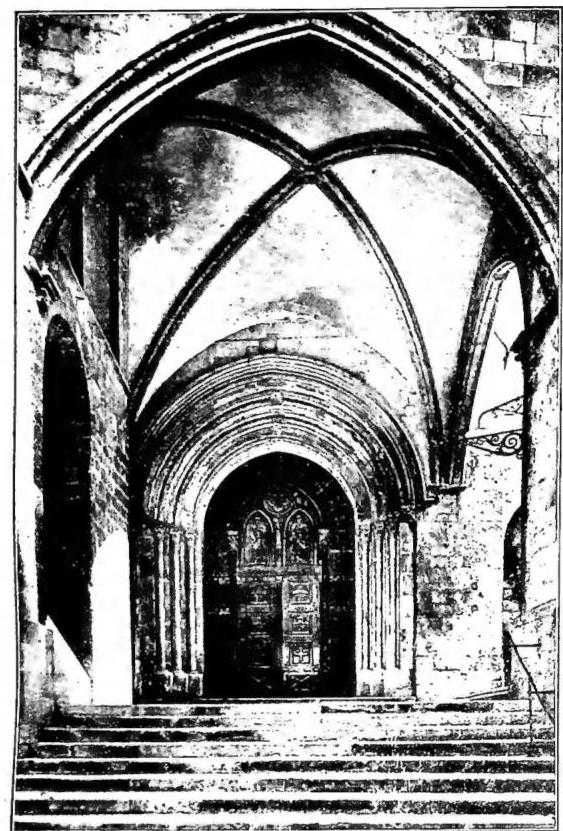
(phot. Cembier)
The principal pilgrimage sanctuaries in the diocese are Notre-Dame de Châlons and Notre-Dame d’Ay near Satillieu; Notre-Dame de Montaigu at Tournon; Notre-Dame de Bon Secours at La Blachère; and, especially, the pilgrimage to the tomb of St. Giovanni Francesco Regis at La Louvesc.