
SICARDO, bishop of CREMONA. — Of a Cremonese family (Casellanus or Casalenus, or rather de Casalaschitz [cf. A. Cavalcabò, La famiglia del vescovo S., in Boll. stor. cremonese, 1 (1931), pp. 145-48]), b. ca. 1155, d. at Cremona on 8 June 1215.
He studied at Bologna; then, it seems, at the cathedral school of Mainz. A subdeacon in 1183, he was ordained a priest shortly afterward and two years later elected bishop of Cremona. A predominant figure in his city’s disputes with Brescia and Milan over possession of Crema, he obtained Cremona’s independence from Frederick I; in 1186 he went to Germany to secure the reconstruction of the « Castrum Manfredi », the first stronghold of a system of fortifications to which he gave particular impetus; in 1203, while the Fourth Crusade was under way, he followed Cardinal Pietro di Capua, papal legate, to Armenia and then to Constantinople. Returning to his homeland in 1205, he intervened as arbitrator in Cremona’s internal struggles (1210). In 1212 he welcomed Frederick II into the city and in return obtained from him confirmation of the privileges concerning Cremona.
His literary production extended into various fields. Lost are a youthful Libes mythologiarum (cf. the prologue to the Chronica and the Summa ad C. 26 q. I), the Acta et obitus s. Homoboni Cremonensis, a Tractatus de humilitate; Chronicorum libri diversi and a Historia Romanorum Pontificum. Preserved, on the other hand, are a Chronica universalis, the first example in Italy of a treatment « ab origine mundi », a Summa canonum, and a treatise on liturgy, Mitrale. The Chronica, initially composed down to the events of 1201 and continued, upon his return from the East, to 1213, draws on the Bible, s. Jerome, Prosper Tiro, Orosius, Isidore, Bede, and above all Paul the Deacon and the Pantheon of Gottfredo da Viterbo: but its most vital part, extensively used by Salimbene, concerns events closest to the author, to the point of constituting one of the most important sources for the history of the Fourth Crusade. The Summa canonum, whose attribution to S. has been questioned without any foundation, composed at Mainz between 1179 and 1181, is characterized by its reproduction of synoptic tables and tabular distinctions: it shows the influence of the school of Simone Anglico. The conclusion, written at a later time, is known as the Apologia Sichardi, because it contains a defense of the work against malicious detractors. The Mitrale, in § II, is, on account of the breadth of its subject matter and the clarity of its exposition, among the most important liturgical treatises of the Middle Ages: it deals with buildings and sacred furnishings (I, I), Orders and vestments (I, II), the S. Mass (I, III), the liturgical year and Sunday and feast-day Offices (II, IV-VIII), and the sanctoral (I, IX). Its principal sources are Amalarius of Metz and the Gemma animae of Honorius of Autun. G. Durand drew extensively Rationale (v.).
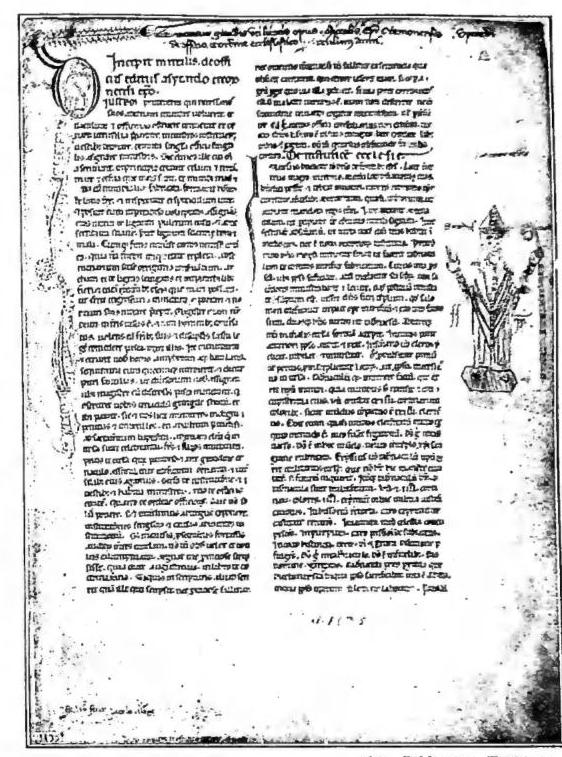
(phot. Vatican Library)
SICARDO DI CREMONA — Incipit of the Mitrale, with a drawing depicting Bishop S. — Vatican Library, cod. Vat. lat. 1135, f. 1r (13th century).
Biographie des Sicardus V. C., in Zeitschrift d. Savigny Stiftung z. Rechtsgesch., Kan. Abt., 23 (1936), pp. 476–78; id., Repertorium der Kanonistik (Studi e testi, 71). Città del Vaticano 1937, V. indice; id., Reflexion sur les Brocards des glossateurs, in Mél. 7, de Ghellinck, II, Gembloux 1931, pp. 783–88; S. Mochi Onory, Fonti canonistiche dell’idea moderna dello Stato (Publ. dell’Univ. catt. del S. Cuore, nuova serie, XXXVIII), Milano (1931), V. indice analitico.