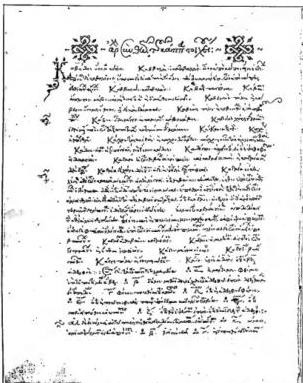
SUIDA (Gr. Σουέδα). — A familiar name, going back to Eustathius in his commentary on Homer (1175), for the supposed compiler of a Lexicon, composed around A.D. 1000: in reality, it is the Hellenized form of the High-Thessalian Σοῦδα, attested in various codices and by Stephanus, a twelfth-century commentator on Aristotle (Comment. in Arist. Gr., XXI, 2, Berlin 1885, p. 285, 18). Suda, moreover, would not be the name of the compiler, of whom no information whatsoever is known, but the title of the collection (Stephanus says «ἐν τῇ Σοῦδα», and the thirteenth-century Paris cod. 2625, in the proem of the Lexicon, bears the superscription «Ἡ Σοῦδα [sott. βίβλος]»), which would have the meaning of “Vademecum.”
The Lexicon, comprising approximately 30,000 entries, is the largest Greek collection of its kind to have come down to us, and is general in character, including not only grammatical and etymological data, but also historical, geographical, scientific, biographical, and literary information. Its sources, rather than being found in the eleven authors named by the compiler at the beginning of his “encyclopedia,” are to be sought in other lexica (Harpocration), in scholastic compilations (on Homer, Sophocles, Herodotus, Aristophanes, Thucydides, and Gregory of Nazianzus), in the Proverbs of pseudo-Dionysius, in the Lives of Diogenes Laërtius and those of the comic poets derived from Athenaeus, in Byzantine Chronicles, in commentaries on Aristotle, etc. Although compiled with little methodological rigor, the Lexicon is valuable, despite errors and confusions, for its transcription of information, especially with regard to literary his-