
SCRIPTORIUM. — According to Isidore (Orig., VI, 9, 2), it is the stylus used to impress marks on wax; but in medieval terminology it denoted the base upon which the sheet was placed while writing and, by extension, the room in which the copyists carried out their work (writing workshop), and hence the centre from which writing was disseminated: this meaning has been preserved in the technical language of palaeography.
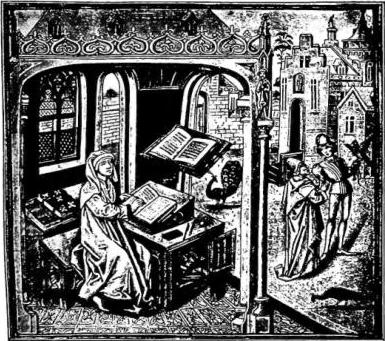
(from V. Leroquala, Le Bréviaire de Philippe le Bon, Bréviaire parisien du XVIe siècle, Bruxelles 1389, plate 11)
SCRIPTORIUM – Copyist in his s., intent on transcribing a codex. Miniature from the workshop of G. Vrelant (15th century).
sculptures (cf. the miniature of the “Roman Virgil,” cod. Vat. lat. 3867 in Enc. Catt., III, cols. 1921–22) refer rather to the moment of composition than to that of transcription. The information becomes more certain from the 8th century onward: during this period, and up to the late Middle Ages, the s. were overwhelmingly—perhaps exclusively—ecclesiastical, and were located in the great monasteries or at cathedral schools. There were undoubtedly also lay scribes (Lupo of Ferrières mentions a manuscript produced by a “scriptor regius”: Epist., 5, in MGH, Epist. Karol. aevi, IV, p. 17), but they worked either individually, or in chanceries, or in the very same ecclesiastical s. as homines of the church or monastery. In the room set aside for the s. were arranged the copyists’ benches, equipped with a footboard; lecterns on which to rest the exemplar from which the copy was made; and a cupboard or chest containing the supply of parchment and the models to be copied (transcription from dictation was an exceptional procedure). The scribe laid the sheet to be filled on a tablet held on his knees, or on a strongly inclined lectern (cf. the illustration in Enc. Catt., III, col. 1923), keeping close at hand the inkwell horn, the knife for sharpening the reed or quill, the punctorium for marking the distance between the lines, the ruler for guiding the lines themselves (marked dry, or with ink or lead), the sponge, and the scraper for corrections. The work was overseen by a monk or cleric—usually the librarian himself—who assigned the portions to be transcribed, advised the scribes, and prepared for them the exemplaria of the script as models (cf. H. Leclercq, Gall. Saint, in DACL, VI, 1, col. 131). A local tradition of writing thus developed, open indeed to foreign influences (not only the models, but even the directors of the s. could come from another institution), yet gradually and more or less consciously developing certain characteristic elements that enable the palaeographer to distinguish the products of one centre from those of others. The work was carried out either for the church or monastery to which the s. belonged, or on commission from outsiders (in that case, the person placing the order usually also supplied the parchment), and could be entrusted to a single copyist or distributed among several scribes. It was always, however, arduous work, requiring constant attention, a steady hand, and patience; it is therefore unsurprising to find here and there in codices subscriptions or marginal notes revealing fatigue or a sense of liberation once the work was completed (cf. H. Leclercq, Scribe, in DACL, XV, 1, cols. 1028–30). Normally, once the copy had been completed, it was reviewed either by the same scribe, by the director of the s., or by another person appointed for the purpose; sometimes, however, this task was left entirely to the reader.
With the development of the universities, lay s. also arose: the need to multiply texts for the use of the schools led to the “industrialization” of the copying process; professors handed the corrected text to an “entrepreneur” (stationarius), who distributed the exemplar, divided into quires (pecie [v.]), among various scribes, who could thus work simultaneously on the same manuscript, accelerating the production of multiple copies. The furnishings of the s. remained more or less the same; however, the sheet to be filled was no longer held on the knees but placed on a table resembling modern school desks, with a horizontal or slightly inclined surface. The Humanist period further altered the character of transcription: on the one hand, there were scholars who personally went in search of texts in monastic libraries and personally recopied them to enrich their own collections; on the other, there were princes who, out of a love of culture or for reasons of political patronage, commissioned sumptuous codices from specialized workshops, which became true court s. The rise of printing, however, soon brought about the gradual, though rapid, disappearance of the s.