
BERNIS, FRANÇOIS-JOACHIM de PIERRES de. — Cardinal, born on 22 May 1715 at St-Marcel de l'Ardèche, into a noble family, he first studied with the Jesuits, then at the seminary of S. Sulpizio. He settled in Paris as the guest of his cousin, the baron de Montmorency. He lived at court. A sensitive and refined spirit, he embodies the typical, ultimately absurd, figure of the Christian Enlightenment thinker: he rejects impiety, but believes in the rationalism of his time. “I have reproached myself as a Christian,” he used to say, “but not as an honnête homme.” He is among the most evocative figures of the century’s bourgeois humanitarianism. Voltaire praised his esprit. His poems opened the doors of the French Academy to him in 1744. In 1751 he was sent as ambassador to Venice, where he led a very worldly life. Returning to Paris, he was ordained a priest (1755), and the following year he left for Vienna.
(phot. Alinari)
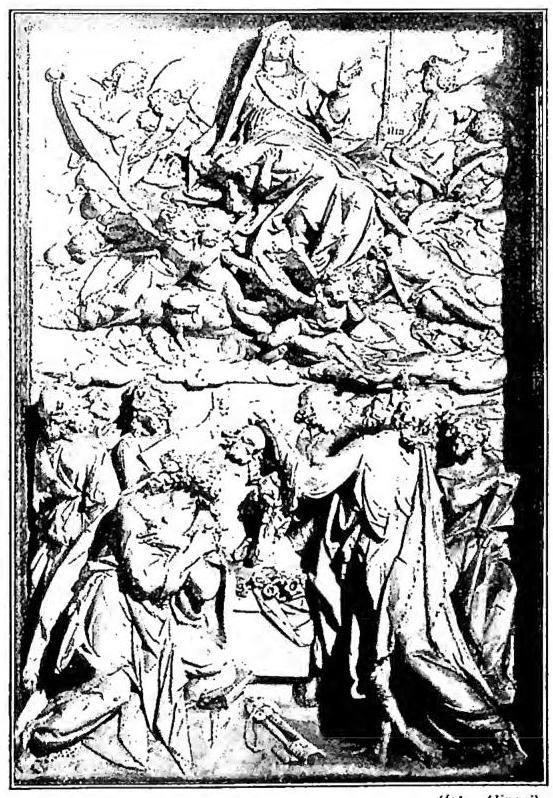
BERNINI, PIETRO - The Assumption, relief in the baptistery chapel of the basilica of S. Maria Maggiore - Rome.
to sign at Versailles the treaty with Maria Teresa, on 1 May 1756. After hostilities began, a year later, he signed with Austria a second treaty more demanding than the first, while at the same time he also began negotiations with Spain, Russia, and Sweden. But the Seven Years’ War was very hard on France, and internal disturbances soon arose, while the financial situation became increasingly alarming. B., who had been appointed Foreign Minister on 27 June 1757, called for peace to be made and internal reforms to be implemented. His proposals were not only received with great hostility, but he himself was accused of having provoked the war by signing the Treaty of Versailles. In Sept. 1758 he was replaced by Choiseul. On 13 Dec. he left Paris in forced exile for his abbey of Saint-Médard in the diocese of Soissons. On 2 Oct. 1758 he was created cardinal by Clement XIII and was ordained a priest. Recalled to Paris by the king, in 1764, after the death of Pompadour, who had been the most tenacious opponent of his financial reforms, he was consecrated archbishop of Albi on 5 Aug. In 1769 he was sent to Rome, where he took part in the Conclave for the election of Clement XIV, and then received from France the task of remaining in Rome as ambassador, with the particular mission of obtaining the suppression of the Jesuits. The negotiations lasted until the suppression, which took place on 16 Aug. 1773. B. remained in Rome and took part in the Conclave for the election of Pius VI. When the French Revolution broke out and the Civil Constitution of the Clergy was promulgated, he worked, as long as he was able, to delay its condemnation by the Pope, putting forward the circumstances in which Luigi XVI found himself; he refused the oath, thereby losing all the rich revenues that made his life in Rome especially splendid, as well as the office of ambassador. He died on 2 Nov. 1794; he was buried in the church of S. Luigi de' Francesi, and in 1803 his body was transported to France.