Machine translation of the 1948–1954 Italian original. The original text is authoritative.
SIRENE. — From the Greek Σειρήν, Σιρήν (Lat. siren, sirena), mythological monsters whose singing, accompanied by musical instruments, seduced and attracted men who imprudently listened to them, bringing them to ruin (Odyssey, XII, 41–43). The s. belong to the group of spirits of death. Their myth has taken on various allegorical meanings in Greco-Roman classical literature and in Christian literature.
I. IN CLASSICAL GRECO-ROMAN LITERATURE
The myth of the Sirens, developed by later writers, is attested for the first time in the Odyssey (XII, 39–54, 158–200), and the most prominent feature of the myth centers on the episode of Ulysses, who, in order to escape their enchantments, stops his sailors’ ears with wax and has himself tied to the mast of the ship so as to hear their song without suffering its tragic consequences. Homer speaks of two Sirens, whereas later they become three or four, although the number three remains the most common. The Sirens of this group were called Leucosia, Ligea, and Partenope. The poet places their abode on an island west of the Mediterranean, without determining it more precisely; later, various localities in Sicily were assigned to them: Capri, or the rocks between that island and the Sorrentine peninsula. At Sorrento there was a temple in their honor, and at Naples the tomb of the Siren Partenope was pointed out, while in Sicily Leucosia was worshipped (Cape Posidonio) and
(from Wilpert, Sarcofagi, pl. 62, I)
SIRENE — Episode of Ulysses and the sirens, and a teaching scene. The first and third sirens have musical instruments, the double tibia and the lyre; the second makes an oratorical gesture. Portrait of the deceased before the parapetasma supported by two cupids. Sarcophagus lid (3rd–4th centuries) from Aguzzano.
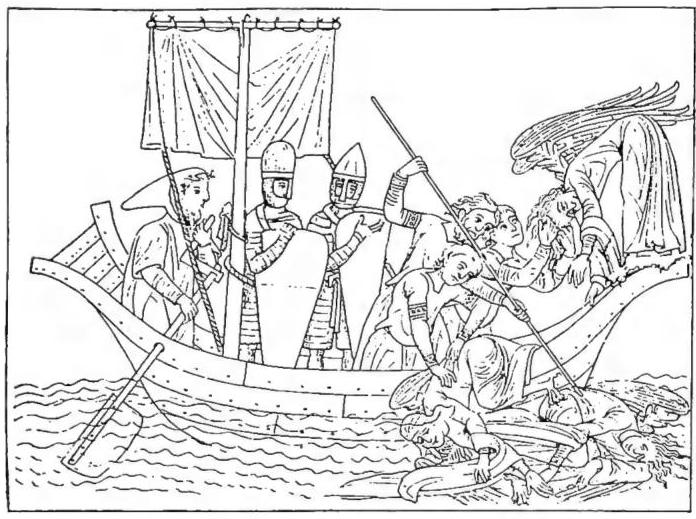
(from R. de Laurier, Miniatures inédites de l'Hortus deliciarum, in Gazette archéologique, 1855)
SIRENE – Ulysses strikes down the s., symbol of victory over the vices they represented in the Middle Ages (cf. Onorio di Autun). Miniature from the Hortus Deliciarum, fol. 221 (ca. 1230).
to Ligea (Terina). Their nature was not always regarded as evil: their musical gifts transformed them into comforters of mortals afflicted by the departure of their loved ones (Euripides, Hel., 168 ff.); their woman-bird appearance led them to be regarded as the bird of the soul, the εἴδωλον of the deceased; they were also adopted as a symbol of the soul that has attained its peace and takes part in the sufferings of the living after having been the cause of suffering for them. For these reasons, as well as because of their powerful apotropaic virtue, they appear so frequently in funerary art. More often, however, the s. were regarded as a baleful obstacle, both moral and intellectual; generally pointed to as a symbol of voluptuousness and the allure of sensual pleasures, for the Neoplatonists they represented the obstacles that the soul must overcome in order to reach its divine homeland, among them «generation», or the pleasures of inferior culture, κακουουσία. Epicurus urged his followers to stop their ears and flee under full sail from encounters with the s. «of poetry», that is, the studies cherished by the rival school (cf. texts cited by Zwicker, Courcelle, Marrou, Alfonsi).
II. IN CHRISTIAN LITERATURE
Given the notoriety of the myth of the s., Christian writers of every century, but especially those of antiquity, knew how to exploit it skillfully in order to draw immediate moral lessons from II. It should be noted at once that the mast of the ship to which Ulysses was bound
is presented as the symbol of the Cross of Christ. In Christian literature, as in all modern European literatures, the s. commonly symbolize lust, the invitation to sensual pleasures that lead the soul to perdition; consequently, the word s. is often synonymous with harlot or, in any case, with a woman who flatters and entices. Among the many texts that might be cited in this regard, see, for example, the Latin version of
Isaiah (13:22; the original has jackals); the Physiologus (ed. F. J. Carmody, Paris 1939, pp. 75-76); s. Ambrose (Explanatio in psalmum, XLIII, 73: PL 14, 1179; Expositio in Ev. sec. Lucum, IV, 2: PL 15, 1612; De fide, III, 1: PL 16, 614, with reference to the Latin text of Isaiah); s. Jerome (Adversus Jovinianum, I, 4: PL 23, 225; cf. also Commentarium in Isaiam, VI, 14: PL 24, 216, and other passages of s. Jerome in Courcelle, cited in the bibliography, p. 90, n. 2); Synesius, bishop of Ptolemais (Epist., 145: PG 66, 1542); s. Maximus of Turin (the whole of homil. 49 is devoted to the episode of Ulysses: PL 57, 339-342); Sidonius Apollinaris (Epist., lib. IX, ep. 6: PL 58, 620); s. Isidore of Pelusium (Epist., lib. V, ep. 185: PG 78, 1435); s. Isidore of Seville (Etym., XI, 3, 30: PL 82, 423, cf. ibid. 83, 1310); Honorius of Autun, Speculum Ecclesiae: PL 172, 855-57 (the s. symbolize avarice, boasting, and lust); Alan of Lille (De planctu naturae: PL 210, 461-462); Dante (Purg., XIX, 7-33). Other authors assigned particular allegorical meanings to the s. The pseudo-Justin (Cohortatio ad gentiles, 36, ed. J. C. Th. Otto, II, Jena 1879, p. 116) compares the eloquence of philosophers, against which those who wish to be saved must stop their ears, to the enchanting s. S. Hippolytus (Philosophumena, VII, 13: PG 16,
3294-95) urges the faithful to guard themselves against heretical doctrines, lest they be seduced by them as by the song of the s.; whoever then wishes to know such doctrines should have himself tied to the tree of the Cross of Christ. S. Augustine (De beata vita, I, 1-4: PL 32, 959-61) attests that rhetoric was for him the s. that nearly prevented him from reaching the harbor of salvation, that is, philosophy and hence the Faith; he also alludes to the s. of superstition (De moribus ecclesiae cath., 34: PL 32, 1342). S. Paulinus of Nola (Epist., XVI, 7: ed. G. Hartel, CSEL, 29, p. 121), for his part, recommends that Jovius flee profane literature as one avoids the « carmina blandimentorum » of the s.; and, to avoid shipwreck, he must not only stop his ears but also close his eyes. Clement of Alexandria, while in the Protrepticum (12: ed. C. Mondésert - A. Plassart, Paris 1949, pp. 187-88) makes the s. the symbol of the fearsome obstacle of habit and alludes to the island of evil where a fresh young courtesan sings, says in the Stromata (II, 2: PG 8, 941) that the word of God in Sacred Scripture is attractive like the song of the s. Procopius of Gaza (Comment. in Genesim: PG 87, 509-10) compares to the s. the preachers who eloquently announce the truths of religion and praise God. Finally, Celsus says that Christians are called by some dancing s. and falsiloque, but Origen cannot account for this accusation (Contra Celsum, V, 64: PG 11, 1285).
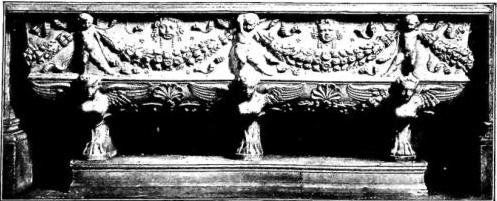
(Alinari photograph)
SIRENE — Sirens supporting the sarcophagus of Pietro Riario, a work by A. Bregno, Mino da Fiesole, and G. Dalmata — Rome, church of the SS. Apostles.
III. ICONOGRAPHY
Homer does not describe their appearance, which was subsequently established by lexicographers and scholiasts, as well as by very ancient monuments, among which the sixth-century Attic vase in the Louvre should be recalled, bearing the inscription Σιγην εμα (cf. Corpus vasorum antiquorum, Louvre, III, Hd, pl. 12, 1 [Parigi 1923]). Four clearly distinct types are known. First type: a bird with a woman’s head. Second type: a female figure as far as the waist, sometimes winged, with the legs and feet of a bird, naked or clothed in a short chlamys, bearing musical instruments (double flute and kithara with the plectrum) and, in some cases, a volumen. These two types are found on Eastern, Egyptian, Greek, and Roman monuments: vases, statuettes, stelae, etc. The scene of Ulysses and the sirens, reproduced on the front of a group of eleven lids of pagan Roman sarcophagi (third-fourth century A.D.), should be interpreted in the Neoplatonic sense mentioned above, and not in a Christian sense, as Wilpert mistakenly judged (Sarcofagi, I, pp. 14-16; III, pp. 5-7, pls. 24-25, 272, 1). The two aforementioned types of sirens continued to be used for ornamental purposes in Byzantine, Coptic, Muslim, Romanesque, and Renaissance art. In the Romanesque period, sirens served chiefly to decorate capitals (cf. list of monuments in Jalabert, pp. 450-57); in the Renaissance they appear as supports for sarcophagi. Third type: complete female figures seated on a rock, clad in a chiton and mantle, with a lyre, syrinx, and double flute, a type found on Etruscan urns (cf. E. Brunn, I rilievi delle urne etrusche, I, Roma 1870, pp. 121-23, pls. 90-94). Fourth type: a female figure whose lower half, from the waist down, is transformed into a fish with two tails turned upward. This last type, already recorded in the Monstrorum liber de diversis generibus (ch. 8) of the sixth-seventh century and in the Bestiaries of the twelfth century (cf. Jalabert, pp. 434, 436), is inspired by tritons or nereids and has been fashionable from the twelfth century onward: it was frequently used by Romanesque sculptors for ornamental purposes, especially on capitals (examples in Jalabert, pp. 458-68), and by illuminators of liturgical books in the interlacings of initial letters or in marginal friezes (cf. the examples cited in the catalogues of V. Leroquais [v.], s. V. sirènes in the respective indexes). The woman-fish siren was also used as a chimerical figure in coats of arms. — Vedi tav. XLVI.
BIBL.: M. Weicker, Der Seelenvogel in der alten Literatur und Kunst, Lipsia 1902; Ch. Michel, Sirènes, in Ch. Daremberg & Saglio, Diction. des antiq. grecques et rom., IV, II (fasc. IV, Parigi 1910), pp. 1353-55; Zwicker, Sirenen, in Pauly-Wissowa, III A 1 (1927), pp. 288-308; D. Jalabert, De l'art orient. ant. à l'art roman, rech. sur la flore et la faune romanes, II. Les sirènes, in Bull. monumental, 95 (1936), pp. 433-71; H.-I. Marrou, MOVCIEOC ANEP, Etude sur les scènes de la vie intellect. figurant sur les monum. funér. rom., Grenoble 1938, pp. 172-77, 252-53; P. Courcelle, Quelques symboles funér. du neo-platonisme latin. Le vol de Dédale-Ulysse et les sirènes, in Rev. des étud. anciennes, 66 (1944), pp. 73-93; L. Alfonsi, Traces du jeune Aristote dans la Cohortatio ad gentiles, faussement attribuée à Justin, in Vigiliæ christ., 2 (1948), pp. 86-88; H.-J. Marrou, Sirènes, in DACL, XV, 1 (1950), coll. 1494-97. A. Pietro Frutaz
BIBL.: M. Weicker, Der Seelenvogel in der alten Literatur und Kunst, Lipsia 1902; Ch. Michel, Sirènes, in Ch. Daremberg & Saglio, Diction. des antiq. grecques et rom., IV, II (fasc. IV, Parigi 1910), pp. 1353-55; Zwicker, Sirenen, in Pauly-Wissowa, III A 1 (1927), pp. 288-308; D. Jalabert, De l'art orient. ant. à l'art roman, rech. sur la flore et la faune romanes, II. Les sirènes, in Bull. monumental, 95 (1936), pp. 433-71; H.-I. Marrou, MOVCIEOC ANEP, Etude sur les scènes de la vie intellect. figurant sur les monum. funér. rom., Grenoble 1938, pp. 172-77, 252-53; P. Courcelle, Quelques symboles funér. du neo-platonisme latin. Le vol de Dédale-Ulysse et les sirènes, in Rev. des étud. anciennes, 66 (1944), pp. 73-93; L. Alfonsi, Traces du jeune Aristote dans la Cohortatio ad gentiles, faussement attribuée à Justin, in Vigiliæ christ., 2 (1948), pp. 86-88; H.-J. Marrou, Sirènes, in DACL, XV, 1 (1950), coll. 1494-97. A. Pietro Frutaz
Cite this article
“SIRENE.” Enciclopedia Cattolica, vol. XI (1953), p. 441. Azione Romana digital edition, https://azioneromana.com/article/sirene.