
SEVERO, bishop of RAVENNA, saint. — He was the last of the twelve bishops of Ravenna called “little doves” because, according to legend, they were designated for election by a dove that alighted on their heads. This is said to have happened to S., a simple weaver who was present at the assembly convened to elect the bishop.
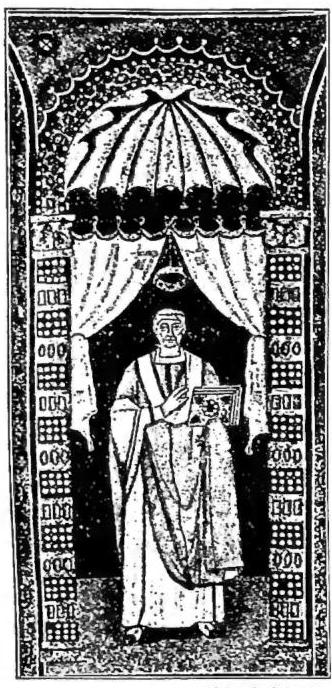
(phot. Anderson)
SEVERO, bishop of RAVENNA, saint — Sixth-century mosaic depicting St. S. Ravenna, church of S. Apollinare in Classe.
canons and synodal letter to Pope Julius he signed (Mansi, III, 39, 42). He is commemorated on 1 February, and his dies natalis is included in the Hieronymian Martyrology, which also commemorates him on 1 January by mistake. He was buried in the cemetery of the “Vicus Salutaris,” outside Classe, and a small shrine called that of S. Ruffillo was built over his tomb. His cult became established very early, so much so that Bishops Pietro III (578) and Giovanni II (578–95) erected for him a magnificent basilica “in regione quae dicitur Salutaris,” later called Severiana, which was destroyed in the 15th century. Giovanni II transferred there the relics of S., Vincenza, and Innocenza, respectively the wife and daughter of S., and placed them in a sarcophagus at the center of the Basilica. Relics of S. were discovered in 1871 in the silver reliquary (5th century) of Grado. In Germany, the cult of S. spread following the transfer of his relics to Mainz and subsequently to Erfurt, carried out by Archbishop Otgar (826–47), who had acquired them at Pavia from the Frankish cleric Felice, who had stolen them before 830. The oldest biographical documents concerning S. are the account by Agnello (ca. 830–32) and the Vita, followed by the translatio, by the Mainz presbyter Liutolfo (shortly after 856: ed. L. V. Heinemann, in MGH. Scriptores, XV, 1 [1887], pp. 289–93). The Archbishop of Mainz Carlo (856–63) granted part of the relics of St. Innocenza to the nuns of Altenmünster.
A. Pietro Frutaz