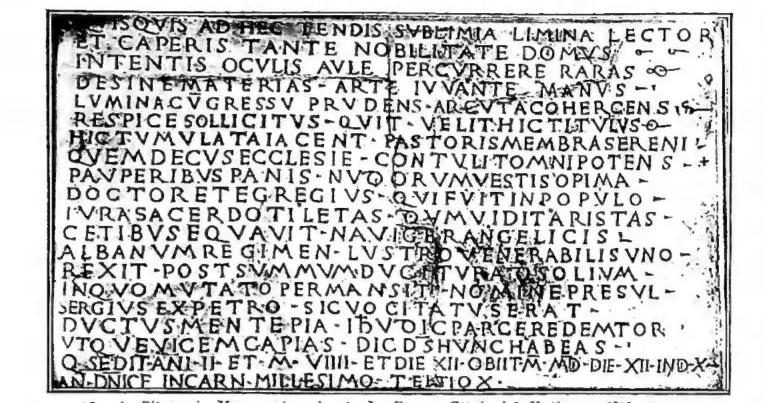
SERGIUS III, POPE. — Roman by origin, he died on 15 April 911. Ordained subdeacon by Marinus I (882–84), deacon by Stephen V (885–91), and bishop of Cere «per vim», Sergius secured the see for himself from Formosus (ca. 893); after the Cadaver Synod of 897, in which he took an active part, he had himself reordained a priest by Stephen VI, since he aspired to the papacy.
At the death of Theodore II (December 897), he was elected pope together with John IX (v.), who succeeded in having himself consecrated first. Dispossessed and condemned at the Roman Council of 898 (can. 8: Mansi XVIII, 226), he awaited his revenge in exile: in January 904, with the support, it seems, of Alberic of Spoleto and his Roman friends, he overthrew the antipope Christopher and, considering his first election valid (he always regarded John IX and his successors as intruders), had himself consecrated on 29 January. The legitimate pope Leo V, imprisoned by the antipope Christopher, was probably still alive; consequently, the beginnings of his pontificate—not to mention his election—would not have been legitimate. He was subsequently judged, however, to have been the true pope. One of his first acts was to abrogate the decisions taken by the Councils of Rome and Ravenna in 898, which had rehabilitated Formosus and his ordinations, and he again declared those ordinations null, also in order to justify his transfer from the see of Cere to that of Rome; the decision was put into practice with a severity never before seen: bishops, priests, and deacons ordained by Formosus had either to be reordained or to abandon their offices, and it was even forbidden to call the aforementioned Pope a priest (cf. Jaffé-Wattenbach, no. 3534). His act provoked scandals and protests in Rome and elsewhere, but in the City everything was silenced by force. Testimonies from the period to the grave distress that arose in the Church—certainly impassioned, but on the whole reliable—are found in the works of the Formosian priests Auxilius and Vulgarius (cf. E. Dümmler, Auxilius u. Vulgarius, Leipzig 1866, texts, pp. 95 ff.), in the Invectiva in Roman, composed between 914 and 928 (PL 129, 823–38), and in the works of Liutprand of Cremona (Antopodosis, I, 29–31; II, 48; III, 43; ed. J. Becker, Hanover 1915, pp. 23, 58–59, 96). In 906 the emperor Leo appealed to Sergius against the patriarch Nicholas concerning the question of his fourth marriage; his legates granted him what he requested. He continued the rebuilding of the Lateran Basilica, which had collapsed in the time of Stephen VI, a work already begun by John IX. Like Hadrian I, he had his portrait reproduced on Roman coins (cf. G. Ladner, I ritratti dei papi nell'antichità e nel Medioevo, I, Vatican City 1941, pp. 111, 159–61). He had close friendly relations with the vestararius Theophylact and his wife Theodora. As for Sergius’s relationship with their daughter Marozia and his consequent paternity of John XI, Fedele believed that he could exonerate him, but Duchesne, on the basis of the papal catalogues incorporated in the Liber Pont., argued, with sound evidence, that it was real. Sergius was—