**STEPHEN VI (VII), POPE.** - Roman, bishop of Anagni. Elected pope in May 896 contrary to the rules of ecclesiastical discipline then in force,
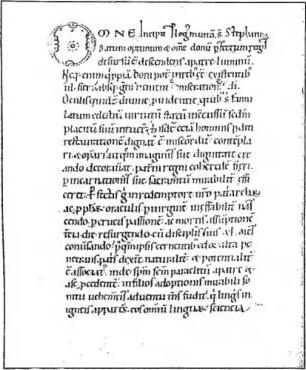
V. STEPHEN (VII) VI, POPE.
---
**STEPHEN I (ST. STEPHEN) KING OF HUNGARY.** - The first Christian king of Hungary (997-1038), canonized in 1083. Born around 970, he was baptized with the name of Stephen (Hungarian: István) and received the name of Constantine at baptism. He was the son of the Magyar prince Géza and his wife Sarolt, of Romanian origin. His father, who had already begun to Christianize the Magyars, had him educated by the German bishop St. Adalbert of Prague, who had taken refuge in Hungary after being driven out of his see. Stephen married Gisela, sister of Emperor Otto III, which strengthened his ties with the West. He succeeded his father in 997 and, after a civil war against the pagan party led by Koppány, consolidated his power.
He submitted himself rigorously to the commandments of religion, the laws, and the teachings of the Church. In the organization of the Kingdom, he oriented himself toward Western examples, especially that of the Carolingian Kingdom, but did not imitate it slavishly: the institutions transplanted from the West to Hungary took on a character of their own. The two fundamental aspects of Stephen’s State—the centralized system of government in the hands of the king and the patrimonial foundation of the State—corresponded to Hungarian tradition. Stephen was also one of the greatest and strongest innovators in Hungarian history. He transformed his people both politically and socially and religiously. Yet he knew how to preserve all that was valuable and compatible with the Christian religion. “Each people lives according to its own laws,” Stephen says in the introduction to his law collection, and he admonished his son in the *Admonitiones* that every people must have the freedom to live according to its own laws.
Stephen organized not only the State but also the Church in Hungary, for whose supreme direction he founded two archbishoprics (Esztergom and Kalocsa) and eight bishoprics (Veszprém, Pécs, Csanád, Vác, Győr, Eger, Nagyvárad, Gyulafehérvár). However, the legend of his appointment as papal legate was created in the 12th century, when, after the Gregorian reforms, the powers exercised by Stephen in organizing the Church and appointing bishops could no longer be conceived except on the basis of a special authorization from the Pope. In Stephen’s time, the State and the Church were not yet separated, and both depended solely on the king. From this, however, did not derive the subordination of the interests of the Church to those of the State. Stephen’s earthly kingdom did not suppress but rather aided and defended the Church and had the lofty mission of educating and preparing its subjects to attain eternal happiness.
No one else influenced Hungarian history as much or as favorably as he did. For centuries, the Hungarian people regarded him not only as the founder of the State but also as a guide from whom to draw constant lessons and examples, strength and aid to endure in difficult times. The importance of Stephen’s kingdom, however, extended beyond Hungarian borders. The Danube basin, which had previously been the last stop of nomadic peoples from which the West could best be attacked, became, thanks to his work, a barrier for the defense of the West. Stephen, so conscious of the individuality of each people, was also aware of the unity of Europe and the Christian world. He built churches not only in Hungary but also in Rome and Byzantium. He wished Hungary to be an intermediary between the West and the East. He greatly favored Western pilgrims on their journey to the Holy Land, earning not only the gratitude of the pilgrims themselves but also that of the great abbot of Cluny, Odilo. In 1030, he defeated the army of Emperor Conrad II, who had invaded Hungary. He died in 1038 and was canonized in 1083 together with his son Emeric and his chief collaborator Gerard. In the Roman *Martyrologium*, he is commemorated on August 15, but his feast is celebrated on September 2.
