
SCORPIONE. – An arthrogastrous arachnid animal, olive-brown in color; its flat body is equipped with two large chelicerae and a long, articulated abdomen ending in a venomous sting. The European species is small, and its sting causes only temporary disturbances; the stings of tropical species, by contrast, which are considerably larger, can be fatal.
The Greeks and Romans made the s. a symbol of wickedness because of its insidious and deadly abdominal sting, and regarded it as a prophylactic animal against the evil eye, on account of its malignity (cf. Steier, Spinnentiere, in Pauly-Wissowa, III A, 2 [1929], cols. 1786–1809). In ancient and medieval Christian literature the s. is a symbol: 1) of heresy (cf. Tertullian, Scorpiace, 1: PL 2, 121) and of the heretic « quia arcuato vulnere in Ecclesiae corpus venena diffundit » (s. Jerome, Contra Vigilantium: PL 23, 363; cf. also Comm. in Ezechielem, I, 1: ibid., 25, 33; Comm. in Joel: ibid., col. 948; s. Augustine, Serm., 126, 8: ibid., 38, 623; s. Bernard, Epist., 196: ibid., 182, 363; the medieval Latin bestiaries of a mystical and dogmatic character); 2) of falsehood and hypocrisy: « scorpiones ergo sunt - dice s. Gregorio Magno - qui blandi et innoxii in facie videntur, sed post dorsum portant unde venenum fundant » (Hom. in Ezechielem, I, 9: PL 76, 879; cf. also the moralizing bestiaries). The Physiologus does not know II.
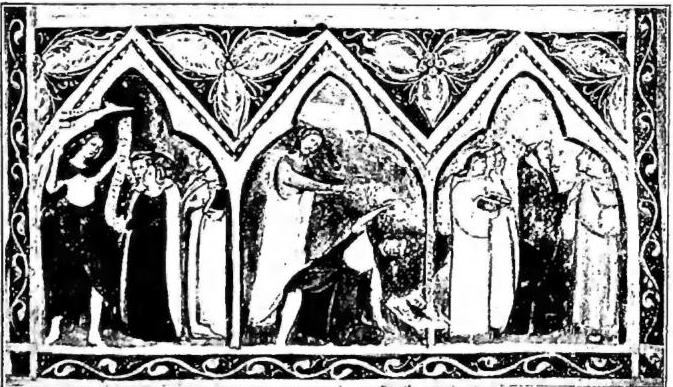
Michel). In Italy, on the other hand, the earliest pictorial and sculptural evidence comes from the Sienese artistic milieu and dates from the 14th century (cf. Bible illuminated by Sienese artists, National Library of Paris, ms. franc. 9561; the Barna at S. Gimignano). Having spread through central Italy and been employed, for example, by Beato Angelico (Florence; Perugia), Donatello (Florence), Paolo Uccello (Urbino), Niccolò da Bologna (Vatican Library), etc., this new symbol then passed into northern Italy, where it was used by Giacomo Jaquerio (Ranverso), Luini (Milan), Gaudenzio Ferrari (Varallo), Giov. Boccati (Venice), etc., and in France and Germany. Yet, as it gradually moved away from its place of origin, it lost its original meaning and disappeared in the 16th century. The s. is a symbol of the Jewish people especially when it is depicted: 1) on the generally yellow banner of the synagogue, defeated and repelled by Christ, in scenes of the Altercationes between Church and Synagogue or in the « Living Crosses »; 2) on the banners, garments, or shields of the henchmen in scenes of the Passion of Christ. In these scenes the s. is paired with the initials S.P.Q.R.,
or with the eagle, to indicate the presence and responsibility of the two deicidal peoples, the Jewish and the Roman.
In Italian and French monuments from the end of the 14th century and the 16th century, the s. is also depicted as an attribute of dialectic or logic, in place of the serpent (cf., for example, Andrea Bonaiuti, S. Maria Novella, Florence; Botticelli, Louvre; A. Pollaiolo, tomb of Sixtus IV in the grottoes of the basilica of S. Peter, etc.). – Vedi tav. V. BIBLICA.: M. Bulard, Le scorpion symbole du peuple juif dans l'art religieux des XIVe, XVe, XVIe siècles, Paris 1935; A. P. Frutaz, Lo s. simbolo di un popolo, in Amici delle catacombe, 5 (1935), pp. 6–13. A. Pietro Frutaz