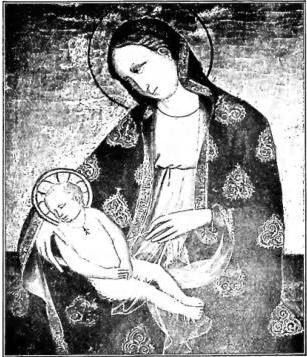
PAOLO UCCELLO. — Paolo di Dono, called P. U., born circa 1397 at Pratovecchio (Casentino), died 10 December 1475 at Florence. He was one of the most singular painters of the Renaissance: alongside Masaccio, he was among the first to understand the value of perspective rediscovered by Filippo Brunellesco and to benefit from the new ingenious insights into reducing bodies to geometric form. Educated in Ghiberti’s large workshop at the time of the second door of the Baptistery of Florence (in whose panels, precisely, perspective is applied in sculptural relief), he was curious about various, often contradictory, experiments, which led him in the past, mistakenly, to be regarded as a “realist.” His fierce love of perspective, which through the engaging “life” Giorgio Vasari devoted to him became proverbial, arose from an intimate need of his imagination to formulate even natural forms in mathematical terms. His influence on fifteenth-century painting in Venice is highly significant and was prompted by the commission offered to him to direct the mosaic school of the Basilica of S. Marco between 1425 and 1430. Later, near the Church of the Eremitani in Padua, he painted, in Palazzo Vitaliani, gigantic chiaroscuro figures that impressed the imagination of Andrea Mantegna. An early fresco in S. Gottardo at Asolo may also be by him, or may have been produced under his immediate influence (Fiocco, Boeck).
But his art, which tended toward the monumental, became more defined in the great fresco commissioned from him in Florence for S. Maria del Fiore, on the inner wall of the entrance, in honor of Giovanni Acuto (1436). He depicts him on horseback, imitating a bronze sculpture erected above the sarcophagus, in perspective, under the influence of the revival of the equestrian-monument theme begun with Donatello’s Gattamelata in Padua. In this work, the metallic color, harmonized with a personal chromatic taste, derives from the desire to imitate metal, but for him it takes on the significance of fully original pictorial invention.
Also on the same wall are his characteristic faces of the four Prophets around the clock frame, imagined in a forceful foreshortening from below, analogous, in draughtsmanship, to the Louvre panel with the five masters of perspective (Giotto, Donatello, Manetti, Brunellesco), which some critics nevertheless believe to be a late copy.
Very deteriorated, but highly important for their compositional originality and chiaroscuro power, are the frescoes of the Green Cloister of S. Maria Novella, with the Flood (certainly carefully studied by Michelangelo), the Drunkenness of Noah, and the Offering of the Patriarch (1445–46).
Fundamental to understanding his art are the three battle paintings known as the “Defeat of S. Romano,” intended to form a triptych: one in London, another in the Louvre, and the finest in Florence, with various portraits of military commanders inserted among the combatants. The heraldic composition is transfigured into calculated and precious interlocking arrangements of color and form, inspired by the fabulous tournament armor and the great helmets of the warriors of the time. The distant landscape, with its geometric stylization, comments on the singular appearance of these knights with their long lances (circa 1456).
P. U. developed a similar imagination in the Night Hunt in the Ashmolean Museum in Oxford and, with references to northern Gothic art, in the precious small panel in the Lanckoronski collection in Vienna, depicting S. Giorgio fighting the dragon, in a landscape that anticipates the Ferrarese painting of Cosmè Tura.
A distinctly Tuscan narrative spirit and acute stylistic sensibility are manifested in the predella depicting the Stolen Host, in the Palazzo Ducale of Urbino (1469), through a taste for perspective and the clarity of fanciful colors, alongside an idyllic vision of the landscape. Finally, various portraits of elegant ladies in profile are attributed to him, though frequently with uncertainty, such as the highly characteristic one in London.
The exceptional nature of P. U.’s pictorial imagination has in modern times prompted more thorough research into his beginnings in art and more ambitious interpretations: the simplistic definition of an attitude, albeit “bizarre” and imaginative, has for some time been replaced by a higher consideration of the painter’s role at the beginnings of the Renaissance, especially in relation to the art of Piero della Francesca (Boeck, Fiocco, Salmi). The artist now appears as one of the most singular minds of that fervent period, saturated with theoretical problems and insights, which was the Florentine Quattrocento, to which geometrizing painting today looks with particular attention.