
SOCIETÀ SALESIANA DI SAN GIOVANNI BOSCO. – It is one of the largest modern religious Congregations whose purpose is the Christian education of young people from the middle and popular classes, in elementary, middle, classical secondary and upper secondary schools; in institutes of arts and trades, with technical and industrial schools; in parish and interparish Sunday oratories; and in the missions. Giovanni Bosco (v.), who began the work in Turin on 8 December 1841, catechizing in the church of St Francis of Assisi a poor young bricklayer from the Sesia valley.
Drawing inspiration from the Milanese traditions of St Charles, but according to his own principles, he first conceived the Sunday Oratory, then the Hospice and vocational schools, and finally the College, placing at the foundation of all his multifaceted educational activity the so-called “preventive system,” which rests upon the practice of charity, reason and the fear of God. To make oneself loved in order to make oneself feared was the cornerstone of his pedagogy. The first permanent headquarters of his work was a poor shed in Turin—Valdocco—where the Oratory of St Francis de Sales, the mother house of the S. S., now stands, with numerous buildings and the imposing enlarged shrine of Mary Help of Christians. There, with 17 members chosen from among the pupils who had remained to assist him, Fr Bosco founded the S. S. in 1859. Pope Pius IX, who had encouraged the work, granted it a decree of praise on 23 July 1864; on 1 March 1868 he gave it definitive apostolic approval, and on 3 April 1874 he sanctioned its rules. After the founder’s death, having spread it throughout Italy, France, Spain and various countries of South America, the S. S. continued to develop rapidly under the governance of his successors: the Servant of God Fr Michele Rua (d. 1910), Fr Paolo Albera (d. 1921), the Servant of God Fr Filippo Rinaldi (d. 1931), and Fr Pietro Ricaldone (d. 1951).
It has given the Church two cardinals and 57 archbishops and bishops. At present it numbers 16,364 members, namely: 7,274 priests, 5,661 clerics and 3,429 coadjutors (laymen). Its foundations number 1,076, distributed as follows: 531 in Europe, 383 in America, 129 in Asia, 26 in Africa and 7 in Oceania. They include the following works: 576 Sunday or daily oratories; with evening schools, after-school programs, mutual-aid funds
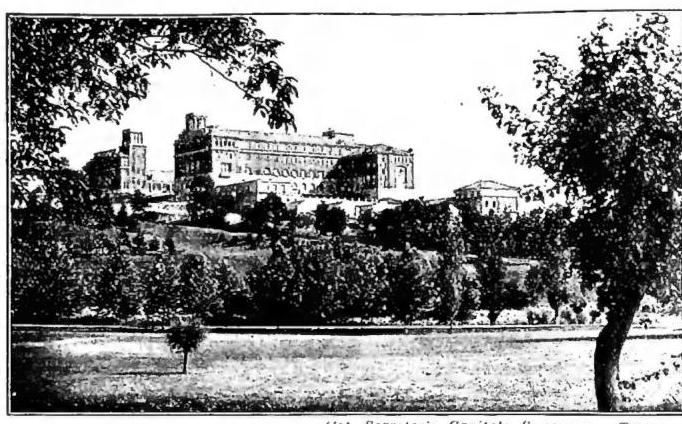
(Int. Secretariat of the Superior Chapter – Turin) SALESIAN SOCIETY OF SAINT JOHN BOSCO – Institute of graphic arts “Bernardi Semeria” at the birthplace of d. Bosco – Colle Don Bosco.
The missionary centers of the S. S. number 73, the principal ones being located in Patagonia and Tierra del Fuego, Paraguay, Brazil, Ecuador, the Belgian Congo, India, Siam, China, Japan, and the Near East. In Colombia the S. S. administers various leprosariums. It also provides for 348 parishes and 202 public churches, excluding the semi-public oratories for boarding students; it has 40 centers for assisting emigrants, 28 of them for Italians; and it promotes the dissemination of the good press through the publication of 627 different periodicals. The present number of young people entrusted to the care of the S. S. amounts to 432,046, including the 134 deaf-mutes instructed according to the most modern methods at the Naples-Tarsia house.
A distinctive feature is the organization of former pupils, united in an international federation headquartered in Turin.
The Works of the S. S. are maintained and prosper thanks to the charitable and generous support of the Salesian cooperators, instituted by s. Giovanni Bosco in 1876 and constituting a kind of Third Order extended throughout the world and enriched by the Holy See with many spiritual favors. Their official organ is the Salesian Bulletin, which is printed in 17 languages, with a circulation of 576,500 copies.
The S., following those of its founder and of s. Maria Mazzarello, has thirteen other causes of beatification and canonization in progress, including those of b. Domenico Savio and of a large group of martyrs of Spain. - Vedi tav. LVI.
BIRL.: E. Ceria, Annali della S. S., 3 vols., Torino 1941-46.